

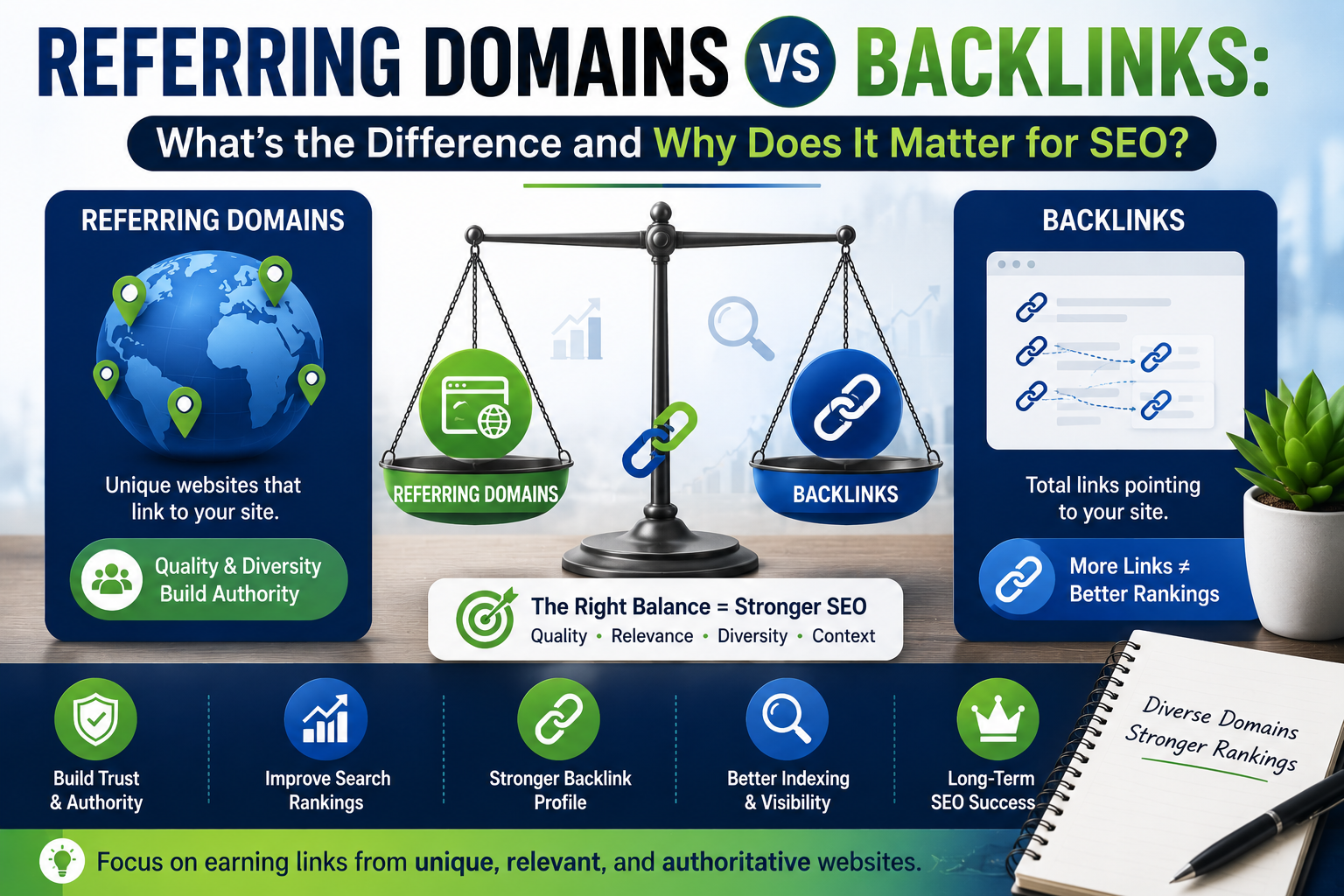

Backlinks are one of the most commonly discussed elements of SEO, but another metric is
equally important when evaluating a website’s link profile: referring domains.
You may have 1,000 backlinks pointing to your website, but if those links come from only 20
websites, your backlink profile is very different from a website with 1,000 backlinks from 300 different domains.
Understanding the difference between referring domains and backlinks can help you build a more balanced link-building strategy and evaluate the true
strength of your backlink profile.
What Is a Backlink?
A backlink is a hyperlink from one website to another.
For example, if Website A publishes an article and links to a page on your website, your website has received a backlink from Website A.
Backlinks can appear in:
- Blog articles
- News publications
- Resource pages
- Guest posts
- Industry guides
- Product reviews
- Business pages
- Editorial content
Search engines can use links as signals for discovering content and understanding relationships between webpages.
However, not every backlink carries the same value. Relevance, context, website quality, and the nature of the link all matter.
What Is a Referring Domain?
A referring domain is a unique website that sends one or more backlinks to your website.
Suppose three different websites link to your homepage:
- exampleone.com
- exampletwo.com
- examplethree.com
You have:
3 backlinks
and:
3 referring domains
Now imagine exampleone.com links to your website 20 different times.
You would then have:
22 backlinks
but still only:
3 referring domains
This is the fundamental difference between the two metrics.
Backlinks measure individual links, while referring domains measure the unique websites providing those links.
Referring Domains vs Backlinks: The Key Difference
The easiest way to understand the difference is with an example.
Imagine your website has the following backlink profile:
| Linking Website | Number of Backlinks |
| Website A | 50 |
| Website B | 30 |
| Website C | 15 |
| Website D | 5 |
Your total backlink count is:
100 backlinks
But your number of referring domains is:
4 referring domains
Now consider another website:
| Linking Website | Number of Backlinks |
| Website A | 25 |
| Website B | 25 |
| Website C | 25 |
| Website D | 25 |
This website also has:
100 backlinks
But it has:
4 referring domains
Now imagine a third website receives 100 backlinks from 100 different websites.
It has:
100 backlinks + 100 referring domains
These three backlink profiles are clearly different, even though the total backlink count is the same.
That’s why looking at backlinks alone doesn’t always provide the complete picture.
Why Referring Domains Matter for SEO
Referring domains are useful because they show how widely your website is being referenced across different websites.
A website that earns links from many relevant sources may demonstrate broader recognition within its industry.
For example, an SEO website might receive links from:
- Marketing publications
- SaaS companies
- SEO blogs
- Business websites
- Content marketing platforms
- Digital agencies
This can create a more diverse backlink profile than receiving most links from just one or two domains.
However, more referring domains doesn’t automatically mean better SEO.
A relevant, trustworthy referring domain can be more valuable than several unrelated or low-quality domains.
The goal should therefore be quality and relevance combined with healthy domain diversity.
Why 100 Backlinks From 5 Domains Isn’t the Same as 100 Backlinks From 100 Domains
Consider two websites.
Website A
- 100 backlinks
- 5 referring domains
Website B
- 100 backlinks
- 100 referring domains
Website B has broader domain diversity.
But this doesn’t mean Website B automatically outranks Website A.
Why?
Because the quality and relevance of those domains matter.
If Website A has five highly authoritative and relevant industry websites linking to it, while Website B has 100 irrelevant or low-quality websites,
Website A may have the stronger backlink profile.
Therefore, SEO professionals should avoid treating referring-domain count as a standalone ranking metric.
How Referring Domains Affect Your Backlink Profile
Your backlink profile consists of many different characteristics, including:
- Total backlinks
- Referring domains
- Anchor text
- Link attributes
- Linking-page relevance
- Domain quality
- Link placement
- Target pages
Referring domains are particularly useful for understanding domain diversity.
For example:
1,000 backlinks / 10 referring domains
may indicate that a large portion of the site’s links comes from a limited number of websites.
Meanwhile:
1,000 backlinks / 300 referring domains
indicates that the links are distributed across a much broader group of websites.
Neither number is automatically good or bad, but the second profile generally provides more domain diversity.
Do Dofollow and Nofollow Links Affect Referring Domains?
Dofollow and nofollow describe link attributes, while referring domains describe the unique websites linking to you.
A single referring domain can provide:
- Dofollow backlinks
- Nofollow backlinks
- Multiple backlinks
- Links to different pages
For example, if one publication links to five different pages on your website,
it remains one referring domain, regardless of whether it creates five or fifty links.
This is why you should evaluate link attributes and referring domains separately.
A natural backlink profile can contain different types of links from different sources.
How to Increase High-Quality Referring Domains
If you want to strengthen your website’s backlink profile, focus on earning links from new, relevant, and credible websites.
1. Create Link-Worthy Content
Useful content gives other websites a reason to reference your pages.
Consider creating:
- Original research
- Industry statistics
- Comprehensive guides
- Case studies
- Free SEO tools
- Templates
- Checklists
- Data-driven articles
For example, a useful SEO calculator or original research report can attract links from multiple websites.
2. Publish High-Quality Guest Content
Guest posting can help you reach relevant publications and introduce your expertise to new audiences.
The focus should be on publishing genuinely useful content rather than creating large numbers of low-quality links.
Choose websites based on:
- Topical relevance
- Content quality
- Real audience
- Editorial standards
- Website reputation
3. Use Digital PR
Digital PR can help businesses earn mentions and links from publications and industry websites.
Original data, expert commentary, research, and newsworthy stories can provide strong reasons for journalists and publishers to reference your website.
4. Build Relationships Within Your Industry
Networking with businesses, publishers, agencies, and content creators can create opportunities for legitimate collaborations and editorial mentions.
The objective isn’t simply to exchange links.
Instead, develop relationships that naturally lead to:
- Expert contributions
- Interviews
- Resource mentions
- Collaborations
- Editorial references
5. Analyze Competitor Referring Domains
Competitor backlink analysis can reveal websites that already link to businesses in your industry.
You can identify:
- Industry publications
- Resource pages
- Relevant blogs
- Business directories
- Editorial opportunities
- Content gaps
However, don’t automatically copy every competitor backlink.
Evaluate whether each website is actually relevant and worthwhile.
How to Check Your Referring Domains
You can use several SEO platforms to analyze referring domains and backlinks.
Popular options include:
- Google Search Console
- Ahrefs
- Semrush
- Moz
- Majestic
These tools can help you understand where your backlinks are coming from and identify changes in your backlink profile.
When reviewing the data, don’t look at just one number.
Consider:
Backlinks + referring domains + relevance + authority + anchor text + link quality
Together, these metrics provide a much better picture.
What Is a Good Referring Domain-to-Backlink Ratio?
There is no universal ideal ratio between referring domains and backlinks.
For example, an established publication might naturally receive thousands of links from a relatively small group of websites because its content is frequently referenced.
Another website may receive thousands of links from thousands of different domains.
Both can be legitimate.
Instead of trying to achieve a specific ratio, focus on whether your backlink profile is:
- Relevant
- Diverse
- Credible
- Naturally developed
- Connected to useful content
Your competitor landscape can also provide useful benchmarking data.
Common Referring Domain Mistakes
Focusing Only on the Number
Having 500 referring domains doesn’t automatically make a website authoritative.
Quality matters.
Chasing Irrelevant Domains
A link from an unrelated website simply to increase your referring-domain count isn’t a strong strategy.
Buying Low-Quality Links in Bulk
Large quantities of low-quality links can create an unnatural backlink profile and don’t provide the same value as relevant editorial references.
Ignoring Existing Links
Don’t only focus on acquiring new domains. Monitor lost backlinks and understand why valuable links disappear.
Using the Same Anchor Text Everywhere
Referring-domain growth should happen alongside a natural and varied anchor-text profile.
Referring Domains vs Backlinks: Which Is More Important?
Neither metric should be viewed in isolation.
Backlinks tell you how many individual links your website has received.
Referring domains tell you how many unique websites are linking to your website.
Both provide useful information.
For example:
10,000 backlinks from 20 domains
and:
2,000 backlinks from 500 domains
represent very different backlink profiles.
A comprehensive SEO analysis should examine both metrics alongside link relevance, quality, context, anchor text, and the pages receiving the links.
Final Thoughts
Understanding referring domains vs backlinks is essential for anyone working on SEO and link building.
Backlinks measure the total number of individual links pointing to your website,
while referring domains measure the number of unique websites providing those links.
A strong backlink strategy shouldn’t focus on reaching an arbitrary backlink count.
Instead, concentrate on earning high-quality links from relevant and diverse websites while maintaining a natural backlink profile.
Create valuable content, build genuine industry relationships, contribute useful content to relevant publications, and monitor your backlink profile regularly.
Ultimately, the goal isn’t simply to collect more links. It’s to build a website that relevant and trustworthy sources genuinely want to reference.
Frequently Asked Questions
Are referring domains the same as backlinks?
No. Backlinks are individual links, while referring domains are the unique websites that provide those links.
Is it better to have more referring domains?
Not necessarily. More relevant and high-quality referring domains can strengthen domain diversity, but quality and relevance are more important than simply increasing the number.
Can one domain provide multiple backlinks?
Yes. One website can link to your website multiple times, but it still counts as one referring domain.
How do I find my referring domains?
SEO platforms such as Google Search Console, Ahrefs, Semrush, Moz, and Majestic can provide backlink and referring-domain information.
Do nofollow links count as referring domains?
Yes. A website can be considered a referring domain even when the links it provides use nofollow or other link attributes.