

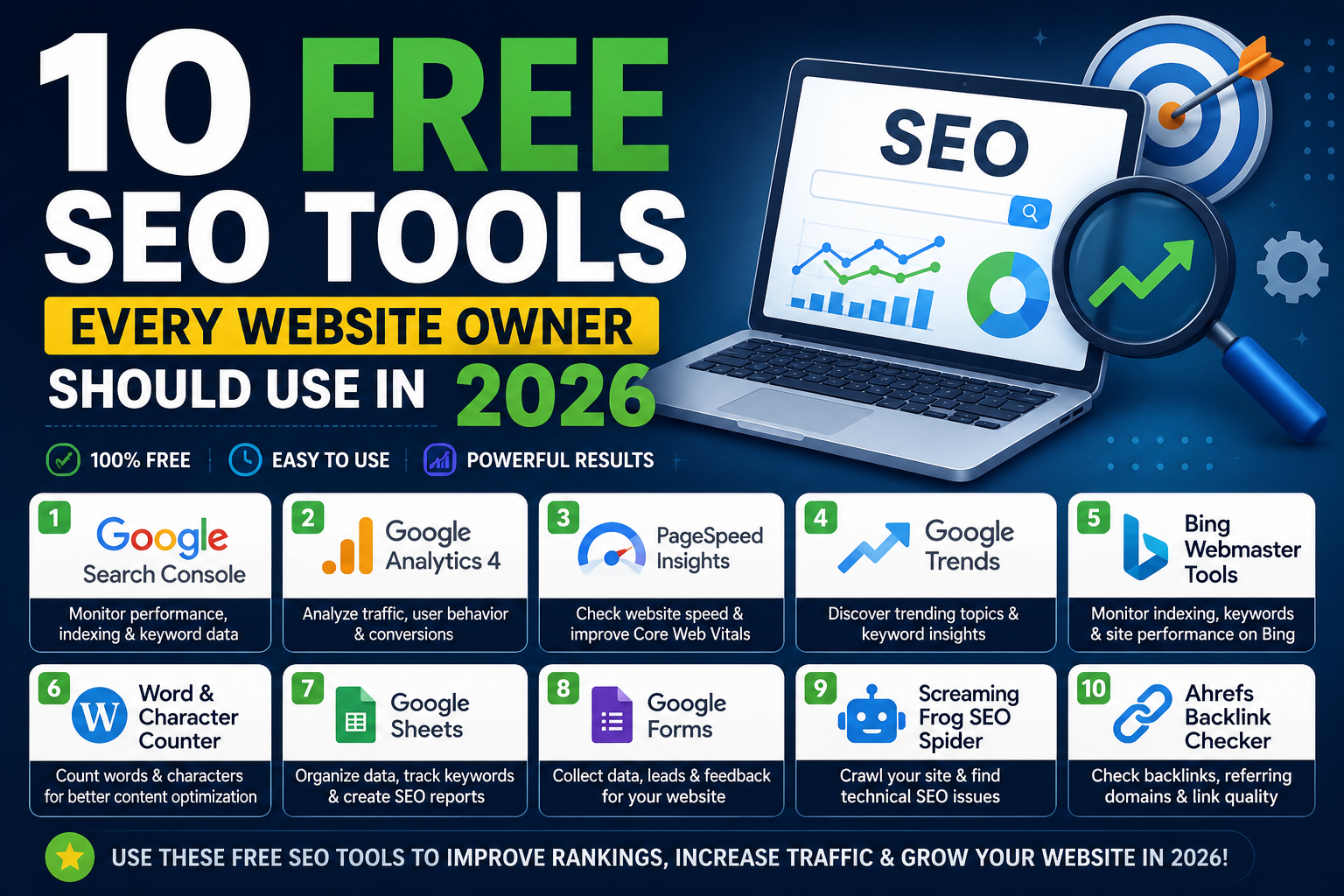

10 Free SEO Tools Every Website Owner Should Use in 2026
Introduction
Search engine optimization (SEO) has become more competitive than ever.
Whether you run a personal blog, an eCommerce store, a SaaS business, or a corporate website, improving your visibility on search engines requires more
than just publishing content.
Successful SEO involves keyword research, technical optimization, content improvement, performance monitoring, and competitor analysis.
While premium SEO platforms offer advanced features, they aren’t always necessary for achieving strong results.
Many free SEO tools provide powerful insights that help website owners optimize their websites, improve rankings, and attract more organic traffic
without increasing marketing costs.
The best approach is to combine Google’s free webmaster tools with practical optimization utilities that simplify everyday SEO tasks.
From monitoring search performance to checking content length and researching competitors, these tools help create a more efficient workflow and a better
decision-making process.
In this guide, we’ll explore some of the most useful free SEO tools every website owner should use in 2026 and explain how they contribute to long-term
search engine success.
Why Free SEO Tools Matter
SEO isn’t a one-time activity. Every website requires continuous monitoring, regular content updates, technical improvements, and performance analysis.
Free SEO tools make these ongoing tasks easier by providing valuable data without requiring expensive subscriptions.
For beginners, they offer an affordable way to learn SEO fundamentals.
For experienced marketers, they streamline repetitive tasks and provide reliable insights that support data-driven decisions.
Instead of relying on assumptions, website owners can use these tools to monitor rankings, analyze user behavior, improve website performance, and
discover growth opportunities.
The result is a more organized SEO strategy that focuses on measurable improvements rather than guesswork.
Google Search Console
Google Search Console should be one of the first tools every website owner sets up. Since the data comes directly from Google,
it provides accurate information about how your website performs in search results.
The platform allows you to monitor keyword rankings, impressions, clicks, average position, and indexing status.
It also alerts you to crawling errors, mobile usability issues, and Core Web Vitals problems that could affect your site’s visibility.
One of its most valuable features is the Performance report, which shows exactly which search queries bring visitors to your website.
This information helps identify pages that deserve additional optimization and highlights keywords with high impressions but low click-through rates.
Regularly reviewing Search Console data enables website owners to improve existing content rather than constantly creating new pages.
Google Analytics 4
Understanding how users interact with your website is just as important as ranking well on Google.
Google Analytics 4 provides detailed insights into visitor behavior, engagement, traffic sources, conversions, and user journeys.
Instead of simply counting visitors, Analytics helps answer important questions such as:
- Which pages receive the most traffic?
- How long do users stay on your website?
- Which traffic sources generate the highest engagement?
- Which landing pages convert best?
These insights help marketers make smarter decisions when planning content, improving user experience, and measuring SEO performance.
Analytics also works well alongside Search Console, allowing website owners to combine search data with user behavior for a more complete
understanding of website performance.
Google PageSpeed Insights
Website speed has become a critical part of both SEO and user experience.
Visitors expect pages to load quickly, and slow websites often experience higher bounce rates and lower conversion rates.
Google PageSpeed Insights analyzes your website and provides recommendations to improve loading performance on both desktop and mobile devices.
The tool evaluates important metrics such as:
- Largest Contentful Paint (LCP)
- Interaction to Next Paint (INP)
- Cumulative Layout Shift (CLS)
Improving these Core Web Vitals can lead to a better user experience and stronger search performance over time.
Simple improvements like compressing images, reducing unused CSS, enabling browser caching, and optimizing JavaScript can significantly improve loading speed.
Google Trends
Search behavior changes constantly. Topics that perform well today may lose popularity in a few months, while new opportunities emerge every day.
Google Trends helps marketers identify trending topics, compare keyword popularity, and understand seasonal search demand.
For example, businesses can discover when interest in specific keywords begins increasing and publish content before competition becomes too strong.
Content creators also use Google Trends to compare multiple keyword variations and select topics with stronger long-term potential.
Bing Webmaster Tools
Although Google dominates search, Bing still represents an important source of organic traffic for many websites.
Bing Webmaster Tools provides crawling reports, keyword data, indexing insights, and technical recommendations specifically for Microsoft’s search engine.
Submitting your XML sitemap and monitoring indexing through Bing Webmaster Tools ensures your content reaches users across multiple search
platforms rather than relying solely on Google.
Word and Character Counter
While Google’s tools help monitor website performance, content optimization requires additional attention.
One simple but extremely useful resource is a Word and Character Counter.
Although it may appear basic, maintaining the correct content length plays an important role in SEO.
Writers frequently need to monitor article length, title tags, meta descriptions, headings, email subject lines, product descriptions, and social media captions.
Exceeding recommended character limits can cause titles and descriptions to be truncated in search results, reducing click-through rates.
A Word and Character Counter helps ensure your content stays within appropriate limits while maintaining readability. It is also useful when comparing
article length against top-ranking competitors, making it easier to determine whether additional information should be added before publishing.
Instead of manually checking content length, this simple tool saves time while supporting better on-page optimization.
Domain Age Checker
Competitor analysis is an essential part of every successful SEO strategy.
Understanding why competing websites perform well requires looking beyond keywords and backlinks.
A Domain Age Checker helps determine how long a website has existed by displaying its registration date and domain age.
Although Google has stated that domain age alone isn’t a direct ranking factor, older websites often have stronger backlink profiles, greater trust, and more
established authority within their industries.
This information becomes particularly valuable when researching competitors, evaluating guest posting opportunities, or analyzing websites for backlink campaigns.
Rather than relying only on Domain Rating or traffic estimates, checking domain age provides additional context about a website’s credibility and long-term presence online.
Combined with backlink analysis, topical relevance, and content quality, a Domain Age Checker supports more informed SEO decisions.
Keyword Research Tools
Every successful SEO campaign begins with keyword research.
Free keyword research tools help identify the phrases users search for while uncovering long-tail keywords with lower competition.
Targeting the right keywords allows businesses to create content that aligns with search intent rather than simply guessing what audiences want.
Well-researched keywords improve rankings, increase qualified traffic, and create stronger opportunities for long-term organic growth.
Microsoft Clarity
Understanding how visitors behave on your website helps identify usability problems that traditional analytics reports often miss.
Microsoft Clarity provides free heatmaps and session recordings that show where users click, scroll, and interact with your pages.
This information helps improve navigation, optimize layouts, and identify sections where visitors become confused or leave the page.
Improving user experience often leads to higher engagement, better conversions, and lower bounce rates.
Building an Effective SEO Workflow
The most successful websites don’t rely on a single SEO tool. Instead, they combine multiple resources throughout the optimization process.
A typical workflow might begin with keyword research before creating optimized content. Once the article is complete,
Google Search Console and Google Analytics help measure its performance, while PageSpeed Insights ensures the page loads efficiently.
Before publishing, reviewing the article with a Word and Character Counter helps confirm that titles, headings, and descriptions remain within
recommended limits.
During competitor research or backlink evaluation, a Domain Age Checker provides additional insights into the authority and history of competing websites.
Using these tools together creates a structured workflow that improves efficiency while supporting better SEO results.
Final Thoughts
Building a successful SEO strategy doesn’t require expensive software. Google’s free platforms, including Google Search Console and Google Analytics 4,
Google Trends, PageSpeed Insights, and Bing Webmaster Tools, provide valuable insights into website performance, search visibility, and user behavior.
Alongside these platforms, practical optimization tools such as a Word and Character Counter and a Domain Age Checker help refine content and
strengthen competitor research.
While they serve different purposes, both tools fit naturally into an effective SEO workflow and simplify tasks that website owners perform regularly.
By combining trusted analytics platforms with practical optimization tools, you can create higher-quality content, make informed decisions, improve
technical SEO, and build a stronger foundation for sustainable organic growth throughout 2026 and beyond.