

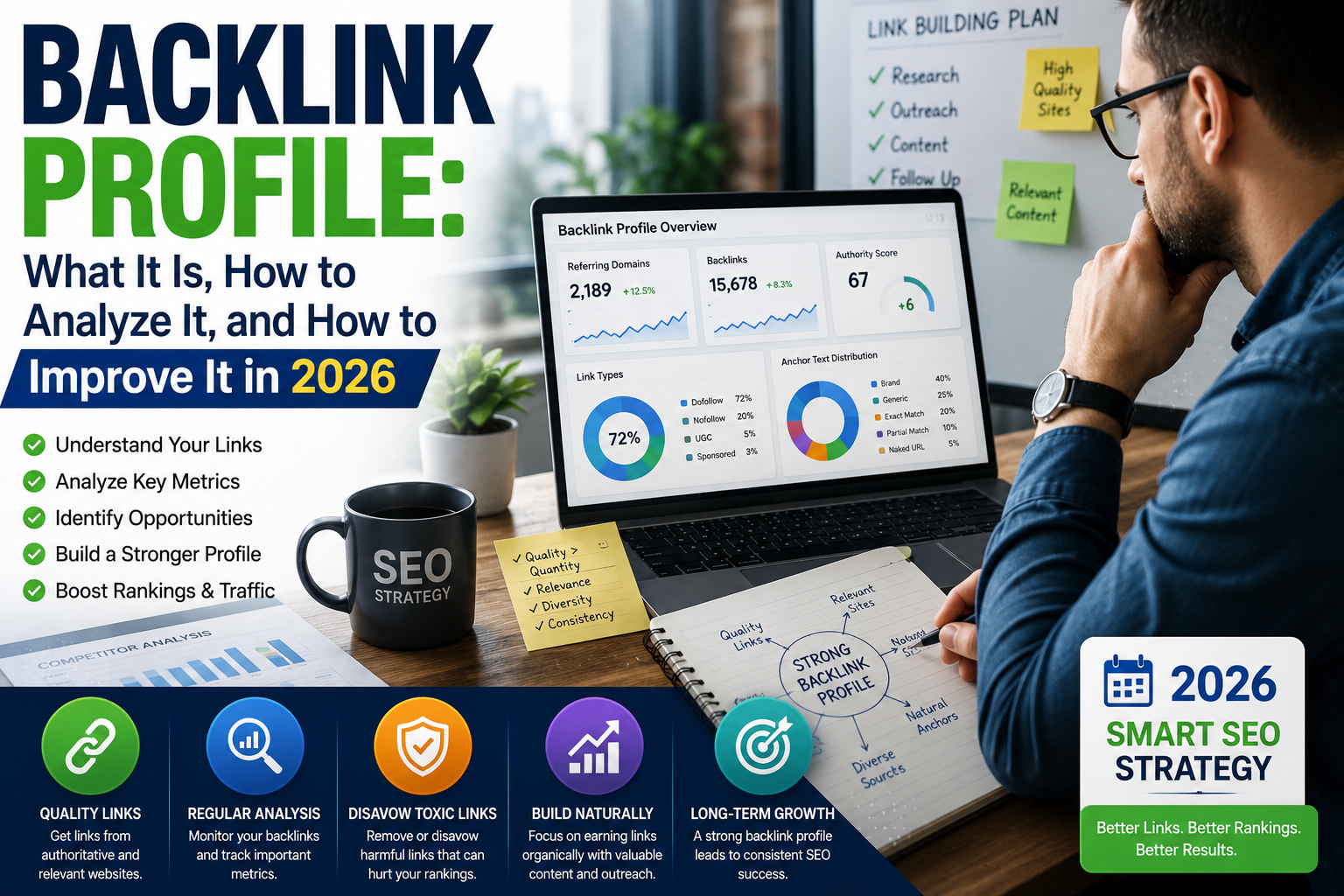

A website’s backlink profile is one of the most important parts of its overall SEO strategy.
Search engines can use links from other websites as signals that help them understand a site’s authority, relevance, and reputation.
However, having a large number of backlinks doesn’t automatically mean having a strong backlink profile.
Link quality, relevance, referring domains, anchor text, and link diversity all matter when evaluating the strength of a website’s backlink profile.
In this guide, we’ll explain what a backlink profile is, how to analyze one, what makes a healthy profile, and practical ways to improve it in 2026.
What Is a Backlink Profile?
A backlink profile is the complete collection of links from external websites pointing to your website.
For example, if 100 different websites link to your domain, those links collectively form part of your backlink profile.
A backlink profile can contain different types of links, including:
- Editorial backlinks
- Guest post links
- Contextual links
- Dofollow links
- Nofollow links
- Brand-name links
- Keyword-based anchor links
- URL-based links
- Links from directories or citations
The quality and diversity of these links can provide a much more useful picture than simply counting the total number of backlinks.
Why Is a Backlink Profile Important for SEO?
Backlinks can help search engines discover relationships between websites and understand the authority and relevance of pages.
A website with backlinks from relevant, trustworthy sources can potentially build stronger authority than a website that has thousands of low-quality or unrelated links.
For example, imagine two websites:
Website A has 500 backlinks from unrelated, low-quality websites.
Website B has 100 backlinks from relevant, established websites within its industry.
The number of links alone doesn’t tell the complete story.
Website B may have a more valuable backlink profile because its links provide stronger relevance and context.
This is why modern link building should focus on quality rather than simply quantity.
What Makes a Healthy Backlink Profile?
There isn’t a single backlink profile that works for every website.
However, a healthy profile generally contains a natural mixture of relevant links from different websites and sources.
Important characteristics include:
Relevant Referring Domains
A backlink from a website that operates in a related industry can provide more meaningful context than a completely unrelated link.
For example, an SEO website receiving a contextual link from a digital marketing publication is highly relevant.
Diverse Anchor Text
Anchor text is the clickable text used in a hyperlink.
A natural backlink profile can contain different anchor variations, including:
- Brand anchors
- Naked URLs
- Generic anchors
- Partial-match anchors
- Exact-match anchors
- Descriptive phrases
For example, if your brand is Smart SEO Trends, your backlink profile might contain anchors such as:
Smart SEO Trends
smartseotrends.com
SEO resources
SEO strategy guide
This creates a more varied profile than using one commercial keyword repeatedly.
Dofollow and Nofollow Links
Backlinks can also have different link attributes.
A dofollow link can generally pass ranking signals, while a nofollow link tells search engines not to treat the link in the same way for crawling/ranking purposes.
However, you shouldn’t build your entire strategy around obtaining only one type.
A website can naturally receive different types of links from editorial mentions, social platforms, directories, publications, and other sources.
The objective should be to build a natural and useful backlink profile, not to chase a specific backlink ratio.
How to Analyze Your Backlink Profile
Analyzing your backlink profile allows you to understand where your links are coming from and identify potential weaknesses.
Here are some important areas to examine.
1. Check Referring Domains
Start by looking at the websites that link to your domain.
Ask:
- Are these websites relevant?
- Are they legitimate?
- Are there many links from the same domain?
- Are the referring websites indexed?
- Do they have real content and audiences?
A backlink profile with links from many relevant referring domains can be more valuable than one dominated by links from a small number of websites.
2. Analyze Anchor Text
Review the anchor text used by websites linking to you.
Look for:
- Branded anchors
- Exact-match keywords
- Partial-match keywords
- Generic anchors
- Naked URLs
If one keyword appears excessively compared with other anchor variations, it may be worth diversifying future link acquisition.
3. Evaluate Link Relevance
Relevance should be considered at both the website level and page level.
For example, a backlink to an article about keyword research makes more sense when it appears within an article discussing SEO, content marketing, digital marketing, or related subjects.
Context matters.
4. Examine Link Quality
Don’t evaluate backlinks based only on metrics such as Domain Rating or Domain Authority.
Also consider:
- Website quality
- Organic visibility
- Content quality
- Relevance
- Editorial standards
- Real audience
- Outbound-link patterns
A high authority metric doesn’t automatically make every link valuable.
How to Improve Your Backlink Profile
Once you’ve analyzed your backlink profile, the next step is improving it.
Create Link-Worthy Content
One of the most sustainable approaches to link building is creating resources that other websites genuinely want to reference.
Examples include:
- Original research
- Industry statistics
- Comprehensive guides
- Free SEO tools
- Case studies
- Data-driven articles
- Practical tutorials
Your content should provide something useful enough that another publisher has a reason to reference it.
Earn Relevant Editorial Links
Editorial links can be particularly valuable because they are placed within content based on relevance.
For example, an SEO article might naturally reference a useful backlink calculator or keyword research resource.
This type of contextual placement can provide both referral traffic and SEO value..
Use Guest Posting Strategically
Guest posting can be another way to build relevant backlinks when the content provides genuine value to the publication’s audience.
Instead of focusing only on getting a link, choose websites where your expertise and content are relevant.
The goal should be to contribute useful information while earning a relevant editorial mention.
Consider Professional Link Building Services
For businesses that don’t have the time or resources to manage outreach themselves, professional link building services can help with prospect research, publisher outreach, content placement, and backlink acquisition.
However, evaluate providers carefully.
Look for services that prioritize:
- Relevant websites
- Editorial placements
- Quality content
- Transparent processes
- Sustainable link acquisition
Avoid strategies based primarily on bulk, low-quality links.
What Are Toxic Backlinks?
The term toxic backlink is commonly used to describe links that may be suspicious, manipulative, or associated with poor-quality websites.
But don’t assume that every low-authority backlink is automatically harmful.
Websites naturally accumulate links from many different sources over time.
Before taking action, investigate the context and quality of the links rather than removing or disavowing links simply because they have a low third-party authority score.
Backlink Profile vs. Number of Backlinks
A common SEO mistake is focusing entirely on backlink counts.
Suppose one website has:
10,000 backlinks from 100 domains
while another has:
500 backlinks from 200 relevant domains.
The first website has more backlinks, but that doesn’t automatically mean it has the stronger profile.
This is why SEO professionals should look beyond total backlinks and analyze referring domains, relevance, authority, anchor text, and link context.
How Often Should You Analyze Your Backlink Profile?
You don’t need to analyze your backlink profile every day.
A monthly or quarterly review can be useful for many websites, while larger websites with active link-building campaigns may benefit from more frequent monitoring.
During an audit, check:
- New referring domains
- Lost backlinks
- Anchor text changes
- Link relevance
- Unusual link patterns
- Important pages gaining or losing links
- Competitor backlink opportunities
Regular monitoring helps you understand how your link profile changes over time.
Final Thoughts
A strong backlink profile isn’t simply a collection of thousands of links.
It is a combination of relevant referring domains, diverse anchor text, useful contextual links, and links earned through valuable content and legitimate SEO activities.
In 2026, the better approach is to focus on quality, relevance, diversity, and long-term authority rather than chasing backlink volume.
Start by analyzing your existing referring domains and anchor text.
Identify opportunities for improvement, create content worth referencing, and build relationships with relevant websites.
Most importantly, remember that backlinks are only one part of SEO.
Combine a healthy backlink profile with strong content, technical SEO, search-intent optimization, internal linking, and a good user experience to build sustainable organic visibility.