

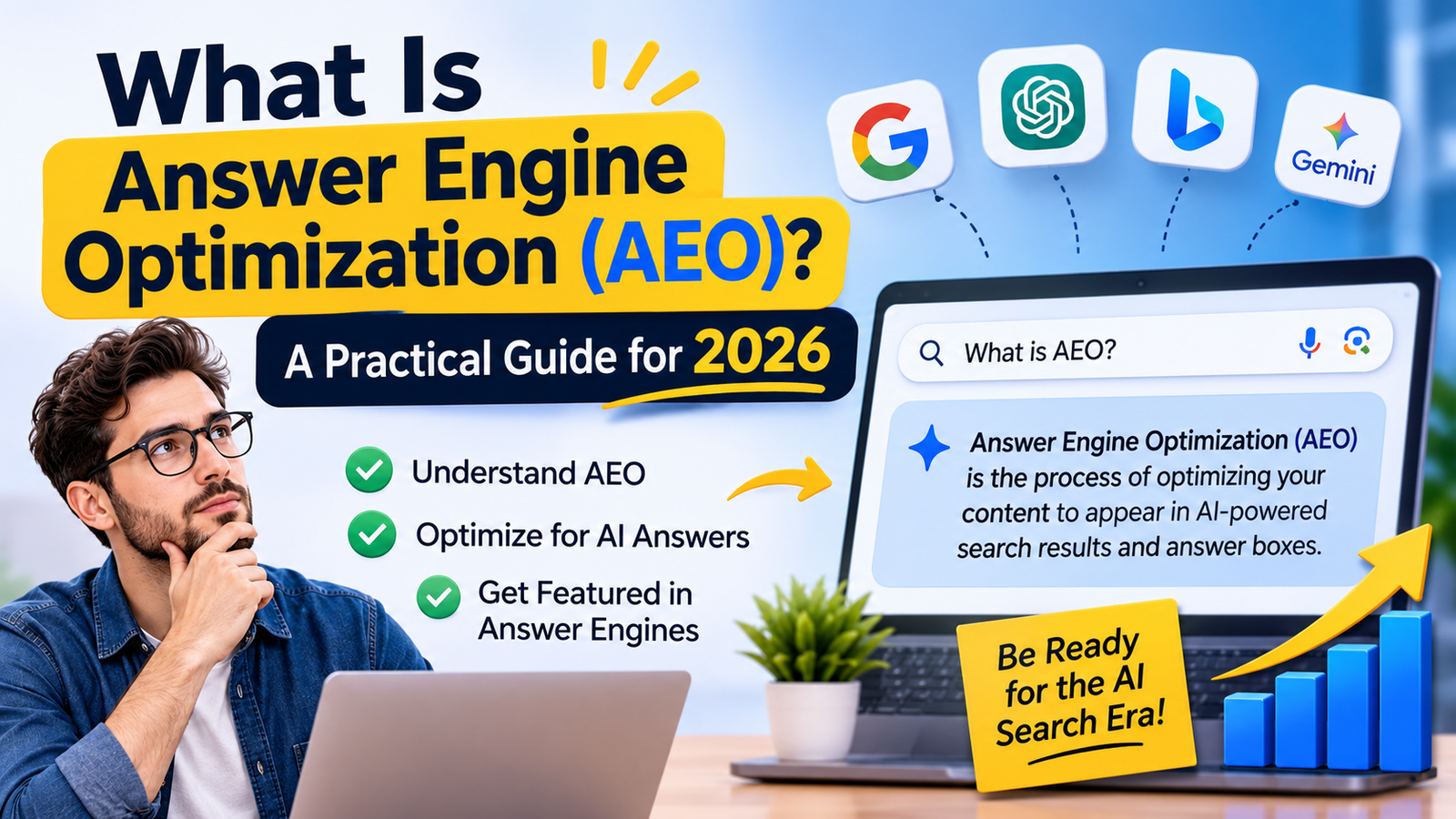

Search is changing, but that doesn’t mean SEO is disappearing.
For years, businesses have focused on getting their websites onto the first page of Google.
They researched keywords, published content, improved technical SEO, and built backlinks to increase their visibility.
Now, people are also asking questions through AI-powered platforms.
Instead of going through several search results, they may use ChatGPT, Google AI features, Gemini, or other AI assistants to find direct answers.
This shift has created more interest in a concept known as Answer Engine Optimization (AEO).
But what exactly is AEO? Does it replace traditional SEO?
And what should website owners do to make their content easier for search engines and AI systems to understand?
Let’s look at what it means and how businesses can approach it.
What Is Answer Engine Optimization (AEO)?
Answer Engine Optimization, commonly known as AEO, is the process of structuring and improving website content so that search engines and AI-powered platforms can understand it and potentially use it when responding to users’ questions.
Traditional SEO often focuses on improving a website’s position in search engine results.
AEO puts additional attention on providing clear, useful, and direct answers to specific questions.
For example, someone searching for “what is link building?”
may see traditional website results, featured answers, or an AI-generated response.
A website that explains the topic clearly, uses relevant information, and provides helpful supporting details may be easier for search systems to understand.
AEO is not a completely separate replacement for SEO.
It builds on many of the same principles, including content quality, technical accessibility, relevance, and website credibility.
Why Is AEO Becoming Important in 2026?
People are becoming more comfortable using AI tools to research products, understand complicated topics, compare services, and find recommendations.
This is changing how businesses think about online visibility.
According to November 2026 trend research, Answer Engine Optimization is among the topics gaining attention in the United States.
At the same time, AI-related searches such as Gemini continue to attract substantial search demand.
This does not mean traditional search has stopped working.
In fact, a November 2026 report on US Google search behavior found that organic clicks to external websites increased to 46.11% in September, showing that conventional search traffic still matters.
The opportunity is not to abandon SEO.
It is to prepare your website for more than one way of discovering information.
AEO vs Traditional SEO: What’s the Difference?
SEO and AEO have overlapping goals, but their approaches can differ.
Traditional SEO focuses on helping web pages rank for relevant search queries.
AEO focuses more specifically on making information understandable and useful for systems that provide direct answers.
Here is a simple comparison:
| Traditional SEO | Answer Engine Optimization |
|---|---|
| Focuses on search rankings | Focuses on answer visibility |
| Targets keywords and search intent | Targets questions and clear answers |
| Improves organic search performance | Supports discovery through answer-based platforms |
| Uses content, technical SEO, and backlinks | Uses clear content, structure, context, and credibility |
| Measures rankings, clicks, and traffic | Also considers mentions, citations, and answer visibility |
These approaches should work together. A well-optimized website should not have to choose between traditional search and AI-powered discovery.
7 Practical Ways to Improve Your Website for AEO
You do not need to rebuild your entire website to start working on AEO.
Many improvements begin with making existing content more useful and easier to understand.
1. Answer the Main Question Early
When someone visits your page, they should not have to read five paragraphs before finding the answer.
Start important sections with a clear explanation of the topic.
You can provide additional context, examples, and details afterward.
For example, if your article targets “What is a dofollow backlink?”, explain the meaning in the opening section before discussing its benefits and limitations.
This makes the content more useful to readers and easier to interpret.
2. Create Content Around Real Questions
Keyword research should go beyond short phrases.
Think about the questions your potential customers actually ask.
For a link-building business, relevant questions might include:
- What is a quality backlink?
- How do guest posts help SEO?
- Are niche edits still useful in 2026?
- What is the difference between dofollow and nofollow links?
- How can businesses evaluate backlink quality?
Use these questions as headings where appropriate.
Answer them properly rather than adding questions simply to include more keywords.
3. Organize Content With Clear Headings
A well-structured article is easier to read and navigate.
Use one clear H1 heading, followed by relevant H2 sections and H3 subsections where necessary.
Avoid headings that sound clever but do not explain what the section is about.
For example, “How Guest Posting Works” is more useful than a vague heading such as “The Bigger Picture.”
4. Publish Helpful and Original Information
AI-generated content has made the internet more crowded.
Publishing another article that repeats the same general advice is unlikely to give readers a strong reason to trust your website.
Add something useful that comes from experience.
This could include:
- Real examples from SEO campaigns.
- Lessons learned from publisher outreach.
- Common mistakes businesses make when buying backlinks.
- Comparisons based on genuine research.
- Practical recommendations for evaluating websites.
Original insights give readers a reason to spend time on your content and return to your website.
5. Build Website Credibility
Credibility matters when people are deciding which information to trust.
Make it easy for visitors to understand who publishes your content, what your business does, and why your information is worth considering.
Some practical steps include:
- Maintain a clear About Us page.
- Include accurate author information.
- Provide relevant business contact details.
- Reference reliable sources when discussing factual claims.
- Keep important pages updated.
- Demonstrate real industry experience.
Avoid publishing claims that cannot be supported.
6. Improve Your Website’s Technical Accessibility
Even excellent content can have visibility problems if search engines cannot properly access or understand your pages.
Review your website for:
- Crawlability and indexability issues.
- Mobile usability.
- Page loading performance.
- Broken internal links.
- Appropriate canonical tags.
- Accurate XML sitemaps.
- Structured data where relevant.
Schema markup can help describe certain types of content, but adding structured data does not guarantee that an AI platform will cite your website.
Technical SEO remains an important foundation for discoverability.
7. Use Relevant Backlinks to Support Your Content
Backlinks remain an important part of a broader SEO strategy.
When relevant websites link to your content, they can help search engines discover pages and understand relationships between websites.
Quality editorial links can also send referral traffic and help build brand awareness.
However, buying large numbers of unrelated links is not a reliable AEO strategy.
Focus on relevant publications, useful content, natural editorial context, and genuine industry relationships.
A link from a relevant website is generally more meaningful than a random placement chosen only because of its metrics.
Do Backlinks Matter for AI Search?
This is one of the most interesting questions in modern SEO.
AI-powered search systems use different technologies and sources to retrieve, interpret, and present information.
Their exact ranking and citation systems are not identical, and there is no universal formula for getting mentioned in AI-generated answers.
It would be inaccurate to claim that every AI platform uses backlinks in the same way as Google.
However, backlinks still have value within the wider search ecosystem.
They can support content discovery, contribute to traditional search visibility, generate referral visits, and help establish relationships between websites and brands.
There is also a difference between earning a backlink and earning an AI citation.
A backlink does not automatically guarantee that an AI system will mention your business.
The sensible approach is to build a website that deserves to be referenced:
Publish useful information, earn relevant editorial links, and establish a consistent presence in your industry.
How Can You Measure AEO Performance?
AEO measurement is still developing, so businesses should avoid relying on a single metric.
You can start by monitoring:
Organic search performance: Track impressions, clicks, rankings, and organic traffic through Google Search Console and your analytics platform.
AI brand mentions: Test relevant questions across AI platforms to see whether your business or content appears in their answers.
Referral traffic: Check whether AI platforms and other external sources send visitors to your website.
Content performance: Identify which pages attract engagement, conversions, and meaningful visits.
Brand visibility: Monitor how often your business is mentioned in relevant industry discussions and publications.
Keep a record of your observations and compare results over time. AI answers can change, so one search test should not be treated as proof of long-term visibility.
Common AEO Mistakes to Avoid
As interest in AEO grows, it is easy to get distracted by shortcuts and exaggerated promises.
Avoid these common mistakes:
- Rewriting every article just to add more questions.
- Publishing large amounts of low-value AI-generated content.
- Treating schema markup as a guaranteed ranking solution.
- Buying unrelated backlinks to influence AI answers.
- Assuming that appearing in an AI answer guarantees website traffic.
- Ignoring traditional SEO and technical website problems.
AEO should improve the usefulness and clarity of your website, not turn content production into a checklist of tricks.
Final Thoughts
Search is evolving, and businesses need to evolve with it.
Traditional SEO remains important, while AI-powered search is creating additional ways for people to discover information and brands.
Answer Engine Optimization gives website owners another reason to focus on clear answers, original insights, reliable information, technical accessibility, and genuine online credibility.
You do not need to chase every new AI trend. Start with your existing website, understand what your audience wants to know, and make your content genuinely helpful.
The goal is simple: create information that people find useful and that search systems can understand.
At Smart SEO Trends, we believe sustainable online visibility comes from a combination of relevant content, sound SEO practices, and quality link-building opportunities.
The search landscape may change, but useful information and genuine credibility will always matter.