


Artificial intelligence is changing how people work, find information, manage businesses, and solve everyday problems.
Over the past few years, AI tools have become increasingly popular for writing content, answering questions, generating images, and analyzing data.
However, the next stage of this development goes beyond simply asking AI a question and receiving an answer.
This is where AI agents come in.
AI agents are designed to do more than respond to instructions.
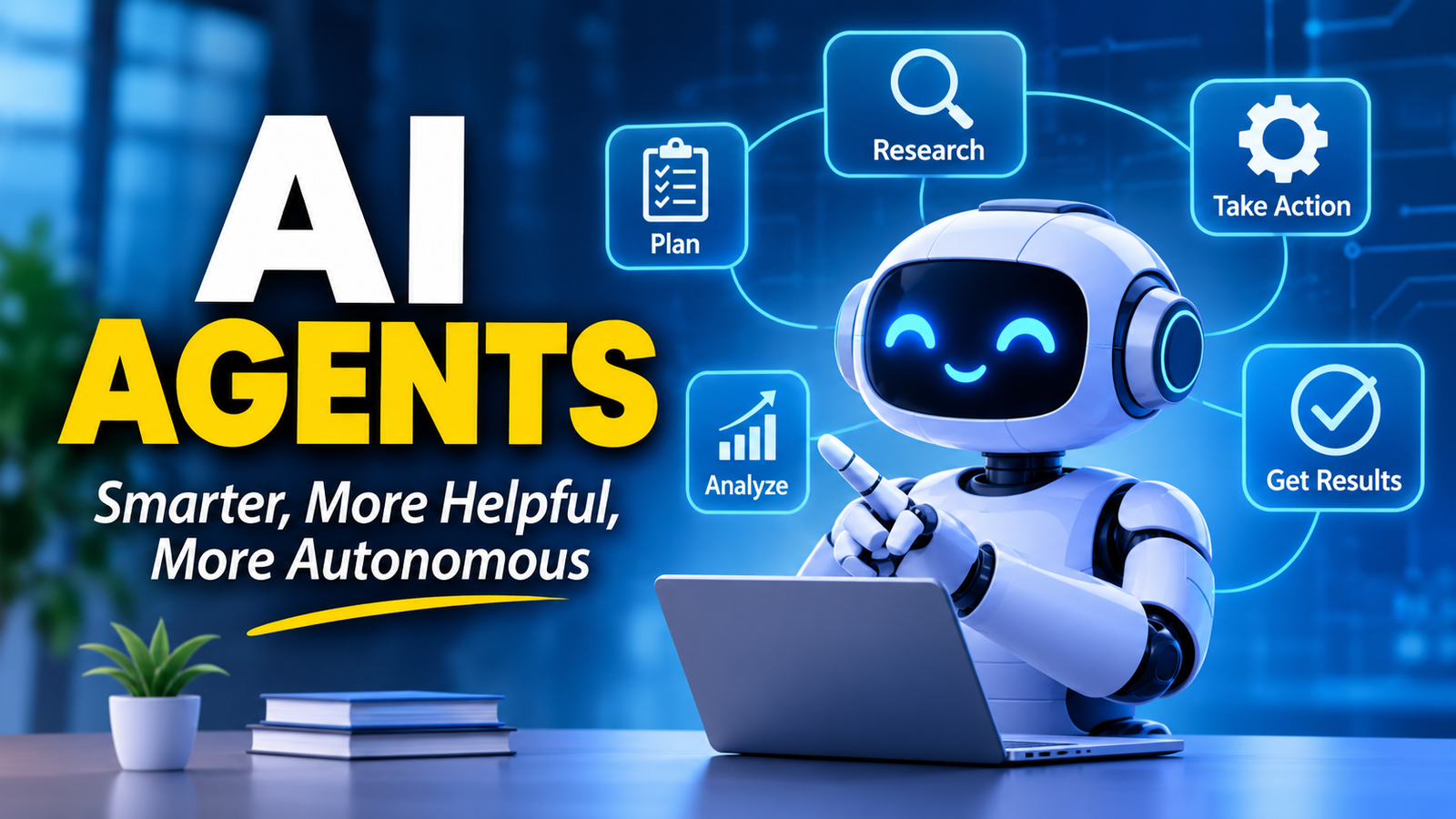
They can understand goals, make decisions, use digital tools, complete multiple steps, and adjust their actions based on the results they receive.
Instead of helping with just one task at a time, an AI agent can potentially manage an entire workflow.
As businesses continue exploring automation and artificial intelligence, understanding how AI agents work and where they can be useful is becoming increasingly important.
What Are AI Agents?
AI agents are software systems that use artificial intelligence to perform tasks with some independence.
They receive a goal or instruction, process available information, decide what actions are necessary, and work toward completing the requested task.
A traditional AI chatbot generally responds to individual prompts.
For example, a user might ask a chatbot to write an email, summarize a document, or explain a technical concept.
An AI agent can take that process further.
If instructed to research potential business partners, it might search for relevant companies, collect information, organize the findings, compare available options, and prepare a report.
The main difference is that an AI agent is designed to work toward an objective rather than simply generate a response.
Depending on its capabilities and permissions, an agent may also interact with websites, APIs, databases, spreadsheets, and other software applications.
How Do AI Agents Work?
AI agents combine several technologies and processes to understand instructions and complete tasks.
Their exact architecture can vary depending on the system, but most follow a similar workflow.
1. Understanding the Goal
The first step is understanding what the user wants to accomplish.
For example, a business owner might ask an AI agent to identify potential customers in the software industry.
The agent needs to understand the target market, the type of companies involved, and the information required.
Some systems can break a broad instruction into smaller tasks before taking action.
2. Gathering Information
After understanding the objective, an agent may collect relevant information from available sources.
These sources can include websites, documents, databases, internal business systems, or connected applications.
The quality of the information matters because inaccurate or incomplete data can affect the decisions made by the agent.
3. Planning the Next Steps
Once the necessary information is available, the agent determines what actions should be taken.
A more advanced agent may create a sequence of steps, identify which tools are required, and decide what information is still missing.
This planning process helps it manage tasks that involve multiple stages.
4. Taking Action
AI agents can use connected tools to perform specific operations.
Depending on their permissions, they may update spreadsheets, organize information, interact with business applications, generate reports, or execute other digital tasks.
For example, an agent connected to a project management platform might create tasks, assign responsibilities, and update project information.
5. Reviewing Results
An important part of agent-based systems is the ability to evaluate the results of their actions.
If an action fails or produces an unexpected result, an agent may try another approach, request additional information, or ask a human for guidance.
However, this does not mean every AI agent can independently correct all mistakes.
Human supervision is still important, particularly when decisions have financial, legal, or operational consequences.
Types of AI Agents
AI agents can be categorized in different ways depending on their design, capabilities, and level of independence.
Here are some common categories.
Simple Reflex Agents
Simple reflex agents respond to specific conditions or inputs.
They follow predefined rules and perform actions when particular situations occur.
For example, a basic automated system might send an alert whenever a website’s server becomes unavailable.
These agents are relatively straightforward because they operate according to predefined conditions.
Goal-Based Agents
Goal-based agents work toward achieving a particular objective.
They evaluate possible actions and select those that help them reach the desired outcome.
For example, an AI scheduling agent might examine available calendar slots and suggest a suitable meeting time.
Learning Agents
Learning agents improve their behavior based on feedback, previous results, or new information.
They can adapt to changing circumstances instead of relying entirely on fixed instructions.
Their effectiveness depends on the quality of their learning process, available data, and system design.
Autonomous AI Agents
Autonomous agents can complete multiple tasks with limited human intervention.
They may plan workflows, use different tools, and make decisions within predefined boundaries.
However, autonomy does not mean unlimited authority. Businesses should establish clear permissions, monitoring systems, and approval requirements.
Multi-Agent Systems
Multi-agent systems involve multiple AI agents working together.
Each agent may have a specific responsibility. One agent might collect information, another might analyze it, and a third might prepare the final output.
This approach can be useful for complex workflows that require different types of expertise.
How Businesses Can Use AI Agents
AI agents are attracting attention because they can support different business functions.
Their applications are not limited to technology companies or large organizations.
Customer Support
Customer support teams handle repetitive questions about products, orders, account access, and company policies.
An AI agent can help answer common questions, retrieve information from approved knowledge bases, and guide customers through basic processes.
For complicated issues, it can transfer the conversation to a human representative.
This allows support teams to spend more time handling situations that require personal attention.
Sales and Lead Generation
Sales teams often spend significant time researching companies, identifying potential customers, and organizing prospect information.
AI agents can assist with parts of this process by gathering publicly available business information, categorizing leads, and preparing research summaries.
For example, a sales agent could help identify companies operating in a specific industry and organize their available business details.
Any outreach or customer communication should still follow applicable privacy requirements and be reviewed before sending.
Content Marketing
Content teams manage research, topic planning, writing, editing, and publishing.
AI agents can support several stages of this workflow.
They may help identify content topics, organize research materials, create outlines, review existing content, and prepare draft reports.
However, human editors remain important for checking factual accuracy, originality, brand voice, and overall content quality.
SEO and Digital Marketing
SEO involves several activities, including keyword research, competitor analysis, content optimization, technical audits, and backlink research.
AI agents can help organize and analyze information across these activities.
For example, an SEO agent might:
- Collect keyword ideas from approved data sources.
- Organize competitor content topics.
- Identify missing sections in existing articles.
- Summarize technical SEO audit findings.
- Categorize backlink opportunities.
- Prepare campaign performance reports.
These capabilities can reduce repetitive work, but SEO decisions still require experience and judgment.
An AI agent cannot automatically determine whether every website is a valuable backlink opportunity.
Relevance, editorial standards, traffic quality, website history, and campaign objectives still matter.
Benefits of Using AI Agents
The growing interest in AI agents is connected to several potential business benefits.
Time savings: Agents can help complete repetitive digital tasks, allowing employees to focus on activities that require creativity, communication, and decision-making.
Workflow automation: Multiple steps can be connected into a single process instead of requiring someone to manually manage every stage.
Better organization: Agents can collect information, categorize records, and prepare structured reports from different sources.
Scalability: Businesses may be able to handle larger workloads without increasing the number of manual tasks at the same rate.
Continuous assistance: Depending on the system and its configuration, agents can perform approved tasks outside normal working hours.
These benefits are not guaranteed. Results depend on the quality of the system, the tools it can access, and how well the workflow is designed.
Challenges and Limitations of AI Agents
Despite their potential, AI agents also introduce challenges that businesses should understand before adopting them.
Accuracy and Reliability
AI systems can misunderstand instructions, produce incorrect information, or take inappropriate actions.
For this reason, important outputs should be checked before they are used in business decisions.
Data Privacy and Security
Agents may need access to sensitive business information, customer records, or internal applications.
Companies should carefully control what information an agent can access and ensure that appropriate security measures are in place.
Cost and Implementation
Building and maintaining an AI agent may require technical resources, software subscriptions, API usage, and ongoing monitoring.
Businesses should evaluate whether the expected benefits justify the investment.
Human Oversight
Not every task should be fully automated.
Financial transactions, legal communications, sensitive customer decisions, and important business changes may require human approval.
A responsible implementation should define which actions an agent can perform independently and which require permission.
AI Agents vs. Traditional Automation
Traditional automation and AI agents both help businesses reduce manual work, but they operate differently.
Traditional automation usually follows predefined instructions. For example, a system might automatically send an email whenever someone submits a contact form.
AI agents can handle more flexible situations. They may interpret information, decide which tool to use, and determine the next step based on the available context.
| Traditional Automation | AI Agents |
|---|---|
| Follows predefined rules | Can interpret goals and context |
| Usually handles fixed workflows | Can manage more flexible workflows |
| Requires predefined conditions | May adapt actions based on results |
| Best for repetitive processes | Useful for multi-step tasks |
| Limited decision-making | Can make bounded decisions |
Both technologies have their place.
Traditional automation is often more predictable for simple, repetitive processes, while AI agents can be useful when a workflow involves changing information or multiple decisions.
The Future of AI Agents
AI agents are likely to become an increasingly important part of business software and digital workflows.
As AI models improve and integrations become more accessible, agents may be able to manage more complicated processes across different applications.
Businesses may use specialized agents for customer support, sales research, marketing operations, financial reporting, and internal administration.
Another important development is the growth of collaborative agent systems.
Instead of relying on one general-purpose agent, organizations may use several specialized agents that work together under a shared workflow.
At the same time, security, accountability, transparency, and human oversight will remain important.
Businesses will need to understand what their agents are doing, which information they are accessing, and how their actions can be reviewed.
The organizations that benefit most will not necessarily be those that automate everything.
They will be the ones that identify the right tasks, build reliable processes, and use AI where it genuinely adds value.
Final Thoughts
AI agents represent an important development in artificial intelligence.
They move beyond simple question-and-answer interactions by helping users plan tasks, access tools, process information, and complete multi-step workflows.
From customer support and sales research to content marketing and SEO, there are many areas where these systems can support everyday business operations.
However, AI agents are not a replacement for human judgment. Their performance depends on accurate information, appropriate permissions, reliable integrations, and effective supervision.
For businesses exploring AI automation in 2026, the best starting point is to identify repetitive tasks that consume valuable time and evaluate whether an AI agent can handle them safely and effectively.
The technology is developing quickly, and understanding how to use it responsibly can help individuals and organizations prepare for the next stage of digital transformation.