

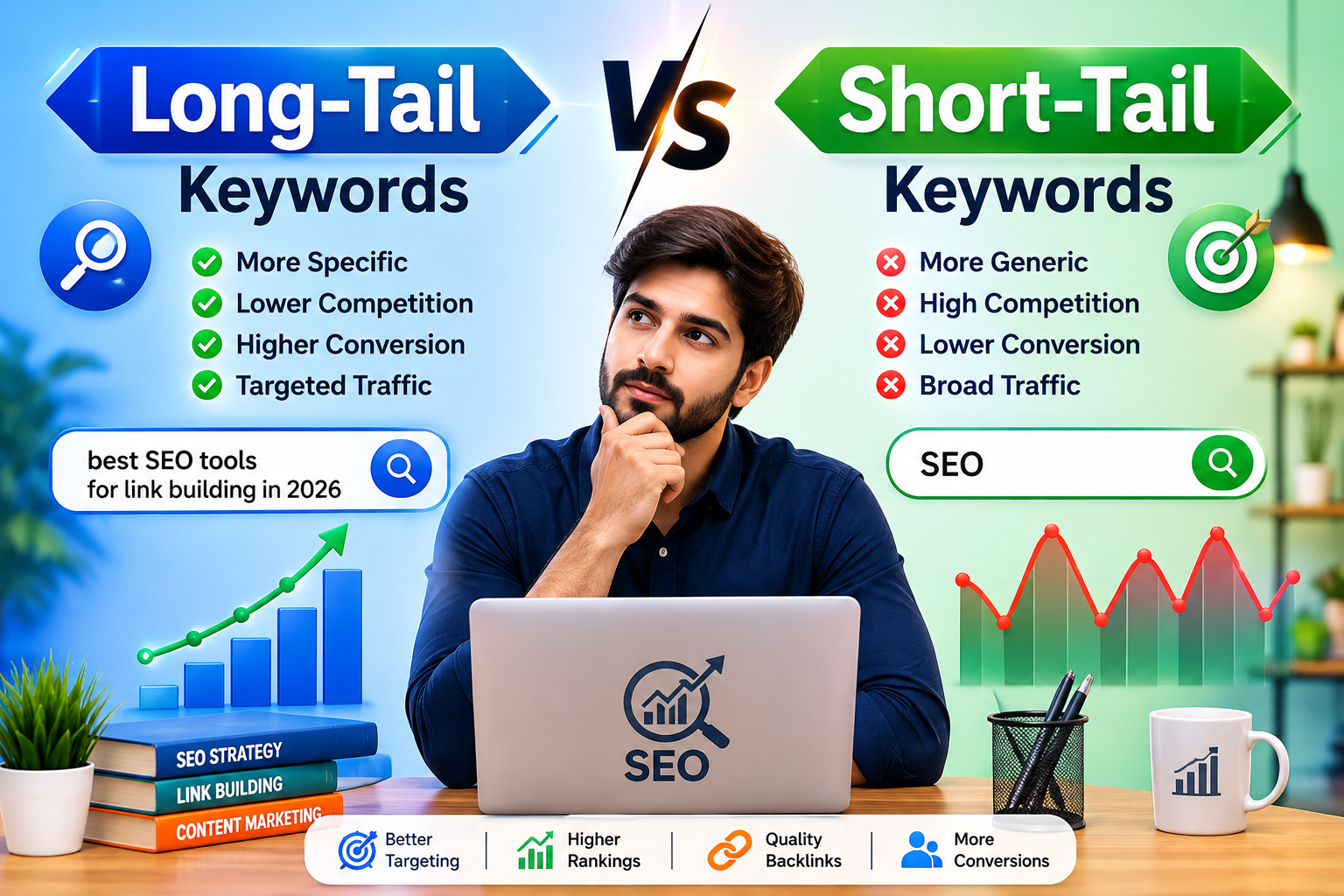

Long-Tail Keywords vs Short-Tail Keywords: Which Should You Target in 2026?
Choosing the right keywords is one of the most important parts of a successful SEO strategy.
While some businesses focus on broad, high-volume terms, others achieve better results by targeting highly specific search queries.
This leads to an important question: long-tail keywords vs short-tail keywords—which should you target in 2026?
The answer isn’t simply one or the other.
Both types can play an important role in SEO, but they serve different purposes.
Short-tail keywords can help build visibility and topical relevance,
while long tail keywords often provide more specific traffic and can better match user intent.
Understanding the differences between them can help you create a more effective keyword strategy, attract relevant visitors,
and build content that addresses what people are actually searching for.
What Are Short-Tail Keywords?
Short-tail keywords are broad search terms that usually contain one to three words.
Examples include:
- SEO
- digital marketing
- backlink services
- keyword research
- content marketing
- SEO tools
These keywords typically have a broad meaning and can attract a large number of searches.
For example, someone searching for “SEO” could be looking for an SEO definition, an SEO agency, SEO tools, tutorials, courses, or something else entirely.
Because of this broad intent, ranking for a short-tail keyword doesn’t always guarantee that the traffic will be highly relevant to your business.
Advantages of Short-Tail Keywords
Short-tail keywords can still be valuable because they can:
- Generate significant search visibility
- Help establish topical relevance
- Attract users at different stages of the buying journey
- Support broader content strategies
- Help websites build authority around major topics
However, competition for these keywords can be extremely high, particularly when established websites dominate the search results.
What Are Long-Tail Keywords?
Long-tail keywords are more specific search queries, usually containing several words.
Examples include:
- best SEO tools for small businesses
- how to build backlinks for a new website
- long-tail keywords for ecommerce SEO
- best keyword research tools for beginners
- how to improve website rankings with SEO
Long-tail searches generally have a narrower meaning than broad keywords.
For example, “SEO” is a very broad term, while “SEO tools for small business websites” communicates a much more specific need.
This specificity can make long-tail keywords particularly useful for businesses targeting users with clear questions, problems, or purchasing needs.
Long-Tail Keywords vs Short-Tail Keywords
The biggest difference between long-tail and short-tail keywords is specificity and intent.
| Factor | Short-Tail Keywords | Long-Tail Keywords |
| Length | Usually 1–3 words | Usually several words |
| Search volume | Generally higher | Generally lower |
| Competition | Often high | Often lower |
| Search intent | Broad | More specific |
| Conversion potential | Variable | Often stronger |
| Ranking difficulty | Usually higher | Often more achievable |
| Content targeting | Broad topics | Specific questions/topics |
Neither type is automatically better. The right choice depends on your website, audience, authority, competition, and SEO objectives.
Which Keywords Have Higher Search Volume?
In most cases, short-tail keywords have higher search volume because they represent broad topics.
For example:
“keyword research”
may receive considerably more searches than:
“best keyword research strategy for SaaS startups.”
However, search volume shouldn’t be the only metric you consider.
A keyword receiving thousands of searches isn’t necessarily more valuable than a keyword receiving a few hundred searches
if the smaller keyword attracts people who are much more likely to become customers.
Search Volume vs Search Intent
Consider these two searches:
“SEO”
and
“SEO agency for SaaS companies.”
The first query is broad.
The searcher could be looking for almost anything related to SEO.
The second query has a much clearer commercial intent.
Therefore, a business offering SEO services may find the second keyword much more valuable despite its lower search volume.
Why Long-Tail Keywords Can Be Easier to Rank For
Long-tail keywords often have less competition because they are more specific.
Large websites may compete heavily for broad terms such as:
- SEO
- marketing
- backlinks
- content marketing
But fewer websites may create dedicated content around a very specific query such as:
“how to build backlinks for a SaaS website without buying links.”
This creates opportunities for smaller or newer websites.
However, lower competition doesn’t mean every long-tail keyword is easy to rank for.
You should still evaluate the search results, content quality, domain authority, search intent, and competition before targeting a keyword.
Long-Tail Keywords and Conversion Rates
One of the biggest advantages of long-tail keywords is their potential to attract users with stronger intent.
Imagine someone searches:
“backlinks”
versus:
“buy guest post backlinks for SaaS website.”
The second query provides significantly more information about what the user wants.
This doesn’t mean every long-tail keyword will convert better, but specific searches can make it easier to create content that directly addresses a user’s needs.
For ecommerce websites, SaaS companies, agencies, and service providers, this can make long-tail keywords an important part of a conversion-focused SEO strategy.
Should You Target Short-Tail or Long-Tail Keywords First?
For most websites, the best approach is to use both.
However, if you’re building a new website or working with a relatively low-authority domain, starting with highly relevant long-tail keywords can be a practical strategy.
For example, instead of immediately targeting:
“SEO”
you could build content around:
- SEO for small businesses
- SEO for SaaS websites
- technical SEO for WordPress
- SEO content writing for startups
- link building strategies for ecommerce
As the website builds authority and topical relevance, you can gradually pursue broader keywords.
How to Build a Keyword Strategy Using Both
A balanced strategy can look like this:
1. Start With a Broad Topic
Choose a major topic relevant to your business.
For example:
SEO
2. Identify Related Subtopics
Break that topic into smaller areas:
- Keyword research
- Technical SEO
- On-page SEO
- Link building
- SEO content
- Local SEO
3. Find Long-Tail Opportunities
Then identify specific queries around those subtopics.
For example:
Link building
could become:
- how to build backlinks
- how to build backlinks for SaaS
- best link building strategies for startups
- guest posting vs link insertion
- how to find relevant link building opportunities
4. Map Keywords to the Right Pages
Don’t target every variation on one URL.
Instead, determine whether related queries should be covered by the same page or deserve separate content.
This is where keyword mapping becomes useful.
A clear keyword-to-page structure can prevent unnecessary duplication and help search engines understand the purpose of each URL.
How Keyword Density Fits Into Long-Tail SEO
When optimizing content for long-tail keywords, it’s important not to repeatedly insert the exact phrase.
For example, if your target keyword is:
“best SEO tools for small businesses”
you don’t need to use the exact phrase dozens of times.
Instead, naturally incorporate related phrases such as:
- SEO tools for small businesses
- tools for small business SEO
- SEO software for small companies
- SEO platforms for small businesses
A Keyword Density Checker can be useful for identifying obvious over-optimization, but it should not dictate your writing.
There is no magic keyword-density percentage that guarantees rankings.
Search engines evaluate the overall relevance and usefulness of a page rather than simply counting keyword repetitions.
Using a Word Counter for SEO Content
A Word Counter can also be useful when planning content around long-tail and short-tail keywords.
Long-tail queries sometimes require highly focused answers.
You don’t necessarily need a 3,000-word article to rank for every specific query.
For example:
“What is a canonical tag?”
may require a concise explanation.
On the other hand:
“Complete technical SEO guide for ecommerce websites”
could justify a much more comprehensive resource.
Use a Word Counter to monitor content length during the writing process, but don’t add unnecessary information simply to hit a particular word count.
Content completeness matters more than word count.
Long-Tail Keywords for White Label SEO Agencies
Long-tail keywords can be particularly useful for agencies providing White Label SEO services.
Instead of targeting only broad phrases such as:
“SEO services”
an agency can create highly specific landing pages and resources targeting queries such as:
- white label SEO services for agencies
- white label link building services
- white label SEO reseller services
- white label SEO for small agencies
- white label link building partner
These queries can communicate much stronger commercial intent.
For an agency managing multiple client campaigns, long-tail keyword research can also help
identify specific industries, locations, services, and customer problems worth targeting.
Common Mistakes When Targeting Long-Tail Keywords
Targeting keywords with no business value
Not every low-competition keyword is worth targeting. Make sure the query is relevant to your audience and business.
Creating a separate page for every variation
Several long-tail keywords may represent the same search intent. Creating separate pages for every variation can create unnecessary content duplication.
Ignoring search intent
A keyword may look attractive based on volume and competition but still be unsuitable for your page.
Focusing only on search volume
Low-volume keywords can generate highly relevant traffic, while high-volume keywords can sometimes produce little commercial value.
Over-optimizing content
Repeating long-tail phrases unnaturally can make content difficult to read and may create an over-optimized experience.
How to Find Long-Tail Keyword Opportunities
You can discover long-tail keywords through several methods:
- Google autocomplete suggestions
- Related searches
- People Also Ask
- Keyword research tools
- Competitor content analysis
- Search Console data
- Customer questions
- Reddit and online communities
- Forums and industry discussions
Your own Google Search Console data can be particularly valuable because it shows the queries for which your pages are already receiving impressions.
If a page is appearing for several related long-tail queries but ranking poorly, you may have an opportunity to improve the content and better satisfy those searches.
Final Verdict: Long-Tail or Short-Tail?
So, long-tail keywords vs short-tail keywords—which should you target in 2026?
The best answer is both, but with different purposes.
Use short-tail keywords to establish broad topical relevance and pursue larger search opportunities.
Use long-tail keywords to target specific questions, niches, problems, and commercial searches.
For newer websites, long-tail keywords can provide a practical starting point because they allow you to focus on narrower topics and more specific search intent.
As your website grows in authority, you can gradually compete for broader keywords.
The strongest SEO strategy isn’t about choosing one keyword type over another.
It’s about creating a keyword ecosystem where broad topics connect with specific long-tail searches, each mapped to the most appropriate page.
In 2026, successful keyword targeting is less about simply chasing search volume and more about understanding
what users want, why they are searching, and which page can provide the best answer.