

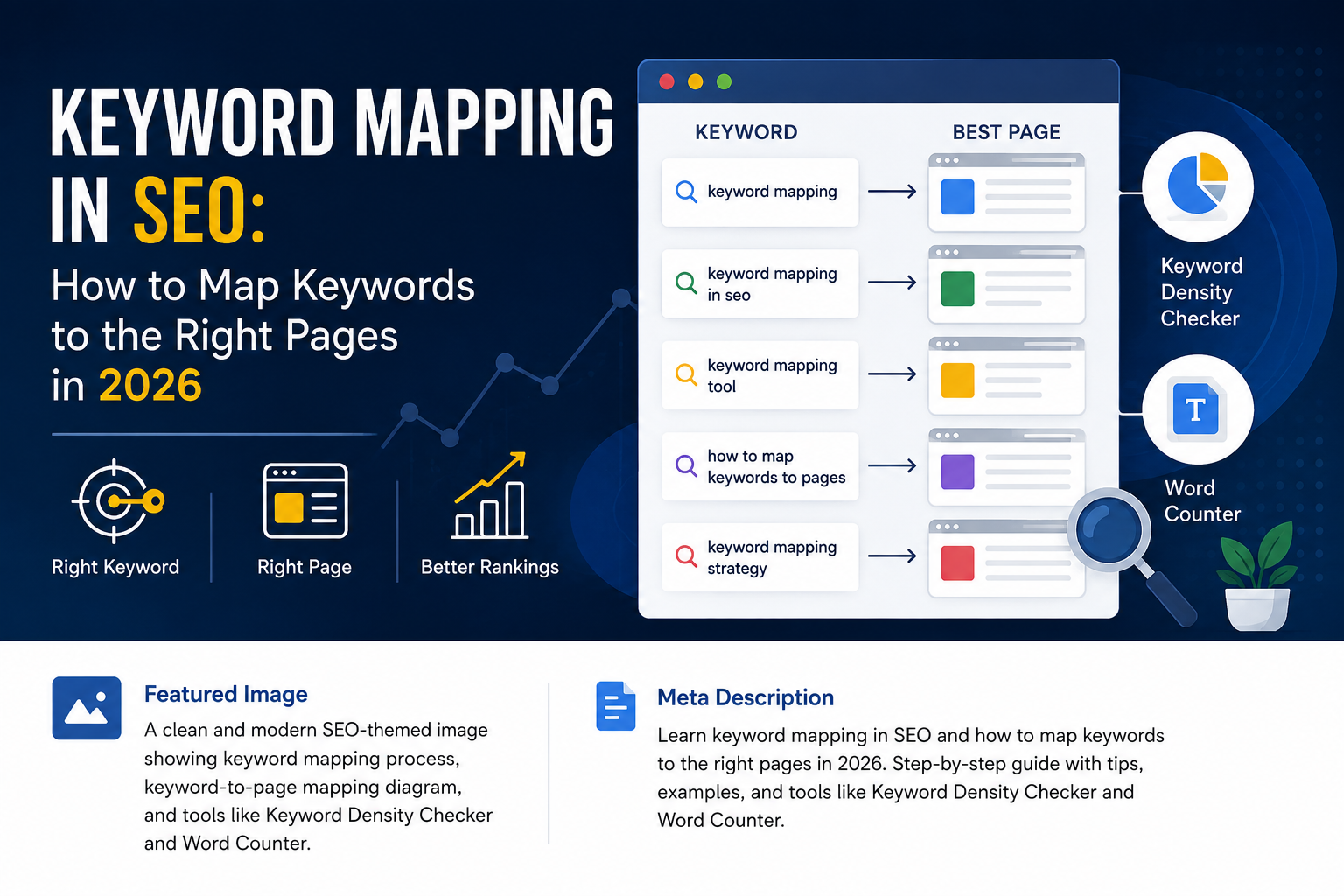

Keyword Mapping in SEO: How to Map Keywords to the Right Pages in 2026
Keyword research is only the first step toward building a successful SEO strategy.
Finding valuable keywords is important, but knowing where each keyword should be used is equally important.
This is where keyword mapping in SEO becomes useful.
Keyword mapping is the process of assigning specific keywords and search intents to the most appropriate pages on a website.
Instead of targeting the same keyword across multiple URLs, you create a clear relationship between keywords, topics, search intent, and individual pages.
A well-planned keyword map can help prevent keyword cannibalization, improve internal linking, strengthen topical relevance, and make your content
strategy more organized.
What Is Keyword Mapping in SEO?
Keyword mapping in SEO means matching target keywords with the pages that should rank for those keywords in search engines.
For example, imagine an SEO website has these keywords:
- SEO tools
- keyword research tools
- keyword density checker
- backlink analysis tools
- SEO writing tools
Instead of targeting all of these terms on one page, you can assign each group to a relevant URL.
| Keyword | Search Intent | Recommended Page |
| SEO tools | Commercial/Informational | SEO Tools Guide |
| Keyword research tools | Commercial | Keyword Research Tools |
| Keyword density checker | Transactional | Keyword Density Checker Tool |
| Backlink analysis tools | Commercial | Backlink Analysis Guide |
| SEO writing tools | Commercial | SEO Writing Tools |
This creates a logical structure where every important keyword has a clear destination.
Why Keyword Mapping Matters for SEO
Without keyword mapping, websites can accidentally create several pages targeting similar keywords.
This can make it difficult for search engines to determine which page should rank.
A keyword map helps you:
- Assign keywords to the most relevant pages
- Avoid keyword cannibalization
- Match content with search intent
- Improve internal linking
- Identify content gaps
- Organize content clusters
- Create a clearer website architecture
- Track keyword performance more effectively
The goal isn’t simply to assign as many keywords as possible to every URL.
The goal is to make each page the best possible result for a specific group of closely related searches.
Step 1: Start With Keyword Research
Before mapping keywords, you need a keyword list.
Use keyword research tools to identify relevant terms based on search volume, competition, relevance, and search intent.
Don’t focus only on high-volume keywords. Long-tail variations can often reveal more specific user needs and can be easier to target.
For example, instead of only targeting:
SEO tools
you might discover:
- SEO tools for beginners
- free SEO tools
- SEO tools for keyword research
- SEO tools for competitor analysis
- SEO tools for content optimization
These keywords may have different intents and therefore shouldn’t automatically be assigned to the same page.
Step 2: Group Keywords by Search Intent
Search intent should play a major role in keyword mapping.
The main types include:
Informational intent:
The user wants to learn something.
Navigational intent:
The user is looking for a particular website, brand, or page.
Commercial investigation:
The user is comparing solutions before making a decision.
Transactional intent:
The user is ready to take an action, such as purchasing a service or using a tool.
For example, “what is keyword mapping” has an informational intent, while “keyword mapping tool” may have a commercial or transactional intent.
Mapping both keywords to exactly the same page may not always be the best strategy.
Step 3: Create Keyword Groups
Once you’ve identified search intent, group closely related keywords.
Suppose your primary keyword is:
keyword mapping
Related terms could include:
- keyword mapping in SEO
- SEO keyword mapping
- keyword mapping strategy
- keyword-to-page mapping
- how to map keywords to pages
These terms can generally be covered by one comprehensive page because they represent closely related searches.
However, a keyword such as keyword mapping tool could potentially deserve a separate page if its search intent and SERP results are significantly different.
Step 4: Assign One Primary Keyword to Each Page
Every important SEO page should have a clear primary topic.
For example:
URL: /keyword-mapping-guide/
Primary keyword: Keyword Mapping in SEO
Secondary keywords: SEO keyword mapping, keyword mapping strategy, keyword-to-page mapping
This doesn’t mean you should use the primary keyword repeatedly. Search engines can understand related terms and context.
Your goal should be to create useful content around the topic rather than forcing exact-match keywords into every paragraph.
Step 5: Use a Keyword Density Checker Carefully
A Keyword Density Checker can be useful during content optimization, particularly when you’re reviewing whether a target phrase appears naturally throughout an article.
However, keyword density shouldn’t become the primary goal of optimization.
For example, if your primary keyword is “keyword mapping in SEO,” you don’t need to repeat that exact phrase in every section.
Instead, use natural variations such as:
- SEO keyword mapping
- mapping keywords to pages
- keyword-to-page mapping
- keyword targeting
- keyword organization
A Keyword Density Checker can help identify accidental overuse, but relevance, readability, search intent, and content quality should come first.
Step 6: Use a Word Counter During Content Planning
A Word Counter is another simple but useful part of the content optimization process.
It can help you maintain an appropriate content length while preparing your mapped pages.
For example, you may decide that:
- A short supporting page needs around 800–1,000 words.
- A competitive informational guide may need 1,500–2,500 words.
- A comprehensive pillar page may require considerably more depending on the topic.
However, there is no universal word-count requirement for ranking.
Don’t add unnecessary paragraphs simply to reach a specific number. The content should be as comprehensive as the topic requires.
Keyword Mapping for White Label SEO
Keyword mapping is especially useful for agencies offering White Label SEO services.
A white-label SEO provider may manage campaigns for multiple agencies and their clients.
Each client can have different services, locations, products, and target audiences.
A structured keyword map helps keep those campaigns organized.
For example, a digital marketing agency working with an e-commerce client might create separate keyword groups for:
- Ecommerce SEO services
- Shopify SEO
- Ecommerce keyword research
- Product page optimization
- Technical SEO for ecommerce
- Ecommerce link building
Each group can then be mapped to the most relevant existing or planned page.
This approach makes it easier for agencies to manage content production, on-page optimization, internal linking, and reporting across multiple campaigns.
How to Map Keywords to Existing Pages
Before creating a new page for every keyword, check your existing content.
You may already have a page that is relevant enough to target the keyword.
A simple process is:
Keyword → Search Intent → Existing URL → Content Gap → Optimization
If an existing page matches the intent, improve that page instead of creating another URL.
If no suitable page exists, consider creating a new piece of content.
This approach can help prevent unnecessary content duplication.
Keyword Mapping and Internal Linking
Keyword mapping also makes internal linking easier.
Once you know which page is responsible for each topic, you can build links between related pages.
For example:
Pillar page: Keyword Research
↓
Supporting page: Keyword Mapping
↓
Supporting page: Search Intent
↓
Supporting page: Keyword Clustering
↓
Supporting page: Keyword Cannibalization
This creates a logical content structure and helps users navigate between related topics.
Common Keyword Mapping Mistakes
1. Mapping the same keyword to multiple pages
This can create unnecessary competition between your own URLs.
2. Ignoring search intent
A page may contain the right keyword but still fail to satisfy what users are looking for.
3. Creating pages for every keyword variation
Not every keyword deserves a separate URL. Closely related terms can often be covered within one strong page.
4. Overusing exact-match keywords
Keyword mapping is about organization, not keyword stuffing.
5. Ignoring existing pages
Always check whether you already have a page that can be improved before creating another one.
6. Focusing only on search volume
A lower-volume keyword with strong relevance and commercial intent may be more valuable than a high-volume keyword that doesn’t match your business.
Final Thoughts
Keyword mapping in SEO provides a structured way to connect keywords, search intent, content, and URLs.
Instead of publishing content randomly, you can build a clear strategy where every important topic has a logical destination.
Start with keyword research, group related terms, understand search intent, assign primary keywords to the most relevant pages, and continuously review your map as your website grows.
Tools such as a Keyword Density Checker and Word Counter can support the optimization process, but they should complement, not replace good SEO judgment.
For agencies managing multiple campaigns, particularly those providing
White Label SEO, keyword mapping can also make content planning, optimization, internal linking, and reporting significantly more organized.
The ultimate goal is simple: one clear topic, one clear search intent, and the right page to satisfy it.
One response to “Keyword Mapping in SEO”
[…] Keyword mapping […]