


If you are trying to improve your Google rankings, one question comes up again and again:
How many backlinks do you need to rank on Google?
There is no universal number.
A page can rank with a handful of highly relevant, authoritative backlinks, while another may need dozens or even hundreds of referring domains to
compete for a highly competitive keyword.
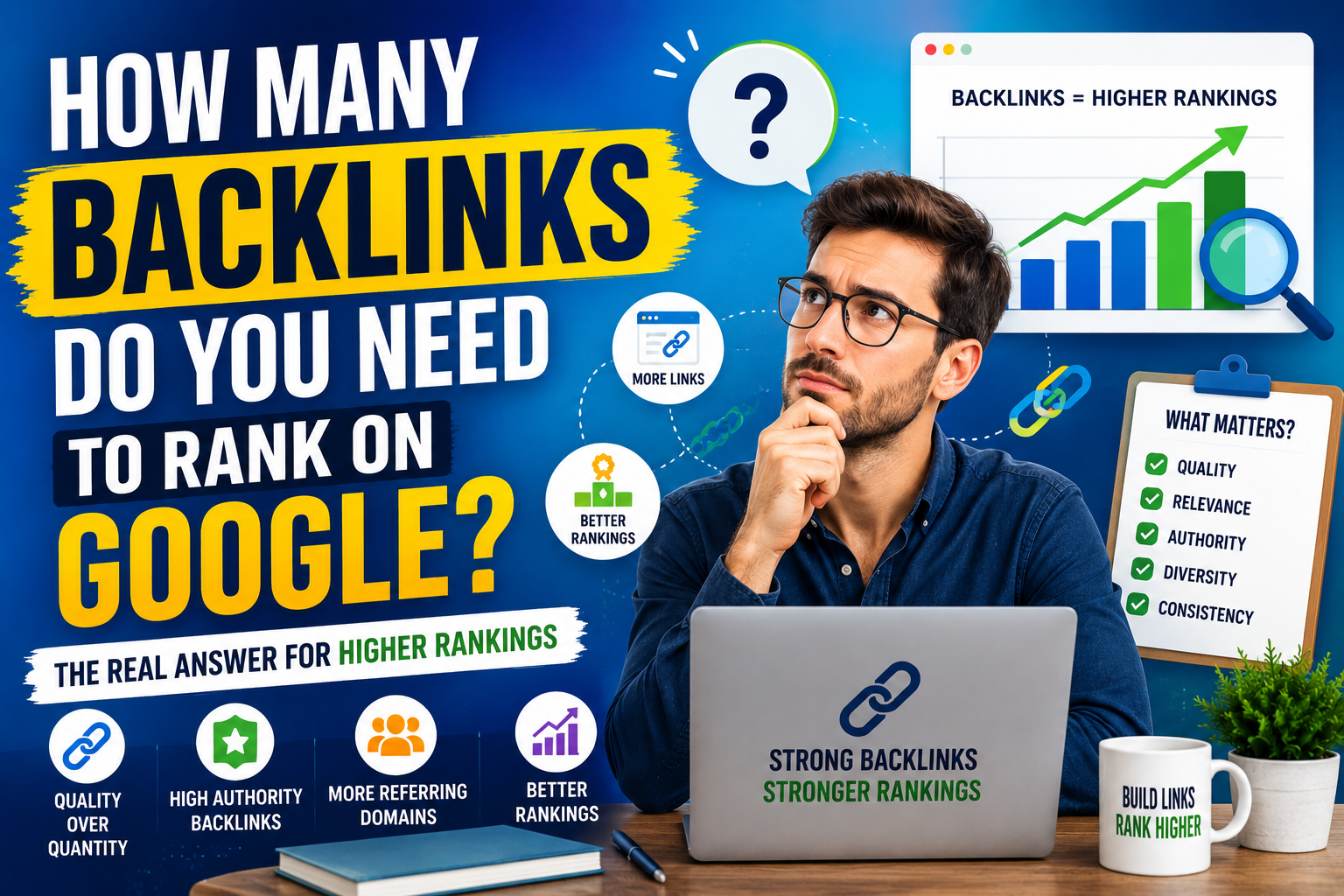
The important thing is not simply how many backlinks you have.
The quality, relevance, authority, diversity, and context of those links matter just as much—or more—than the total number.
In this guide, you’ll learn how to estimate the number of backlinks you may need, how to analyze competitors, and how to build a backlink strategy that
supports sustainable SEO growth.
Is There a Fixed Number of Backlinks Needed to Rank?
No.
Google does not have a rule such as “a page needs 50 backlinks to reach page one.”
Rankings depend on many signals, including the quality and relevance of the content, search intent, website authority, internal linking, competition, and
the overall strength of the backlinks pointing to a page.
For example, imagine you are targeting a keyword with very little competition.
A well-optimized article may rank with only a few relevant backlinks.
Now consider a competitive commercial keyword where established websites already dominate the search results.
Those pages may have hundreds or thousands of backlinks from numerous referring domains.
This is why looking at backlink quantity alone can be misleading.
Instead of asking:
“How many backlinks do I need?”
A better question is:
“How strong is the competition, and what kind of backlink profile do the pages ranking above me have?”
What Determines How Many Backlinks You Need?
Several factors influence how many backlinks a page may need before it can compete effectively.
1. Keyword Competition
Competition is one of the biggest factors.
A long-tail keyword with specific search intent may require relatively few backlinks because fewer websites are competing for it.
A broad keyword such as “SEO” or “digital marketing” is significantly harder.
The websites ranking for these terms often have strong domains, extensive content libraries, and large backlink profiles.
Before building links, analyze the current search results and determine how difficult the keyword is likely to be.
2. Quality of Backlinks
Ten high-quality backlinks can be more valuable than 100 weak or irrelevant links.
A backlink from a reputable website that is relevant to your industry can provide much stronger SEO value than a large number of links from unrelated, low-quality websites.
For example, if you run an SEO agency, a contextual link from an established marketing or technology publication is generally more relevant than dozens of links from unrelated websites.
This is why a successful backlink campaign should prioritize quality over quantity.
3. Topical Relevance
Relevance matters when evaluating backlinks.
Suppose you publish an article about SaaS SEO.
A contextual backlink from a SaaS, marketing, technology, or business website makes more sense than a
link from an unrelated entertainment website.
Relevant links can also help search engines better understand the relationship between your content and the topic you are targeting.
4. Referring Domains
A common mistake is focusing entirely on the number of backlinks instead of the number of unique referring domains.
If one website links to your page 50 times, you technically have 50 backlinks, but those links are still coming from one referring domain.
On the other hand, 20 relevant websites linking to your content represents a more diverse backlink profile.
Therefore, when analyzing competitors, look at both:
- Total backlinks
- Referring domains
The second metric can provide a much more useful picture of link diversity.
Backlink Quality Matters More Than Quantity
More backlinks do not automatically mean better rankings.
Consider two hypothetical websites.
Website A has 500 backlinks from low-quality, unrelated websites.
Website B has 40 backlinks from relevant, authoritative websites.
Website B could potentially outperform Website A because its links are more credible and contextually relevant.
A strong backlink should ideally come from a legitimate website, be relevant to your topic, appear naturally within useful content, and provide genuine value to readers.
This is why your strategy should focus on acquiring high-quality backlinks rather than simply trying to reach an arbitrary backlink count.
How Many Backlinks Do You Need for Low-Competition Keywords?
For low-competition keywords, you may not need many backlinks.
If your content thoroughly satisfies search intent and your website has reasonable authority, a small number of relevant links can sometimes be enough to compete.
For example, a new article targeting a very specific long-tail keyword might begin gaining visibility with several strong referring domains.
However, there is no guaranteed number.
Your competition could have fewer backlinks but stronger domains, better content, or more relevant links. Therefore, backlink requirements should always be evaluated against the actual SERPs.
How Many Backlinks Do You Need for Competitive Keywords?
Competitive keywords usually require a stronger overall SEO strategy.
You may need significantly more referring domains when competing against established websites with:
- Strong domain authority
- Large numbers of referring domains
- Extensive topical coverage
- High-quality content
- Strong internal linking
- Established brand recognition
In these situations, simply matching the competitor’s backlink count isn’t enough.
If a competitor has 200 referring domains, getting 201 random backlinks isn’t a strategy.
Instead, look for opportunities to obtain better and more relevant links while building stronger content and topical authority.
Why Referring Domains Matter
Imagine you receive 100 backlinks from five websites.
Another competitor receives 50 backlinks from 30 different relevant websites.
The raw backlink numbers make the first website look stronger, but the referring-domain distribution tells a different story.
This is why SEO professionals commonly examine referring domains when conducting competitor backlink analysis.
When reviewing your competitors, record:
Competitor → Referring domains → Total backlinks → Link quality → Relevant opportunities
This gives you a much clearer picture of the competitive landscape.
How to Estimate the Backlinks Your Competitors Have
One of the easiest ways to estimate your backlink requirements is to analyze the pages already ranking for your target keyword.
Start by searching your target keyword on Google.
Look at the top-ranking pages and identify their backlink profiles using SEO platforms such as Ahrefs, Semrush, or Moz.
Record the following information:
| Metric | What to Analyze |
|---|---|
| Referring domains | Number of unique websites linking to the page |
| Backlinks | Total links pointing to the page |
| Domain authority | Overall strength of the competing website |
| Page authority | Strength of the specific ranking page |
| Link relevance | How closely related the linking sites are |
| Content quality | Depth and usefulness of the competing content |
You don’t need to copy the competitor’s backlink profile exactly.
Instead, use it to understand.
A Practical Backlink Calculation Method
There is no official backlink calculator that can tell you the exact number of links required for a ranking.
However, you can create a practical estimate.
Suppose the top five competitors have approximately:
- Competitor 1: 80 referring domains
- Competitor 2: 55 referring domains
- Competitor 3: 42 referring domains
- Competitor 4: 35 referring domains
- Competitor 5: 25 referring domains
The average is around 47 referring domains.
Instead of targeting 100 low-quality backlinks, you could aim to build a diverse set of relevant, high-quality referring domains while improving your content and internal linking.
The goal isn’t to beat an arbitrary number.
The goal is to build enough authority to become competitive with the pages already ranking.
How to Build the Right Number of Backlinks Safely
Once you understand your competition, focus on acquiring links naturally and strategically.
Guest posting, digital PR, linkable assets, industry resources, partnerships, and relevant editorial placements can all contribute to a healthy backlink profile.
You should also diversify your backlink sources.
For example, instead of getting every link from the same type of website, aim for a natural combination of relevant publications, industry blogs, resource pages, business websites, and other legitimate sources.
The anchor text should also look natural. Avoid repeatedly using the same keyword-rich anchor text across every backlink.
Your objective should be a natural and diverse backlink profile, not a specific number.
Don’t Ignore Internal Linking
External backlinks aren’t the only links that matter.
Internal links help search engines discover your content and understand relationships between pages on your website.
For example, if you publish an article about the number of backlinks needed to rank, you can internally connect it with related resources covering:
- Dofollow vs. nofollow links
- High-authority backlinks
- Anchor text
- White hat link building
- Professional link building services
- Guest posts and link insertions
This creates a connected topic cluster instead of isolated articles.
Common Backlink Mistakes to Avoid
One of the biggest mistakes is buying large quantities of low-quality links simply because they are cheap.
Other common problems include:
- Focusing only on backlink quantity
- Ignoring referring domains
- Building links from completely unrelated websites
- Using the same exact-match anchor repeatedly
- Ignoring content quality
- Trying to build hundreds of links immediately
- Measuring success only by backlink count
- Failing to analyze competitors before starting a campaign
A backlink strategy should support the website’s overall SEO strategy rather than operate separately from it.
How Long Does It Take for Backlinks to Improve Rankings?
Backlinks don’t always produce immediate ranking improvements.
Google needs time to discover, crawl, and evaluate links and the pages associated with them.
Your rankings can also be affected by content changes, competitors, algorithm updates, and other SEO factors.
Instead of expecting every backlink to produce an immediate ranking jump, monitor your website over time.
Track:
- Keyword positions
- Organic impressions
- Organic clicks
- Referring domains
- Page-level traffic
- Rankings for related keywords
This gives you a better understanding of whether your overall SEO strategy is working.
FAQs
How many backlinks do I need to rank #1 on Google?
There is no fixed number. The required level of backlinks depends on keyword competition, content quality, website authority, and the strength and relevance of competing pages.
Is it better to have 10 high-quality backlinks or 100 low-quality backlinks?
Generally, 10 relevant, high-quality backlinks can be more valuable than 100 poor-quality links. Quality and relevance should be prioritized over raw quantity.
Can a website rank with zero backlinks?
Yes. Some pages can rank without external backlinks, particularly for low-competition searches or when the website already has strong authority and topical relevance. However, backlinks can become increasingly important as competition increases.
Should I focus on backlinks or content first?
You need both. Strong content gives people a reason to link to your website, while relevant backlinks can help build authority and visibility. A balanced strategy is usually more effective than focusing exclusively on one.
Final Thoughts.
So, how many backlinks do you need to rank on Google?
There isn’t a magic number.
For some low-competition keywords, a few strong and relevant referring domains may be enough.
For highly competitive keywords, you may need a much larger and more authoritative backlink profile.
The smartest approach is to analyze the pages already ranking, evaluate their referring domains and backlink quality, improve your own content, and then
build relevant links that strengthen your site’s authority.
Remember: don’t chase backlinks simply to increase a number.
Build the right backlinks from the right websites for the right content.
That approach is far more sustainable than trying to reach an arbitrary backlink target.
One response to “How Many Backlinks Do You Need to Rank on Google in 2026?”
[…] to rank higher on Google is no longer about simply adding keywords to a page or building as many backlinks as […]