
How to Improve Google Rankings in 2026: 15 Proven SEO Strategies
Getting your website to rank higher on Google is no longer about simply adding keywords to a page or building as many backlinks as possible.
Google’s search ecosystem has become considerably more sophisticated.
Search results now consider many signals related to relevance, content quality,
user experience, links, technical accessibility, and the overall usefulness of a page.
At the same time, search is changing because of AI-powered experiences such as AI Overviews and AI Mode.
Google has also published guidance explaining that traditional SEO best practices continue to matter for visibility in generative AI features.
If your website is receiving impressions but not enough clicks, or many of your keywords are stuck on pages two,
three, or beyond, your strategy should focus on improving the pages that already have search visibility while building stronger topical authority.
Here are 15 proven SEO strategies you can use in 2026 to improve Google rankings and increase organic traffic.
1. Target the Right Search Intent
One of the biggest SEO mistakes is creating content around a keyword without understanding what the searcher actually wants.
For example, someone searching for:
“best SEO tools”
probably wants a comparison or list of tools.
Someone searching for:
“how to do keyword research”
probably wants a tutorial.
Someone searching for:
“Ahrefs pricing”
has a commercial or transactional intent.
Before creating a page, search your target keyword on Google and analyze the current results.
Look at:
- Content format
- Search intent
- Average content depth
- Topics covered
- Questions answered
- Search features
- Competing websites
- User expectations
Your goal should not be to create a page that simply contains the keyword.
Your goal should be to create the most useful result for that search intent.
2. Find Keywords With Ranking Potential
Keyword research is still an important part of SEO, but choosing keywords purely based on search volume can lead to disappointing results.
Instead, look for keywords that match:
- Your website’s niche
- Your expertise
- Your existing topical authority
- Your audience’s needs
- Your products or services
- Your current ranking positions
A keyword with 500 monthly searches and strong commercial relevance can be more valuable than a keyword with 20,000 searches that attracts the wrong audience.
Use tools such as Google Search Console, Google Keyword Planner, Ahrefs, Semrush, or other keyword research platforms to identify opportunities.
Most importantly, don’t ignore the keywords your website is already appearing for.
Those keywords often represent your easiest SEO opportunities.
3. Optimize Pages Ranking in Positions 11–30
One of the most effective SEO strategies is improving pages that are already ranking but haven’t reached the first page.
For example, if a page ranks at:
- Position 12
- Position 16
- Position 21
- Position 27
it already has some level of relevance and authority.
Instead of immediately creating another article, analyze why competing pages are ranking above it.
Improve:
- Search intent alignment
- Content depth
- Headings
- Examples
- Statistics
- Internal links
- Images
- Page title
- Introduction
- FAQs where genuinely useful
- Supporting topics
- Overall clarity
This is often more efficient than starting from zero with a brand-new keyword.
4. Create People-First Content
Google’s current guidance emphasizes creating helpful, reliable content primarily for people rather than content designed only to manipulate search rankings.
That means your articles should actually solve the reader’s problem.
Instead of writing:
“SEO is important for websites because SEO helps websites rank higher.”
Provide something useful:
- Step-by-step instructions
- Real examples
- Screenshots
- Original insights
- Templates
- Checklists
- Calculations
- Comparisons
- Practical recommendations
If someone finishes your article and still needs to search Google for the same question, the article probably needs improvement.
5. Build Topical Authority
Publishing unrelated articles across dozens of topics makes it harder to establish a clear topical focus.
Instead, build content clusters.
For example, an SEO website could create a main pillar around:
SEO
Then create supporting content around:
- Keyword research
- Technical SEO
- On-page SEO
- Link building
- Internal linking
- Content optimization
- Local SEO
- E-commerce SEO
- SEO tools
- Search Console
- AI SEO
These articles should be connected through relevant internal links.
A strong topical structure helps users navigate your website and allows search engines to discover relationships between related pages.
6. Strengthen Internal Linking
Internal links are one of the easiest SEO improvements you can make without acquiring a backlink.
When you publish a new article, identify existing pages that are contextually relevant and link to them.
For example, an article about improving Google rankings could naturally link to:
- Keyword research
- Keyword mapping
- Internal linking
- Backlink building
- SEO tools
- Technical SEO
- Content optimization
Don’t add internal links simply to increase the number of links.
The link should help the reader discover something useful.
Use descriptive anchor text rather than generic phrases such as:
“click here.”
For example:
“learn how to create an effective keyword mapping strategy”
is more descriptive.
Google’s documentation also recommends descriptive anchor text because it helps users and search engines understand the destination page.
7. Improve Your Page Titles
Your title is one of the first things users see in Google Search.
A good title should clearly communicate what the page offers.
Instead of:
SEO Tips
use:
15 Proven SEO Strategies to Improve Google Rankings in 2026
Instead of:
Backlinks Guide
use:
How to Build High-Quality Backlinks: A Practical SEO Guide
Your title should be:
- Clear
- Relevant
- Specific
- Useful
- Aligned with search intent
Avoid stuffing the same keyword repeatedly.
Also remember that Google may sometimes generate or adjust title links based on information from the page and other sources, so
the title should accurately represent the content.
8. Improve Organic CTR
Ranking is only part of the equation.
You can have thousands of impressions and still receive very little traffic if your click-through rate is low.
Suppose a page receives:
10,000 impressions
but only:
50 clicks
That is a 0.5% CTR.
If you improve the page’s ranking and search-result presentation, even a small CTR improvement can generate substantially more traffic.
Look for pages in Google Search Console that have:
- High impressions
- Low CTR
- Reasonable ranking positions
Then test improvements to:
- Title
- Meta description
- Search intent
- Content relevance
- Structured data where applicable
- Page introduction
Don’t use clickbait. The title should accurately represent what users will find on the page.
9. Refresh Outdated Content
Old content can gradually lose visibility when competitors publish better and more current information.
Review your important pages regularly.
Check:
- Outdated statistics
- Broken links
- Old screenshots
- Expired tools
- Outdated recommendations
- Old terminology
- Missing sections
- New developments
- New examples
However, don’t change the publication date simply to make an old article look new.
Update the content when there is a genuine reason to improve it.
The goal is better content, not merely a newer date.
10. Optimize for Featured Search Results and AI Search
Google Search is evolving beyond traditional ten-blue-link results.
AI Overviews and AI Mode can provide users with synthesized answers and links to supporting sources.
Google has stated that SEO fundamentals remain relevant to these generative AI search experiences.
To make your content easier to understand and reference:
- Answer questions clearly
- Use descriptive headings
- Provide original information
- Explain concepts thoroughly
- Include relevant entities and terminology
- Use structured content
- Support claims with credible sources
- Avoid unnecessary filler
Don’t try to write content exclusively for AI.
Instead, create genuinely useful content that works for human readers first.
11. Improve Technical SEO
Great content won’t perform well if search engines have difficulty accessing or understanding your website.
Regularly check:
- Indexing
- XML sitemap
- Robots.txt
- Canonical tags
- HTTPS
- Mobile usability
- Page speed
- Broken links
- Redirects
- 404 pages
- Duplicate content
- JavaScript rendering
- Core Web Vitals
Google Search Console should be one of your primary tools for monitoring search visibility and technical issues.
Google also recommends checking official Search guidance rather than blindly following recommendations from third-party SEO tools.
12. Build Relevant, High-Quality Backlinks
Backlinks can still play an important role in SEO, but quality and relevance matter more than simply increasing the number of referring domains.
A strong backlink is typically:
- Relevant to your niche
- Editorially placed
- From a real website
- Contextually appropriate
- Useful to readers
- From a page that itself provides value
For example, an SEO website receiving a contextual link from a marketing publication can be more meaningful than receiving dozens of irrelevant links from unrelated websites.
Avoid strategies based on manipulating rankings through excessive or artificial link schemes.
Your link-building strategy should focus on relevance, editorial value, and genuine relationships.
13. Improve E-E-A-T Signals
Google encourages content that demonstrates experience, expertise, authoritativeness, and trustworthiness where appropriate.
You can strengthen these signals by making your website more transparent.
Consider adding:
- Author bios
- About page
- Contact information
- Editorial guidelines
- Sources and references
- Original research
- Case studies
- Real examples
- First-hand experience
- Clear business information
For example, an SEO article written by someone with practical SEO experience can be
significantly more useful when it includes real processes, examples, screenshots, and lessons learned.
Don’t simply claim expertise.
Demonstrate it through the content.
14. Use Google Search Console as an SEO Opportunity Finder
Google Search Console isn’t only a reporting tool.
It can help you discover new content opportunities.
Go to:
Performance → Search Results → Queries
Then look for keywords where your website receives:
Deep impressions + low clicks
Also identify queries where your average position is between approximately:
8–30
These can become optimization opportunities.
For example, if one article receives impressions for:
- “SEO strategy”
- “SEO strategy for small business”
- “how to create an SEO strategy”
- “SEO strategy 2026”
you may be able to improve the existing article to cover these related intents more effectively.
This approach turns your own search data into a content strategy.
15. Create Content That Deserves to Rank
Ultimately, the strongest SEO strategy is simple:
Create something genuinely worth ranking.
Ask yourself:
“If Google removed all ranking factors and users simply chose the best article, would they choose mine?”
If the answer is no, improve the article.
Add:
- Original examples
- Better explanations
- Visuals
- Data
- Templates
- Tools
- Checklists
- Expert opinions
- Case studies
- Practical steps
Don’t make an article longer just to hit a specific word count.
A useful 1,500-word article can be better than a repetitive 4,000-word article.
How to Find Your Biggest SEO Opportunities
If your website is already receiving impressions, don’t immediately assume you need hundreds of new articles.
Start with your existing data.
Step 1: Open Google Search Console
Go to:
Performance → Search Results
Step 2: Find high-impression keywords
Sort your queries by impressions.
Step 3: Look for low CTR
Identify keywords receiving impressions but few clicks.
Step 4: Check average position
Pay particular attention to pages ranking around positions 8–30.
Step 5: Open the corresponding page
Ask:
- Does the page satisfy the search intent?
- Is the title compelling?
- Does it answer the main question immediately?
- Does it cover related questions?
- Are internal links relevant?
- Does it contain original information?
- Is the page technically healthy?
Step 6: Improve the page
Update the content instead of automatically creating another page targeting the same intent.
Final Thoughts
Improving Google rankings in 2026 requires more than publishing new articles and building backlinks.
The strongest approach combines:
Search intent + useful content + topical authority + internal linking + technical SEO + CTR optimization + relevant backlinks + continuous improvement.
If your website is already receiving search impressions, you have an important advantage:
Google is already discovering and showing your content.
Your next goal should be turning those impressions into higher rankings and clicks.
Start by identifying pages ranking between positions 11 and 30, improve their content and internal links, optimize titles and search intent, and then build
relevant authority around the topics where your website already has visibility.
SEO is rarely a one-time task.
The websites that consistently improve their content, technical foundation, and user experience are better positioned to earn sustainable
organic visibility as Google Search continues to evolve.
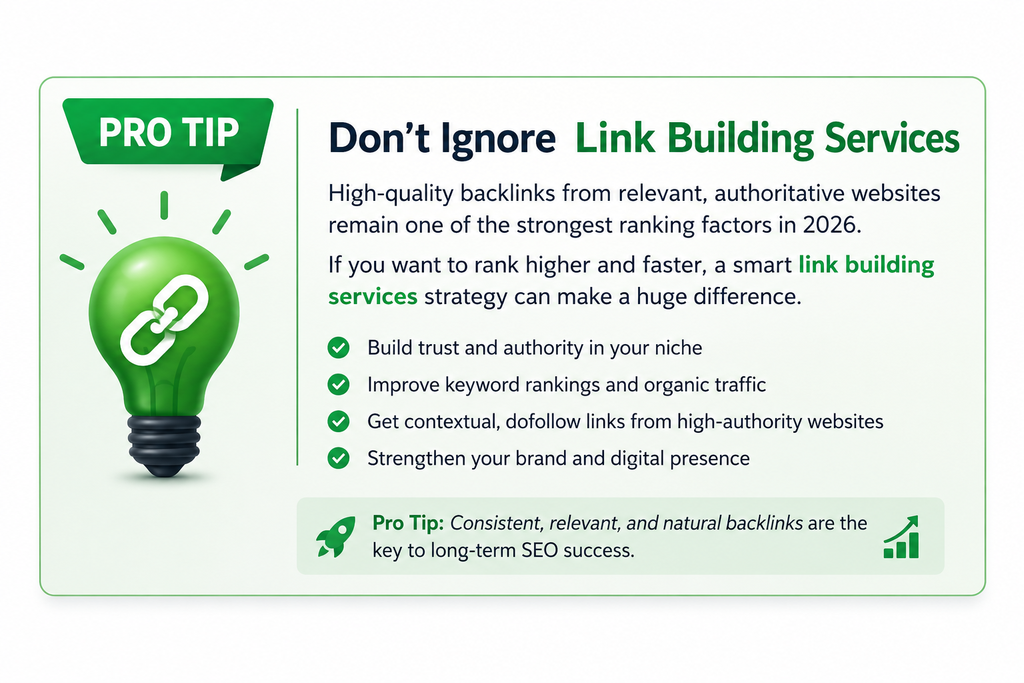
Pro Tip
Pro Tip: Don’t focus only on getting more backlinks; focus on getting the right backlinks.
Prioritize relevant, authoritative websites, create genuinely useful content, and make sure every link adds value for the reader.
If you need help building high-quality, niche-relevant backlinks, consider using professional link building services to strengthen your website’s authority and search visibility.