


.Backlinks remain an important part of SEO, but not every backlink has the same value.
A link placed naturally within relevant, useful content can provide more context and value than a link placed randomly on an unrelated page.
These links are commonly known as contextual backlinks.
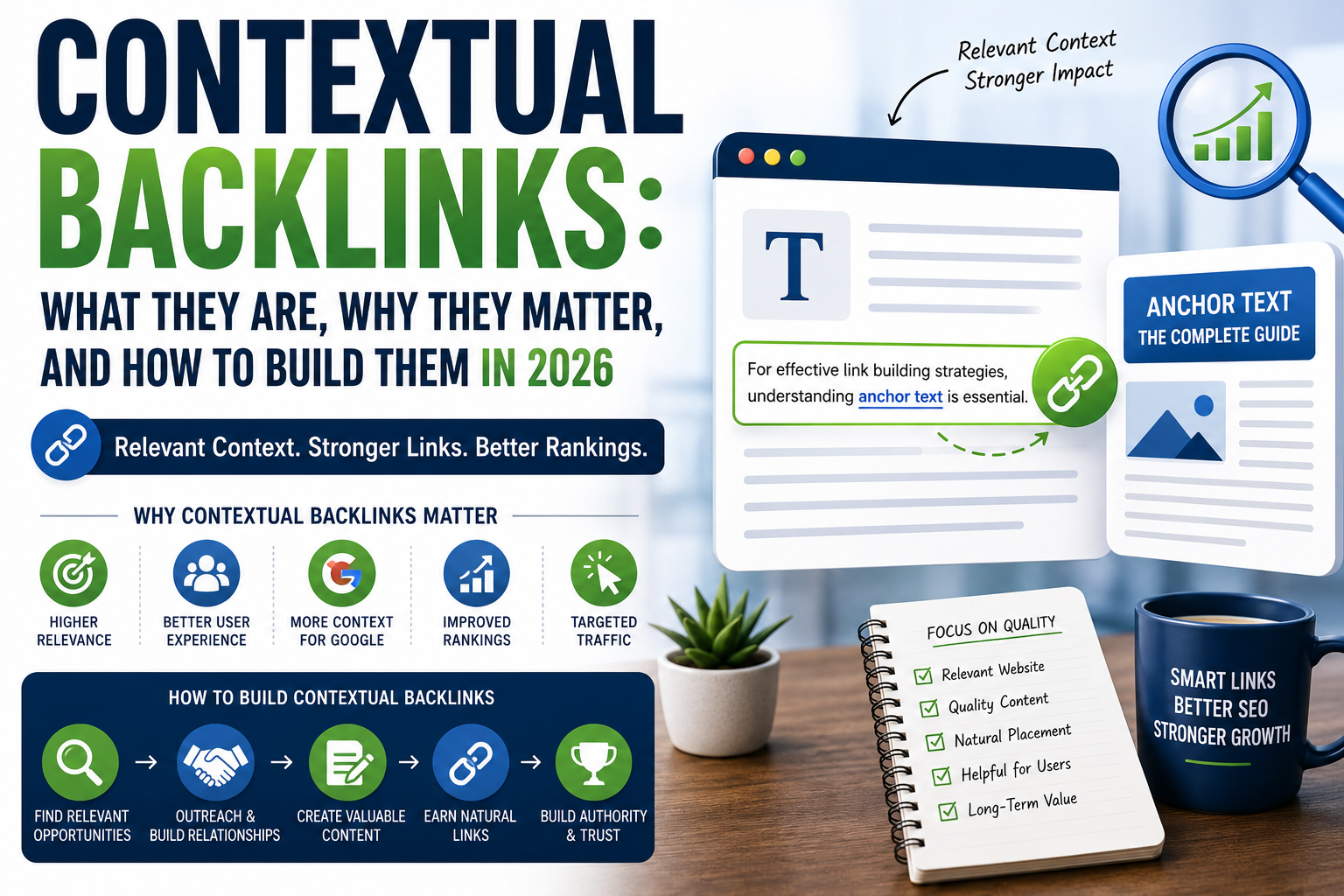
Contextual backlinks are links placed within the main body of content where the surrounding text is relevant to the linked page.
They can help users discover additional information while giving search engines more context about the relationship between the two pages.
In 2026, effective link building is less about collecting the highest possible number of links and more about building relevant, useful, and credible
connections between websites.
What Are Contextual Backlinks?
A contextual backlink is an external link placed naturally within the main content of a webpage and surrounded by text that is relevant to the linked page.
For example, imagine an article discussing SEO content strategies that says:
Businesses can improve their organic visibility by developing a well-planned keyword research strategy.
If “keyword research strategy” links to a relevant guide explaining keyword research, that is a contextual backlink.
The important elements are:
- The link appears within the main content.
- The surrounding content is relevant.
- The linked page provides additional value.
- The link makes sense for the reader.
- The placement doesn’t feel forced.
Context is what separates this type of link from many generic or site-wide links.
How Do Contextual Backlinks Work?
Contextual links create a relationship between the linking page and the destination page.
Suppose Website A publishes an article about link building strategies and links to a detailed guide on Website B about anchor text.
The surrounding discussion about link building helps explain why the anchor-text resource is relevant.
For readers, the link provides an opportunity to learn more.
For search engines, the surrounding content can provide additional information about the subject and relationship between the pages.
However, a contextual backlink is not automatically valuable simply because it appears inside an article.
The quality of the website, relevance of the content, placement, and overall link profile still matter.
Why Do Contextual Backlinks Matter for SEO?
1. They Provide Relevance
Context helps establish why a link exists.
A link from a page discussing SEO to another SEO resource is generally more logical than a link from an unrelated topic.
Relevance should therefore be one of the first things you consider when evaluating a contextual backlink opportunity.
2. They Can Improve User Experience
A useful contextual link gives readers an easy way to find additional information without searching for it themselves.
For example, someone reading about technical SEO may encounter a link to a detailed guide about canonicalization.
Instead of leaving the page to search for another resource, the reader can follow the link directly.
3. They Can Help Search Engines Understand Content Relationships
Links connect pages across the web.
When a relevant page links to another relevant resource using descriptive surrounding content, it can provide additional context about the subject matter of both pages.
This is one reason contextual relevance should be considered when building backlinks.
4. They Can Support Referral Traffic
Unlike links placed where users rarely look, a well-positioned contextual link can attract visitors who are actively reading about the subject.
If the linked resource is genuinely useful, those visitors may explore additional pages, sign up for a service, or use a tool.
Therefore, a good backlink can provide value beyond SEO.
Contextual Backlinks vs. Regular Backlinks
The term “backlink” covers many different types of links.
A backlink can appear in:
- Main content
- Author bios
- Resource pages
- Navigation
- Sidebars
- Footers
- Directories
- Forums
- Other website sections
A contextual backlink specifically refers to a link that appears naturally within relevant content.
For example:
Contextual placement:
Learn more about anchor text best practices before launching your next link-building campaign.
Less contextual placement:
Website links: SEO Tools | Marketing | Backlinks | Contact
The first example provides a clear reason for the link and connects it to the surrounding discussion.
However, this doesn’t mean every non-contextual link is worthless. Different types of links can serve different purposes.
The key is evaluating each link according to its relevance, quality, and purpose.
What Makes a Contextual Backlink High Quality?
Not all contextual links are equally valuable.
A strong contextual backlink typically has several characteristics.
Relevant Website
The linking website should ideally be relevant to your industry, audience, or topic.
For example, an SEO company receiving a link from a marketing publication makes more sense than receiving a link from an unrelated website.
Relevant Page
The specific page containing the link should also be relevant.
A website can have a good overall reputation but still have individual pages that are unrelated to your topic.
Useful Surrounding Content
The article should provide genuine value to readers rather than existing solely to host backlinks.
Natural Link Placement
The link should fit naturally into the paragraph and contribute to the discussion.
Relevant Destination
The page receiving the backlink should actually provide useful information related to the context of the link.
Credible Website
Look beyond third-party metrics such as DR or DA. Consider the website’s content quality, organic visibility, audience, topical relevance, and overall reputation.
How to Build Contextual Backlinks in 2026
Building contextual backlinks should focus on creating genuine reasons for other websites to reference your content.
1. Create Link-Worthy Content
The easiest way to earn contextual backlinks is to create resources worth referencing.
Examples include:
- Original research
- Industry studies
- Statistics
- Detailed guides
- Case studies
- Free SEO tools
- Calculators
- Templates
- Checklists
- Original insights
For example, an SEO website could create a useful backlink analysis tool that other marketing websites can reference when discussing link building.
2. Use Strategic Guest Posting
Guest posting can provide opportunities to contribute useful content to relevant publications.
The focus should be on quality and relevance, not producing as many guest posts as possible.
Before approaching a website, evaluate:
- Topical relevance
- Content quality
- Audience
- Organic visibility
- Editorial standards
- Existing outbound links
The article should be genuinely useful to that publication’s readers.
3. Conduct Relevant Outreach
Outreach can help you introduce valuable resources to publishers and website owners.
Instead of sending generic messages to hundreds of websites, identify pages where your resource genuinely adds value.
For example:
“I noticed your article discusses backlink analysis.
We recently published a detailed guide explaining how referring domains differ from backlinks, which may provide additional context for your readers.”
This approach is more relevant than simply asking for a backlink.
4. Use Link Insertions Carefully
A link insertion involves adding a link to an existing webpage.
When done appropriately, it can be contextual because the link is added within an existing discussion.
However, the page must genuinely be relevant.
A good link insertion should:
- Fit the existing paragraph.
- Provide additional information.
- Match the article’s topic.
- Improve the reader’s experience.
Don’t force a link into a paragraph simply because a placement is available.
5. Build Digital PR Opportunities
Digital PR can help websites earn contextual mentions from publications.
Original research, expert commentary, statistics, product data, and newsworthy insights can give journalists and publishers a reason to reference your website.
These editorial mentions can be particularly useful because the link is often surrounded by relevant discussion.
Contextual Links and Anchor Text
Anchor text is another important part of contextual linking.
Anchor text is the clickable text within a hyperlink.
For example:
Learn more about high-authority backlinks.
Here, “high-authority backlinks” is the anchor text.
The anchor should accurately describe the destination page and fit naturally within the sentence.
Avoid forcing exact-match commercial keywords into every backlink.
A natural backlink profile can contain a variety of anchor text, including:
- Brand names
- URLs
- Partial-match phrases
- Descriptive phrases
- Generic terms
- Topical keywords
The most important consideration is that the anchor makes sense in its context.
Do Contextual Backlinks Need to Be Dofollow?
No.
A contextual backlink can have different link attributes depending on the linking website’s policies.
Dofollow links can pass ranking signals, while nofollow and other qualifying link attributes are treated differently by search engines.
However, you shouldn’t evaluate a backlink exclusively based on whether it is dofollow.
A relevant link can still provide:
- Referral traffic
- Brand exposure
- Content discovery
- Audience visibility
- Relationship-building opportunities
A healthy backlink strategy should focus on quality, relevance, and usefulness, rather than obsessing over one link attribute.
Contextual Backlinks vs. Link Insertion
These terms are sometimes used interchangeably, but they describe slightly different concepts.
A contextual backlink describes the nature and placement of a link—it’s relevant and integrated within content.
Link insertion describes the process of adding a link to existing content.
A link insertion can therefore be contextual if the link is placed naturally within relevant content.
For example, adding a link to a relevant existing paragraph about anchor text can create a contextual link.
But inserting an unrelated link into an article simply because there is an available placement doesn’t make it a high-quality contextual backlink.
Common Contextual Link-Building Mistakes
Choosing Websites Based Only on DR
Domain Rating and similar metrics can help with prospecting, but they shouldn’t be the only deciding factor.
Evaluate relevance, traffic, content quality, and website reputation as well.
Using Irrelevant Websites
A high-metric website isn’t automatically a good backlink opportunity if the topic and audience have nothing to do with your business.
Over-Optimizing Anchor Text
Using the same exact-match commercial keyword repeatedly isn’t a sustainable approach.
Creating Thin Guest Posts
Guest content should provide genuine value. Thin articles created primarily to place links can weaken the quality of your overall strategy.
Adding Links Where They Don’t Belong
If removing a link would make the paragraph read the same, ask whether the link was necessary in the first place.
Focusing Only on Dofollow Links
Link attributes are only one part of evaluating a backlink.
Buying Links Without Evaluating Quality
Price shouldn’t be the primary factor when evaluating a link opportunity. A cheap backlink from an irrelevant website may provide little value.
How to Evaluate a Contextual Backlink Opportunity
Before accepting or pursuing a placement, consider the following:
1. Is the website relevant?
Does it cover topics related to your industry?
2. Is the specific page relevant?
Does the article provide an appropriate context for your link?
3. Is the content useful?
Would a real reader benefit from the article?
4. Is the link placement natural?
Does it fit within the paragraph?
5. Is the destination page valuable?
Does your page genuinely expand on the topic?
6. Does the website appear trustworthy?
Review its content, audience, organic visibility, and overall quality.
7. Will the link provide potential referral traffic?
A useful link can provide value even beyond search rankings.
How Many Contextual Backlinks Do You Need?
There is no universal number of contextual backlinks required to rank a webpage.
The number you need depends on:
- Keyword competition
- Search intent
- Content quality
- Website authority
- Competitor strength
- Existing backlink profile
- Topical authority
Instead of targeting a fixed number, analyze the pages already ranking for your target keyword.
Look at:
- Their referring domains
- Backlink quality
- Content depth
- Search intent
- Internal linking
- Topical coverage
Then develop a strategy based on the actual competitive landscape.
Final Thoughts
Contextual backlinks are valuable because they connect relevant information across the web in a way that can benefit both users and websites.
The strongest approach isn’t to chase hundreds of links simply for the sake of increasing backlink numbers.
Instead, focus on earning and building relevant, useful, credible, and naturally placed links.
Create content worth referencing, contribute valuable guest content, conduct targeted outreach, evaluate link opportunities carefully, and maintain natural
anchor-text diversity.
When contextual backlinks are combined with strong content, internal linking, technical SEO, and a healthy backlink profile, they can become an
important part of a sustainable SEO strategy in 2026.