


Introduction
Backlinks have long been a key part of SEO, but how website owners and SEO professionals evaluate them has changed significantly.
In the past, many link-building campaigns focused heavily on metrics such as Domain Authority (DA), Domain Rating (DR), and the total number of referring domains.
A high-authority website was often considered a valuable backlink opportunity.
However, these metrics do not tell the complete story.
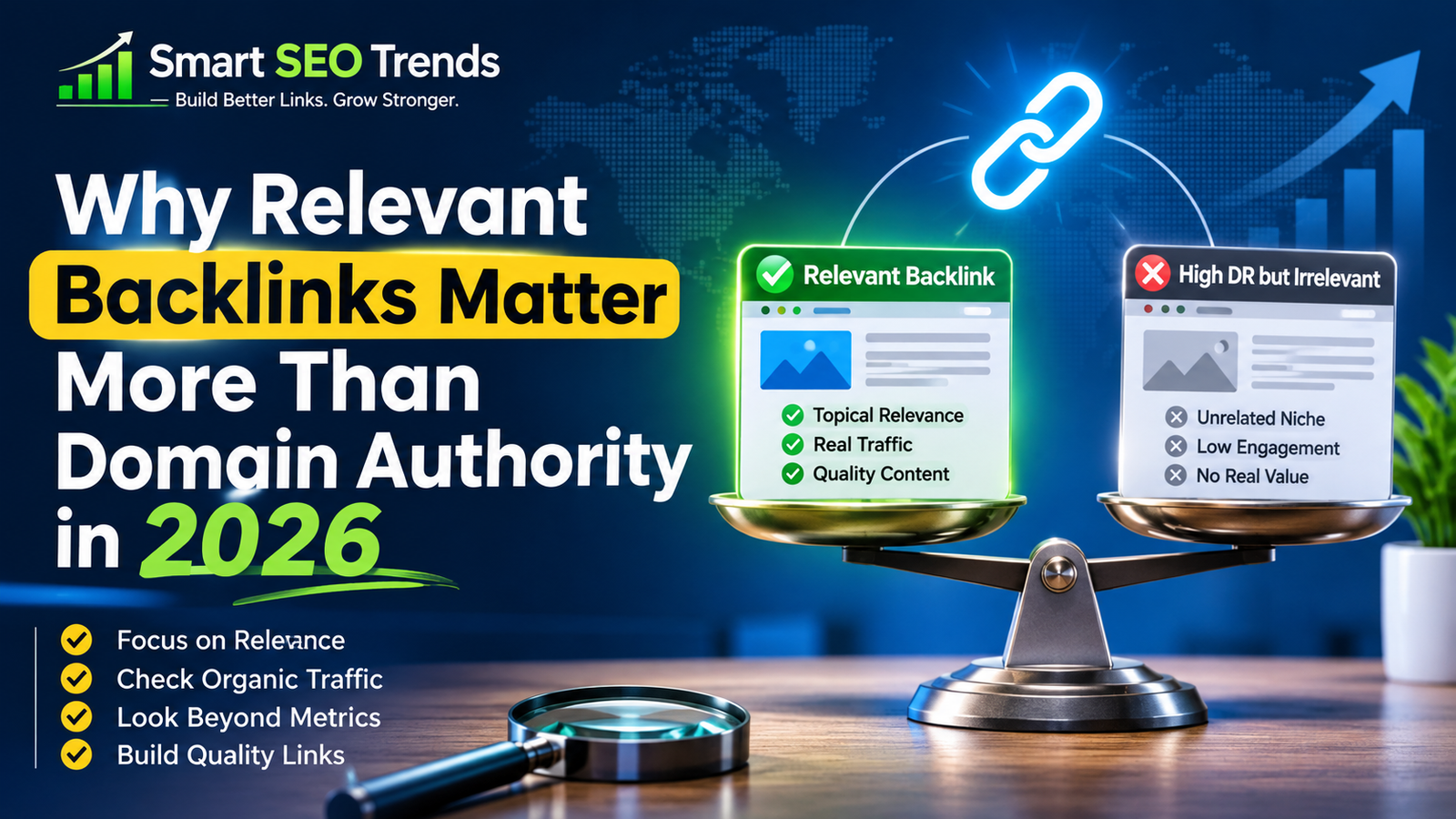
A website can have an impressive DR but limited organic visibility, irrelevant content, or an audience that has nothing to do with your industry.
On the other hand, a smaller website with genuine traffic, relevant content, and a focused audience may offer a much more suitable backlink opportunity.
This is why relevance deserves more attention in modern link-building strategies.
In 2026, businesses and SEO professionals should look beyond authority scores and evaluate how well a potential backlink fits their website, audience, and overall content strategy.
What Is Backlink Relevance?
Backlink relevance refers to how closely the linking website, its content, and the surrounding context relate to the website receiving the backlink.
For example, imagine you operate a SaaS company that provides project management software.
A backlink from a website that regularly publishes content about software, business technology, productivity, or project management would generally
make more contextual sense than a link from an unrelated entertainment website.
The same principle applies across different industries.
A financial website receiving links from finance publications, accounting blogs, and business resources has a more natural topical connection than one
receiving links from completely unrelated websites.
Relevance is not limited to the overall niche of a website. The individual article containing the backlink also matters.
A relevant link placed naturally within an informative article provides context that a random link in unrelated content cannot offer.
Why Domain Authority Alone Is Not Enough
Domain Authority and Domain Rating are third-party metrics developed by SEO platforms.
They help professionals compare websites and understand certain aspects of their backlink profiles.
These metrics can be useful during website evaluation, but they are not direct Google ranking factors.
One common mistake in link building is treating DR or DA as the primary indicator of website quality.
Consider two hypothetical websites:
Website A
- Domain Rating: 75
- Limited relevant organic traffic
- Covers multiple unrelated subjects
- Weak topical connection to your industry
Website B
- Domain Rating: 38
- Consistent organic traffic
- Publishes content within your niche
- Has an audience relevant to your business
If your business operates in the technology industry, Website B may be a more suitable opportunity despite having a lower authority score.
This does not mean high-authority websites are automatically poor choices.
It simply means authority metrics should be considered alongside other factors.
A good backlink evaluation process looks at the complete picture rather than relying on a single number.
5 Factors to Consider When Evaluating a Backlink Opportunity
Before investing in a guest post or link insertion, it is worth reviewing several important aspects of the potential publishing website.
1. Topical Relevance
Start by understanding what the website actually publishes.
Review its main categories, recently published articles, and overall subject matter.
Determine whether its content aligns with your industry or target audience.
For example, a cybersecurity company should prioritize opportunities on websites discussing technology, data protection, software, and digital security.
A relevant publishing environment makes the backlink more contextually appropriate.
2. Organic Traffic and Visibility
Organic traffic provides useful information about whether a website receives visitors through search engines.
However, looking at the estimated traffic number alone is not enough.
Review the website’s ranking keywords, traffic trends, and pages that attract visitors.
A website receiving consistent traffic from relevant search queries may be a stronger candidate than one showing a large but unrelated traffic estimate.
It is also worth checking whether its organic visibility has remained relatively stable or experienced significant declines.
SEO tools such as Ahrefs and Semrush can help with this research, although their traffic figures are estimates rather than exact analytics data.
3. Content Quality
Content quality is another important consideration.
Explore several recently published articles. Are they informative, properly structured, and written for actual readers?
Do they provide useful information, or do they appear to exist mainly to accommodate external links?
A website that consistently publishes useful editorial content is generally a more attractive publishing opportunity.
Look at the quality of its existing articles, internal linking, editorial consistency, and the way external references are included.
4. Backlink Profile
A website’s existing backlink profile can provide additional insight into its overall SEO quality.
Check the types of websites linking to it, the relevance of referring domains, and whether its backlink profile contains suspicious patterns.
A high DR does not automatically indicate a healthy backlink profile.
Similarly, a lower-authority website should not be rejected without investigation.
The quality and relevance of its referring domains can provide a better understanding of its overall profile.
5. Editorial Placement and Context
Where and how a backlink appears can make a difference to its usefulness.
A contextual backlink placed naturally within a relevant article is generally preferable to a link hidden in an unrelated page, footer, or poorly maintained directory.
For example, if an article discusses project management software, referencing a useful software resource within the relevant section creates a logical connection.
The link should provide additional value to readers rather than interrupting the content.
Guest Posts vs. Link Insertions: Which Is Better?
Both guest posts and link insertions can be useful approaches to earning relevant backlinks, but they serve slightly different purposes.
Guest posting involves publishing a new article on an external website.
It allows businesses to introduce a relevant topic, share useful information, and include appropriate references to their resources.
Link insertion involves adding a relevant link to an existing article that has already been published.
The advantage of an existing article is that it may already have search visibility, organic traffic, and an established audience.
However, not every existing article is a suitable placement opportunity.
The content must genuinely relate to the destination page, and the proposed reference should improve the reader’s experience.
The best approach depends on the website, content availability, editorial standards, and campaign objectives.
Rather than choosing one method for every campaign, SEO professionals should evaluate opportunities individually.
Common Backlink Evaluation Mistakes to Avoid
Even experienced SEO professionals can make mistakes when evaluating publishing websites.
One common mistake is prioritizing DR or DA without reviewing actual website content.
Another is ignoring traffic quality. A website may attract visitors, but those visitors might come from countries or search topics that have little relevance to the target business.
Some campaigns also focus on acquiring as many backlinks as possible within a limited budget.
This can result in placements on websites that offer little contextual value.
Other mistakes include:
- Ignoring sudden changes in organic visibility.
- Choosing websites based only on their advertised metrics.
- Overusing exact-match anchor text.
- Publishing content on unrelated websites.
- Ignoring the quality of existing articles.
- Treating every high-authority domain as a valuable opportunity.
Avoiding these mistakes can help businesses make more informed link-building decisions.
How to Build a More Effective Link-Building Strategy in 2026
A sustainable link-building strategy begins with research rather than outreach.
First, understand the target website and the audience you want to reach. Identify the topics, industries, and publications that naturally relate to your business.
Next, create a list of potential publishing websites and evaluate them using multiple indicators, including topical relevance, organic visibility, content quality, and backlink profile.
Once suitable websites have been identified, focus on building genuine editorial opportunities.
Guest posts should offer useful information to readers. Link insertions should add context to existing articles.
Anchor text should read naturally, and every placement should make sense within the surrounding content.
It is also important to monitor your backlink profile over time.
Review newly acquired links, check whether published pages remain accessible, and evaluate the overall quality of your link-building activities.
Remember that no individual backlink guarantees higher rankings.
Search performance depends on multiple factors, including content quality, technical SEO, competition, and search intent.
The objective should be to build a relevant and trustworthy backlink profile rather than chase numbers.
Final Thoughts
Domain Authority and Domain Rating can help SEO professionals evaluate potential publishing websites, but they should never be the only deciding factors.
A website’s relevance, organic visibility, editorial quality, and existing backlink profile all deserve attention when selecting link-building opportunities.
In 2026, businesses should focus on building connections with websites that make sense for their industry and audience.
Whether you choose guest posts, niche edits, or contextual link insertions, the underlying principle remains the same:
Prioritize relevance, quality, and genuine editorial value.
A smaller number of carefully evaluated backlink opportunities can be a more sensible investment than a large collection of unrelated placements.
The goal isn’t simply to get more backlinks. It’s to earn the right backlinks.