

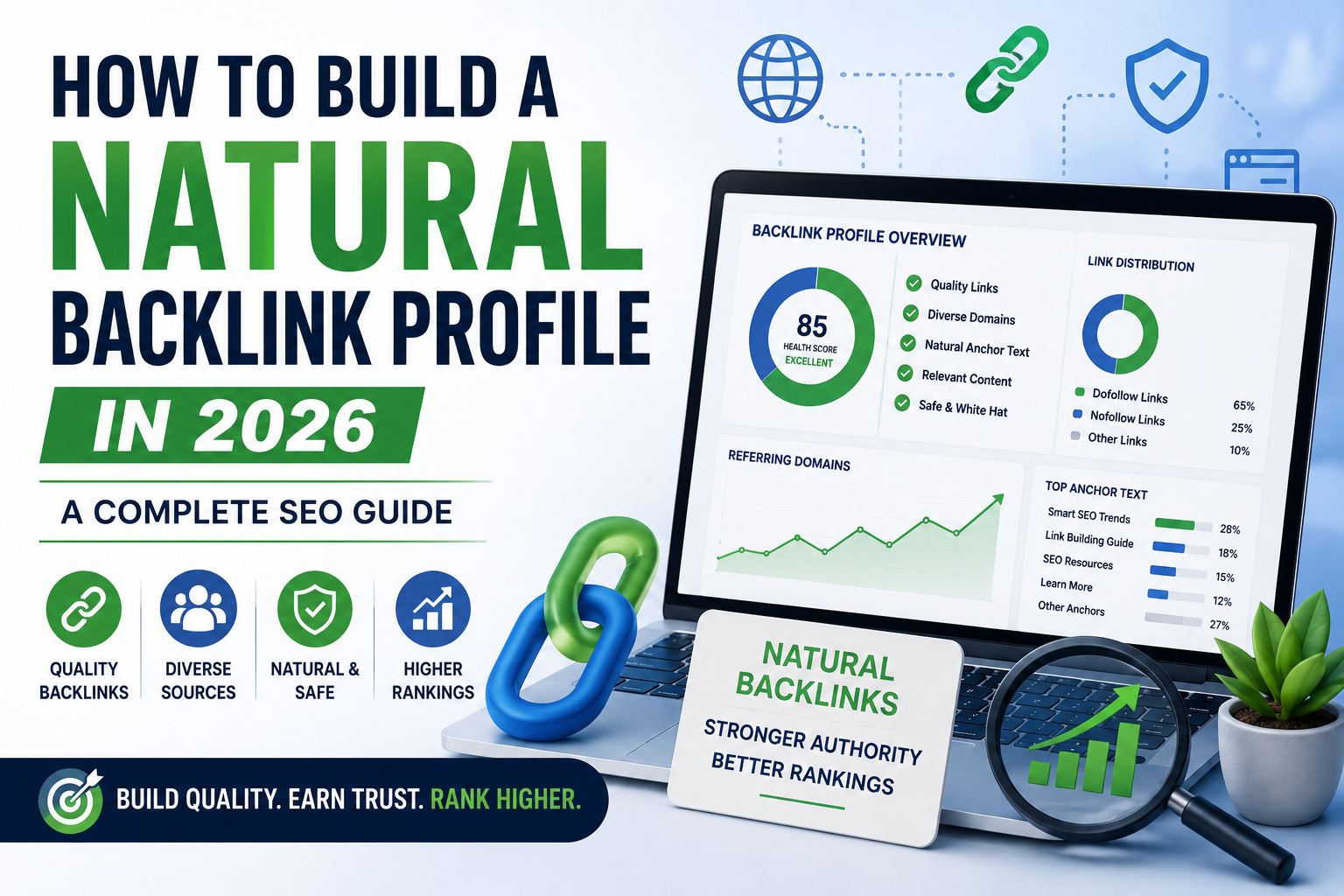

Building backlinks remains an important part of SEO, but not every backlink contributes equally to a website’s authority. Search engines evaluate links in
context, considering factors such as relevance, quality, diversity, and the overall pattern of a website’s backlink profile.
A natural backlink profile is one that develops through relevant, useful, and credible links rather than relying on manipulative or excessive link-building tactics.
In 2026, businesses should focus less on simply acquiring a large number of backlinks and more on building a diverse, relevant, and trustworthy backlink
profile that supports long-term organic growth.
What Is a Natural Backlink Profile?
A backlink profile is the complete collection of external links pointing to a website or webpage.
For example, if your website receives links from industry blogs, news websites, business publications, resource pages, and relevant websites, all of those
links contribute to your backlink profile.
A natural backlink profile generally contains links that come from different relevant domains, use varied anchor text, point to different pages, and appear in meaningful contexts.
The goal isn’t to make every backlink look identical. Instead, your link profile should develop naturally as different websites reference your content for different reasons.
Why Does a Natural Backlink Profile Matter for SEO?
Backlinks can help search engines discover content and understand relationships between websites and topics.
Links from relevant and credible websites can also contribute to a site’s authority and visibility.
However, simply increasing your backlink count isn’t a reliable SEO strategy.
Consider two websites:
Website A has 5,000 backlinks from hundreds of unrelated or low-quality sources.
Website B has 500 backlinks from relevant industry websites, publications, resource pages, and authoritative domains.
Website B may have a much healthier backlink profile despite having fewer links.
This is why modern link building should prioritize quality, relevance, context, and diversity.
7 Elements of a Healthy Backlink Profile
1. Relevant Referring Domains
Relevance is one of the most important considerations when evaluating backlinks.
A link from a website that operates in the same industry or covers a closely related subject is generally more meaningful than a random link from an unrelated website.
For example, an SEO website receiving a contextual link from a digital marketing publication makes more sense than receiving hundreds of links from
unrelated websites.
When building backlinks, ask:
- Is the website relevant to my industry?
- Does the linking page discuss a related topic?
- Would the link be useful to readers?
- Does the website appear to have a legitimate audience?
2. Quality and Authority
A healthy backlink profile should contain links from credible websites.
However, don’t focus exclusively on third-party metrics such as Domain Rating (DR) or Domain Authority (DA).
These metrics can be useful for prospecting, but they shouldn’t be the only criteria used to evaluate a backlink.
Look at the overall website:
- Content quality
- Topical relevance
- Organic visibility
- Editorial standards
- Audience
- Existing outbound links
- Website reputation
A relevant website with genuine content and an engaged audience can be more valuable than a high-metric website that exists primarily for selling links.
3. Anchor Text Diversity
Anchor text is the clickable text used in a hyperlink.
For example:
Learn more about link building strategies.
Here, “link building strategies” is the anchor text.
A natural backlink profile doesn’t normally rely on one exact-match keyword repeatedly.
Instead, anchor text can include:
- Branded anchors
- Naked URLs
- Generic anchors
- Partial-match anchors
- Topical phrases
- Natural descriptive phrases
For example, instead of repeatedly using:
best backlink services
you might naturally see anchors such as:
Smart SEO Trends
this guide
backlink strategies
learn more
backlink resources
SEO link building
The objective isn’t to follow a fixed percentage formula.
Context and natural language matter more than forcing an artificial anchor-text ratio.
4. Dofollow and Nofollow Links
A backlink profile can contain different link attributes, including dofollow and nofollow links.
Dofollow links can pass ranking signals, while nofollow links are generally treated differently by search engines and may not pass ranking credit in the
same way.
However, a natural backlink profile doesn’t need to consist exclusively of dofollow links.
A website can naturally receive links from:
- News websites
- Social platforms
- Forums
- Blogs
- Business directories
- Publications
- Resource pages
Different websites may use different link attributes.
Therefore, don’t build a strategy around obtaining only one type of backlink. Focus on earning relevant and useful mentions across the web.
5. Link Placement and Context
Where a backlink appears can matter.
A contextual link within a useful article is usually more meaningful than a link placed randomly in a footer, sidebar, or unrelated section.
For example:
Businesses looking to improve their organic visibility can use a structured SEO content strategy to organize topics and target relevant search queries.
The link is surrounded by relevant information and provides additional context to the reader.
Contextual relevance should always be considered when evaluating a backlink opportunity.
6. Domain Diversity
Having hundreds of links from the same website doesn’t necessarily provide the same value as earning links from many relevant referring domains.
For example:
Website A
500 backlinks → 8 referring domains
Website B
300 backlinks → 120 referring domains
The second profile may provide much stronger domain diversity.
This doesn’t mean you should chase a specific number of referring domains.
Instead, continuously work toward earning genuine mentions from different relevant sources.
7. Natural Link Velocity
Link velocity refers to the rate at which a website acquires backlinks.
A sudden increase in backlinks isn’t automatically harmful.
A website can naturally receive hundreds or even thousands of links after publishing something newsworthy.
However, artificially creating large numbers of links in a short period can create an unnatural pattern.
Rather than worrying about a specific number of links per month, focus on building a sustainable system for:
- Publishing useful content
- Promoting valuable resources
- Building relationships
- Conducting legitimate outreach
- Earning editorial mentions
How to Build a Natural Backlink Profile in 2026
1. Create Content Worth Linking To
The foundation of sustainable link building is valuable content.
People are more likely to link to resources that provide something useful, such as:
- Original research
- Statistics
- Comprehensive guides
- Case studies
- Free tools
- Templates
- Checklists
- Industry insights
- Practical tutorials
For example, an SEO website could create a Backlink ROI Calculator, a detailed link-building study, or a comprehensive guide to anchor text.
These assets provide a reason for other websites to reference them.
2. Earn Relevant Backlinks
Instead of asking every website for a backlink, identify websites where your content genuinely adds value.
You can find opportunities through:
- Competitor backlink analysis
- Industry publications
- Resource pages
- Relevant blogs
- Digital PR
- Expert contributions
- Content outreach
The key is relevance.
A backlink should make sense for both the linking website and its audience.
3. Use Guest Posting Strategically
Guest posting can be useful when the primary goal is contributing valuable content to a relevant publication.
Don’t approach guest posting as a system for producing hundreds of keyword-rich links.
Instead:
- Find relevant publications.
- Study their existing content.
- Pitch useful topics.
- Create original content.
- Add links only where they genuinely help readers.
This creates a more sustainable approach to editorial link building.
4. Build Contextual Links
Contextual backlinks appear naturally within relevant content.
For example, an article discussing technical SEO might reference a useful guide explaining canonicalization.
This is more useful than inserting an unrelated link simply because a backlink opportunity exists.
Always ask:
“Would the reader benefit from clicking this link?”
If the answer is yes, the link is much easier to justify.
5. Diversify Your Anchor Text
Don’t use the same commercial keyword as the anchor text for every backlink.
Instead, let anchor text vary naturally according to the context of each linking page.
For example, a website about SEO might receive links using:
- Smart SEO Trends
- SEO resources
- this SEO guide
- learn more
- backlink strategies
- link building guide
- the complete guide
This creates a more natural-looking profile while keeping the links contextually relevant.
6. Diversify Your Link Sources
Try to build relationships with different types of websites rather than depending on one source.
Your backlink profile can include relevant links from:
- Industry blogs
- SaaS websites
- Marketing publications
- Business websites
- News publications
- Educational resources
- Partner websites
- Industry communities
The exact mix will depend on your niche and content strategy.
7. Monitor Your Backlink Profile Regularly
Building backlinks isn’t the end of the process.
You should periodically review your backlink profile to identify:
- New referring domains
- Lost backlinks
- Broken backlinks
- Unexpected links
- Irrelevant links
- Changes in anchor text
- Important referring pages
Tools such as Google Search Console, Ahrefs, Semrush, and other SEO platforms can help you monitor backlink activity.
The goal isn’t to panic over every low-quality link. Instead, look for patterns and significant changes.
How Many Backlinks Do You Need to Rank on Google?
There is no universal number of backlinks required to rank a webpage.
The answer depends on:
- Keyword competition
- Search intent
- Content quality
- Topical authority
- Website reputation
- Internal linking
- Backlink quality
- Competitor strength
For a low-competition keyword, a page might rank with very few external links.
For a highly competitive commercial keyword, ranking may require considerably more authority.
Therefore, don’t set a target such as “I need 1,000 backlinks.”
A better question is:
What level of authority and relevance do the pages currently ranking for my target keyword have?
Then build a strategy that improves your content and authority accordingly.
Dofollow vs. Nofollow: How They Fit Into a Natural Profile
A common mistake is assuming that every backlink must be dofollow.
A natural backlink profile can contain different link attributes because websites have different editorial policies.
For example, a publication may use a nofollow or other qualifying attribute for certain external links, while an editorial resource may use a standard link.
Instead of obsessing over link attributes, focus first on:
Relevance + quality + context + usefulness.
This approach produces a stronger long-term link-building strategy.
What Is Backlink Profile Diversity?
Backlink profile diversity means having a healthy variety of backlink sources, pages, anchors, contexts, and referring domains.
A diverse profile may include:
- Multiple referring domains
- Different relevant industries or subtopics
- Different anchor-text variations
- Links to multiple important pages
- Editorial mentions
- Resource links
- Content-based links
- Different link attributes
Diversity doesn’t mean deliberately creating random links.
It means allowing your backlink profile to develop through different legitimate sources and content types.
Common Backlink Profile Mistakes
Avoid these common mistakes when building backlinks:
Buying Links Without Evaluating Quality
Price alone doesn’t determine backlink value. Always evaluate the website, relevance, content quality, and placement.
Using Exact-Match Anchors Repeatedly
Repeatedly using the same commercial keyword can create an unnatural pattern.
Focusing Only on DR or DA
Third-party metrics are useful for prospecting, but they don’t tell the complete story.
Building Links From Unrelated Websites
A backlink should make contextual sense.
Ignoring Internal Linking
External backlinks aren’t the only way to strengthen your website. A strong internal linking structure can help distribute relevance and authority across your own pages.
Chasing Quantity Over Quality
One useful, relevant backlink can be more valuable than dozens of irrelevant links.
Backlink Profile Best Practices for 2026
A sustainable backlink strategy should follow these principles:
- Prioritize relevance over raw backlink volume.
- Build relationships with legitimate websites.
- Create content people naturally want to reference.
- Diversify referring domains.
- Use natural anchor text.
- Don’t focus exclusively on dofollow links.
- Evaluate websites beyond DR and DA.
- Use contextual links where appropriate.
- Monitor your backlink profile regularly.
- Avoid manipulative link-building patterns.
- Strengthen internal linking alongside external link building.
- Focus on long-term authority rather than short-term link volume.
Final Thoughts
Building a natural backlink profile in 2026 isn’t about collecting as many links as possible.
It’s about developing a relevant, diverse, credible, and sustainable link ecosystem around your website.
Focus on creating genuinely useful content, earning links from relevant websites, diversifying your anchor text and referring domains, and maintaining a
healthy balance between different types of links.
Most importantly, don’t treat backlinks as isolated SEO metrics.
A strong backlink profile should support a broader strategy that includes high-quality content, technical SEO, internal linking, topical authority, and a
positive user experience.
When these elements work together, backlinks become more than just numbers in an SEO tool; they become part of a sustainable strategy for building
authority and improving organic search visibility.