

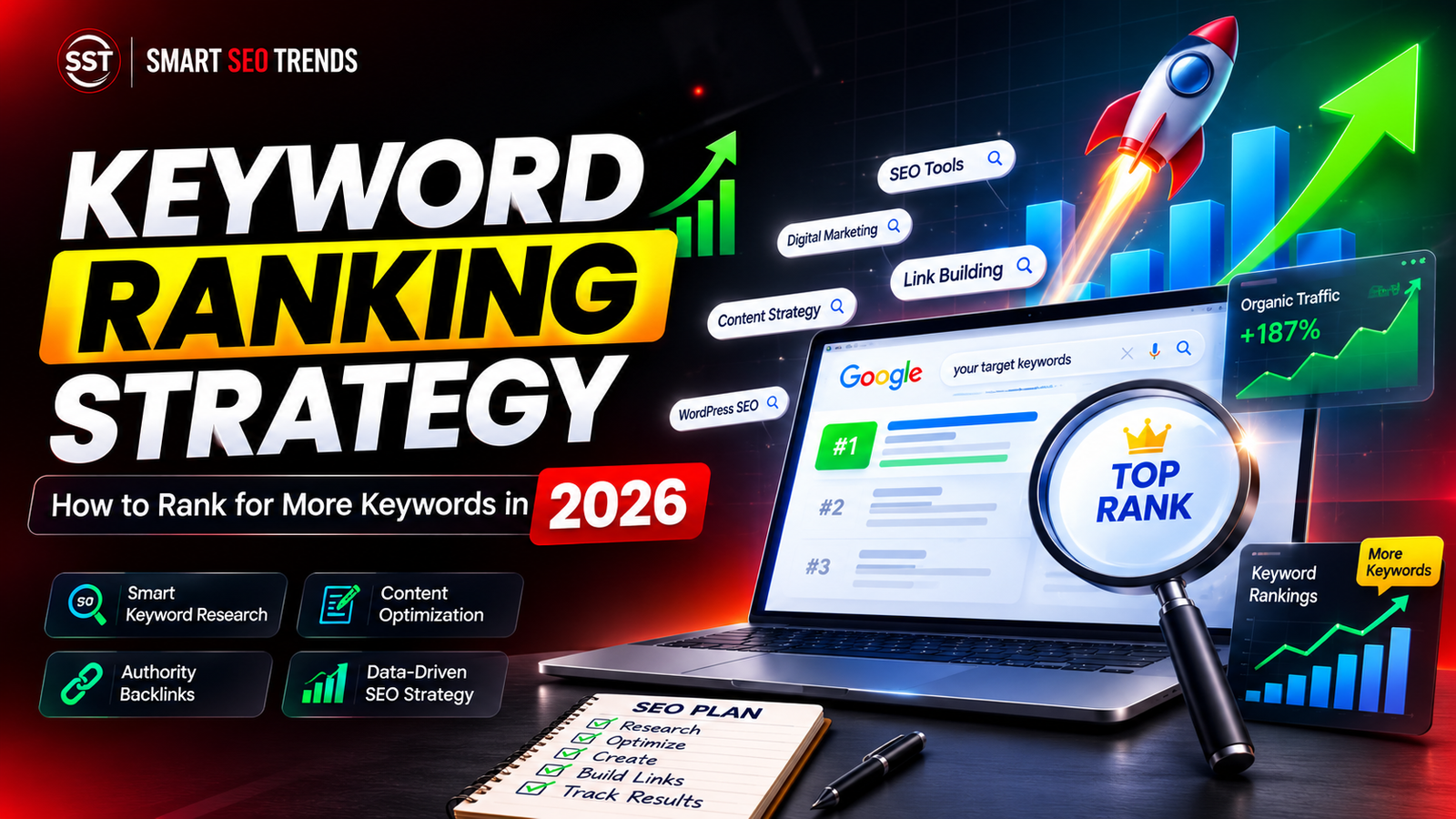

Ranking for more keywords is no longer about repeating the same phrase throughout an article.
In 2026, successful SEO requires a broader strategy that combines search intent, topical relevance, high-quality content, internal linking, technical optimization, and authoritative backlinks.
For Smart SEO Trends, this topic is particularly relevant because Google Search Console is already showing impressions for keyword-ranking queries.
For example, “keyword ranking strategy” has generated 102 impressions at an average position of 80.3, while “improve keyword ranking” has generated 26 impressions at position 82.8.
That means Google is already testing the website for this topic. The next goal is to improve relevance and rankings so those impressions can turn into clicks.
What Is a Keyword Ranking Strategy?
A keyword ranking strategy is a planned approach to improving a website’s visibility for relevant search queries.
Instead of targeting one keyword on one page, a modern strategy considers:
- Primary and secondary keywords
- Search intent
- Related topics and entities
- Content depth
- Internal links
- Backlinks
- Technical SEO
- User experience
- Existing keyword opportunities
The objective isn’t simply to rank for a larger number of keywords.
The goal is to rank for relevant keywords that can bring qualified organic traffic.
1. Start With Keywords You Already Rank For
One of the easiest ways to improve keyword rankings is to look at your existing Search Console data.
If a page is already receiving impressions for a keyword, Google has already recognized some relevance between that page and the search query.
For example, instead of immediately creating another article for a keyword, check whether an existing page is already appearing for it.
Look for:
- Keywords generating impressions but few clicks
- Keywords ranking between positions 11 and 30
- Keywords closely related to your existing content
- Queries where impressions are increasing
- Long-tail variations of your primary keyword
These are often better opportunities than starting completely from scratch.
2. Target Search Intent, Not Just Keywords
Search intent determines what the user actually wants when entering a query into Google.
A keyword can have several types of intent:
Informational Intent
The user wants to learn something.
Examples:
- what is keyword ranking
- how does SEO work
- what is anchor text
Commercial Intent
The user is researching options before making a decision.
Examples:
- best SEO tools
- best link building services
- SEO agency comparison
Transactional Intent
The user is ready to take action.
Examples:
- buy SEO services
- hire SEO agency
- guest posting services
If your content doesn’t satisfy the intent behind the query, simply adding more keywords won’t guarantee better rankings.
3. Build Topic Clusters
A single article rarely needs to rank for every keyword related to a subject.
Instead, create a group of closely connected pages.
For example, a website focused on link building could have:
Pillar topic:
Link Building
Supporting topics:
- Keyword Ranking Strategy
- Anchor Text
- Dofollow vs Nofollow Backlinks
- Guest Posting
- Link Insertion
- High-Authority Backlinks
- Link Building Trends
These pages can then link to one another naturally.
This helps users discover related information while creating stronger topical connections between your pages.
4. Optimize Existing Content
Before publishing a new article, check whether an existing page can be improved.
Content optimization can include:
- Updating outdated information
- Improving the introduction
- Adding missing subtopics
- Expanding thin sections
- Answering related questions
- Improving headings
- Adding relevant internal links
- Updating examples
- Improving title and meta description
Don’t rewrite an article simply for the sake of making it longer. Every addition should make the page more useful.
5. Use Secondary Keywords Naturally
Your primary keyword shouldn’t be repeated excessively.
Instead, identify related phrases that naturally belong to the topic.
For a page targeting keyword ranking strategy, relevant variations could include:
- keyword ranking strategies
- improve keyword rankings
- improve keyword ranking
- how to rank for more keywords
- SEO keyword strategy
- keyword ranking tips
- keyword optimization strategy
- improve search rankings
- SEO ranking strategy
Your Search Console data already contains several related variations, including “keyword ranking strategy,” “improve keyword ranking,” and “how to rank for more keywords.”
Use these phrases where they genuinely improve the content rather than forcing them into every paragraph.
6. Improve Internal Linking
Internal links are one of the simplest ways to strengthen your website structure.
When publishing a new article, look for older pages that are contextually related.
For example, a keyword-ranking article could naturally link to pages about:
- Keyword research
- On-page SEO
- Anchor text
- Link building
- SEO tools
- Backlinks
At the same time, those older pages can link back to the new article using descriptive, natural anchor text.
This creates a connected content ecosystem rather than a collection of isolated articles.
7. Build Relevant Backlinks
Content quality is important, but backlinks can still play a major role in competitive search results.
Focus on acquiring backlinks from websites that are:
- Relevant to your topic
- Legitimate and established
- Editorially controlled
- Useful to their audience
- Contextually related to your content
For a keyword-ranking article, relevant backlinks could come from SEO, digital marketing, SaaS, content marketing, or business publications.
Avoid building links simply because a website has a high authority metric.
Relevance and quality matter.
8. Optimize for Long-Tail Keywords
Long-tail keywords are often easier to target than broad, highly competitive terms.
For example:
Broad:
SEO
More specific:
keyword ranking strategy
Long-tail:
how to improve keyword rankings for a new website
Long-tail searches can also reveal clearer user intent.
A strong strategy is to build your main article around the broader topic while answering multiple specific questions within the same page.
9. Improve Your SERP CTR
Ranking isn’t the final goal.
You also need people to click your result.
If your page receives many impressions but very few clicks, test your:
- SEO title
- Meta description
- Search intent alignment
- Content angle
- Value proposition
For example, instead of a generic title:
Keyword Ranking Strategy
you could use:
Keyword Ranking Strategy: How to Rank for More Keywords in 2026
The second title communicates exactly what the reader will learn and includes the current year.
However, CTR optimization works best when the page has already achieved reasonable visibility.
If a page is ranking around position 80, improving the title alone won’t solve the underlying ranking problem.
10. Track Rankings and Improve Continuously
SEO isn’t a one-time process.
After publishing or updating a page, monitor:
- Impressions
- Clicks
- CTR
- Average position
- New keyword variations
- Pages gaining visibility
- Pages losing visibility
If a page starts ranking for new related queries, those queries can reveal opportunities for additional optimization.
For example, your current Search Console data already shows multiple keyword-ranking variations. That is a useful signal that Google is associating your website with this broader topic.
Common Keyword Ranking Mistakes
Keyword Stuffing
Repeating the same keyword unnecessarily can make content difficult to read and doesn’t create a better user experience.
Creating Too Many Similar Pages
Publishing multiple articles targeting nearly identical keywords can create unnecessary overlap.
Ignoring Search Intent
A perfectly optimized article can still struggle if it doesn’t answer what the searcher actually wants.
Focusing Only on High-Volume Keywords
High-volume keywords aren’t always the most valuable. Relevant, lower-volume searches can generate highly targeted visitors.
.
Ignoring Existing Opportunities
Sometimes the fastest SEO improvement comes from updating a page that already has impressions rather than publishing another new article.
Final Thoughts
A successful keyword ranking strategy in 2026 is about building relevance rather than simply inserting keywords into content.
Start with the queries your website already receives impressions for.
Identify pages with ranking potential, improve their content, strengthen internal linking, target related long-tail searches, and build relevant backlinks.
Most importantly, use Search Console as a feedback system.
Your existing data already shows that “keyword ranking strategy” and related queries are generating visibility for Smart SEO Trends.
The opportunity now is to turn that existing visibility into higher rankings, better CTR, and more organic traffic.
One response to “Keyword Ranking Strategy: How to Rank for More Keywords in 2026”
[…] result is an immediate loss of keyword rankings on pages 1 and […]