

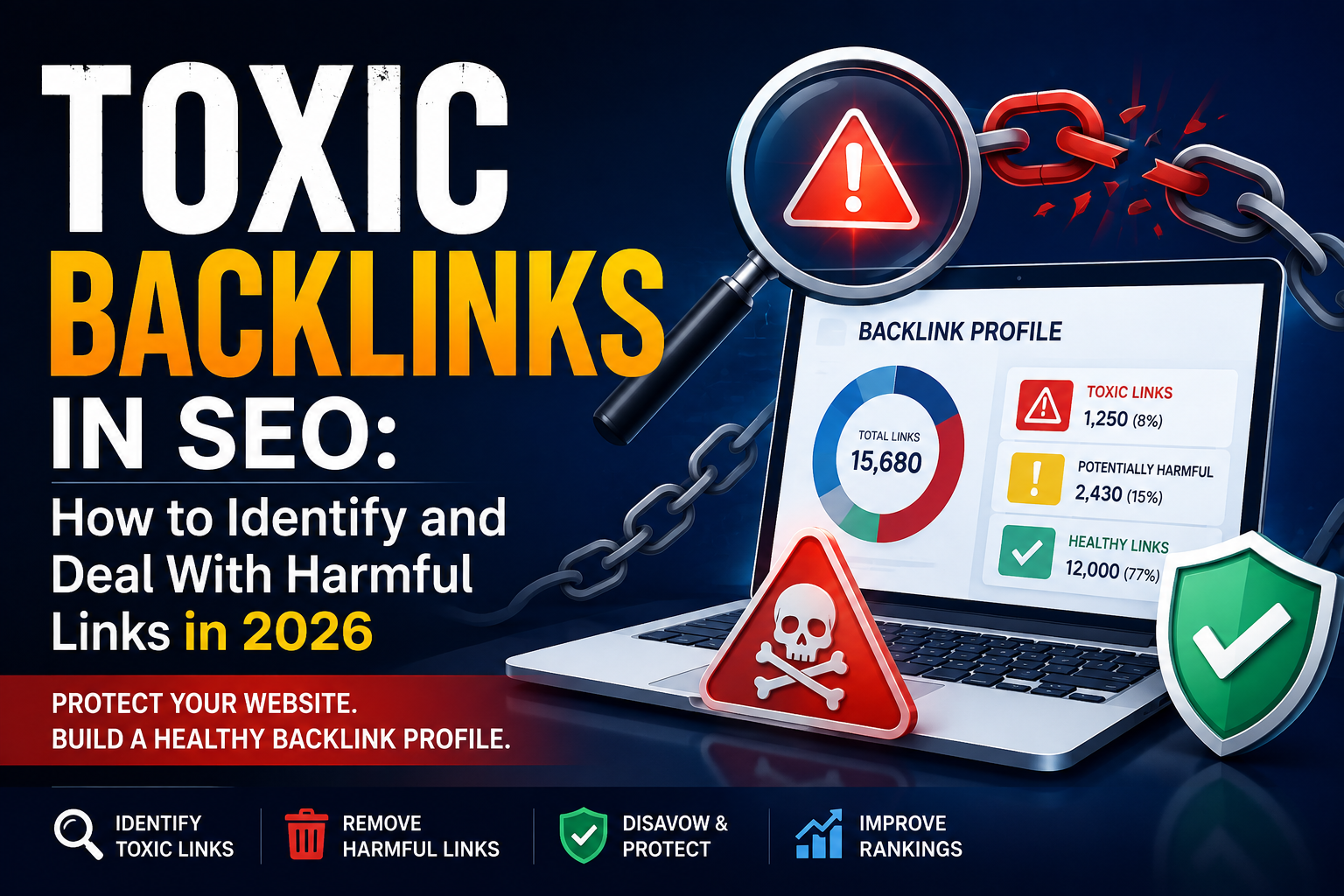

Toxic Backlinks in SEO: How to Identify and Deal With Harmful Links
Backlinks remain an important part of SEO, but not every backlink is beneficial.
Some links can be irrelevant, manipulative, or potentially harmful to a website’s backlink profile.
These are commonly referred to as toxic backlinks.
Building backlinks without monitoring their quality can create an unbalanced link profile.
That’s why SEO professionals should regularly review where their links are coming from, what anchor text they use, and whether those links are relevant
to the website.
In this guide, we’ll explain what toxic backlinks are,
how to identify them, whether they actually hurt SEO, and what you can do when you discover suspicious links in your backlink profile.
What Are Toxic Backlinks?
Toxic backlinks are links from websites or pages that may be considered low-quality, irrelevant, manipulative,
or otherwise suspicious from an SEO perspective.
Examples can include links coming from:
- Spammy websites
- Irrelevant websites
- Automatically generated pages
- Link networks created primarily for SEO manipulation
- Pages containing large numbers of unrelated outbound links
- Websites with suspicious or unnatural link patterns
- Low-quality directories
- Hacked or compromised pages
However, it’s important to understand that a low-quality-looking backlink is not automatically harmful.
A website can naturally receive links from poor-quality or irrelevant sources without doing anything wrong.
Therefore, you shouldn’t immediately remove or disavow every backlink that looks unusual.
The context and overall link pattern matter.
Why Do Toxic Backlinks Matter?
Search engines evaluate links as part of understanding relationships between websites and pages.
Links can help search engines discover content and understand authority and relevance.
Problems can arise when a website has a backlink profile dominated by unnatural or manipulative links.
For example, a website that suddenly receives hundreds of links using the same commercial anchor text from unrelated websites may look very different
from a website that gradually earns relevant editorial links.
This is why maintaining a healthy backlink profile is important.
A healthy profile usually contains links from a variety of relevant sources rather than relying heavily on one type of website, one anchor text pattern,
or one link-building method.
What Makes a Backlink Look Toxic?
There isn’t a single metric that determines whether a backlink is toxic.
Instead, look at several factors.
1. Irrelevant Website
Relevance is an important consideration.
For example, if a website about financial services receives hundreds of links from completely unrelated websites with no contextual connection, those links deserve closer examination.
One unrelated link isn’t necessarily a problem. A large pattern of unrelated links may be more concerning.
2. Spammy Pages
Some websites exist primarily to publish large quantities of low-quality content and outbound links.
If a page contains dozens or hundreds of unrelated commercial links, its SEO value may be questionable.
3. Manipulative Anchor Text
Anchor text can provide useful context about a backlink.
For example, a natural backlink profile might contain a mixture of:
- Brand names
- Website URLs
- Natural phrases
- Topical phrases
- Generic anchors
If a website has an unusually high concentration of exact-match commercial anchors, it may warrant investigation.
This is also why understanding anchor text is important when analyzing a backlink profile.
4. Automatically Generated Links
Some links are generated automatically through software, low-quality platforms, or spam systems.
These links generally don’t provide meaningful editorial value.
5. Link Networks
Networks created primarily to manipulate search rankings can create unnatural link patterns.
SEO professionals should focus on earning links because the linked content is genuinely useful rather than participating in schemes designed solely to
influence rankings.
Are All Low-Quality Backlinks Dangerous?
No.
This is one of the most important points to understand.
You may find thousands of strange backlinks pointing toward your website.
That doesn’t automatically mean your website has been penalized.
Search engines have systems designed to evaluate and discount many forms of spam.
For example, competitors, automated bots, scrapers, and random websites can create links to your website without your involvement.
You cannot control every website that links to you.
Therefore, don’t panic every time you discover an unfamiliar domain in your backlink report.
Instead, look for patterns of clearly manipulative or problematic links, particularly when they are connected to your own SEO activities.
Toxic Backlinks vs Nofollow Links
Toxic backlinks and nofollow links are not the same thing.
A nofollow link is a link that includes a nofollow relationship attribute.
It tells search engines that the publisher doesn’t want the link to be treated as a normal editorial endorsement in the same way as a standard followed link.
A nofollow link isn’t automatically toxic.
In fact, natural backlink profiles can contain a mixture of followed and nofollow links.
You can learn more about this distinction in your existing guide on dofollow vs nofollow links.
The important point is:
Nofollow does not mean toxic.
A nofollow link from a reputable and relevant website can still generate referral traffic, visibility, and brand exposure.
How to Identify Toxic Backlinks
A backlink audit is the best way to identify potentially problematic links.
Start by collecting your website’s backlink data from reliable SEO tools.
Then examine each suspicious domain or backlink using several factors.
Check the Referring Domain
Ask:
- Is the website real?
- Does it have useful content?
- Is it relevant to my industry?
- Does it appear to exist primarily for publishing links?
- Does the website contain excessive advertisements or outbound links?
Check the Linking Page
The domain itself isn’t always enough.
A good website can contain a poor-quality page, and a relatively small website can contain a legitimate editorial link.
Look at the actual page containing your backlink.
Check Anchor Text
Look for unusual patterns.
If most of your backlinks use branded or natural anchor text but a large group suddenly uses the same money keyword, investigate further.
Check Link Context
Ask whether your link makes sense within the surrounding content.
A contextual mention that genuinely helps readers is generally more meaningful than a random link inserted into unrelated content.
How to Deal With Toxic Backlinks
Once you’ve identified suspicious links, don’t immediately start deleting everything.
Follow a structured process.
Step 1: Identify the Most Problematic Links
Separate backlinks into categories:
Natural and relevant:
Keep them.
Low-quality but harmless:
Usually monitor them rather than taking drastic action.
Clearly manipulative or problematic:
Investigate them more carefully.
This prevents you from wasting time trying to clean every low-authority backlink.
Step 2: Contact the Website Owner
If you control the link or have a relationship with the publisher, you may be able to request removal.
For example, if a link was created through an outdated partnership, you can ask the website owner to remove or change it.
Step 3: Monitor Your Backlink Profile
Backlink monitoring should be an ongoing SEO activity rather than a one-time project.
Check for:
- New referring domains
- Sudden backlink spikes
- Unusual anchor text
- Links from irrelevant websites
- Lost high-quality backlinks
- Changes in important referring domains
Regular monitoring makes unusual patterns easier to identify.
Should You Use Google’s Disavow Tool?
The disavow tool is often misunderstood.
You shouldn’t use it simply because a backlink has a low Domain Rating, low traffic, or looks unfamiliar.
Google’s own systems can generally ignore many types of spammy links.
Disavow is intended for situations where you have a significant number of artificial or unnatural links and believe they may be affecting your site’s
performance, particularly in circumstances involving link schemes or a manual action.
Before using it, make sure you understand exactly why you’re submitting those domains or URLs.
An unnecessary disavow file can create more problems than it solves.
How to Build a Healthier Backlink Profile
Instead of spending all your time removing questionable links, focus on building a stronger overall backlink profile.
Earn Relevant Editorial Links
The best backlinks are usually those that make sense within useful content.
A relevant website mentioning your article because it provides additional value to readers is much more meaningful than a random link placed solely for SEO.
Focus on Relevance
A relevant link from a smaller website can be more useful than an irrelevant link from a website with impressive SEO metrics.
Consider:
Relevance + Context + Quality + Editorial Value
rather than looking at Domain Rating alone.
Diversify Your Link Sources
Avoid relying on a single link-building method.
A natural backlink profile may include links from:
- Industry publications
- Blogs
- News websites
- Resource pages
- Business websites
- Communities
- Partners
- Digital PR campaigns
- Editorial mentions
Maintain Natural Anchor Text
Don’t force exact-match keywords into every backlink.
Use a natural mixture of branded, URL, generic, and contextually relevant anchor text.
Your anchor text should make sense to readers first.
Toxic Backlinks and White Hat Link Building
A strong White Label SEO or traditional SEO campaign should prioritize sustainable link acquisition rather than manipulating backlink metrics.
White-hat link building focuses on creating content and relationships that can naturally generate valuable mentions.
For agencies managing multiple clients, this becomes even more important.
A White Label SEO provider should have a clear process for evaluating publisher relevance, content quality, link placement, anchor text, and overall
website quality before recommending a backlink opportunity.
The goal should be to build a backlink profile that looks natural and provides genuine value, not simply to increase the number of referring domains.
How Often Should You Audit Backlinks?
There is no universal schedule that works for every website.
A small website with limited link-building activity may only need periodic reviews.
A large website or agency managing active campaigns may benefit from more frequent monitoring.
Consider reviewing your backlink profile:
- After a major link-building campaign
- After a significant traffic or ranking change
- When you notice unusual backlink growth
- When receiving a manual action
- During regular SEO audits
The more active your link acquisition is, the more important consistent monitoring becomes.
Common Toxic Backlink Mistakes
Removing every low-DR backlink
Low Domain Rating doesn’t automatically mean a link is harmful.
Disavowing everything suspicious
Not every unusual backlink requires disavowal.
Looking only at domain metrics
DR, DA, and traffic are useful third-party metrics, but they don’t tell the complete story.
Ignoring relevance
A link’s topical relationship with your website matters.
Over-optimizing anchor text
Aggressive exact-match anchor text can create an unnatural pattern.
Buying links purely for rankings
Links obtained primarily to manipulate rankings can create unnecessary SEO risk.
Toxic Backlinks Checklist
Before taking action against a backlink, ask:
- Is the referring website legitimate?
- Is the website relevant to my niche?
- Is the linking page useful?
- Is the link editorial or obviously manipulative?
- Is the anchor text natural?
- Is there a pattern involving many similar links?
- Was the link created intentionally?
- Is there any reason to believe the links are causing an actual SEO problem?
If the answer to most of these questions is no, investigate further before taking action.
Final Thoughts
Toxic backlinks shouldn’t be treated as a simple list of links that must be deleted.
A healthy SEO strategy requires looking at the overall backlink profile, including relevance, context, anchor text, link patterns, and the
quality of referring websites.
Don’t panic when you discover a few strange backlinks. Instead, regularly monitor your backlink profile and focus your efforts on earning relevant, useful,
and editorially justified links.
A strong backlink strategy isn’t about having the largest number of links.
It’s about building a profile that supports your website’s authority, relevance, and long-term SEO growth.
And remember: quality, relevance, and natural link acquisition matter more than simply collecting backlinks.