

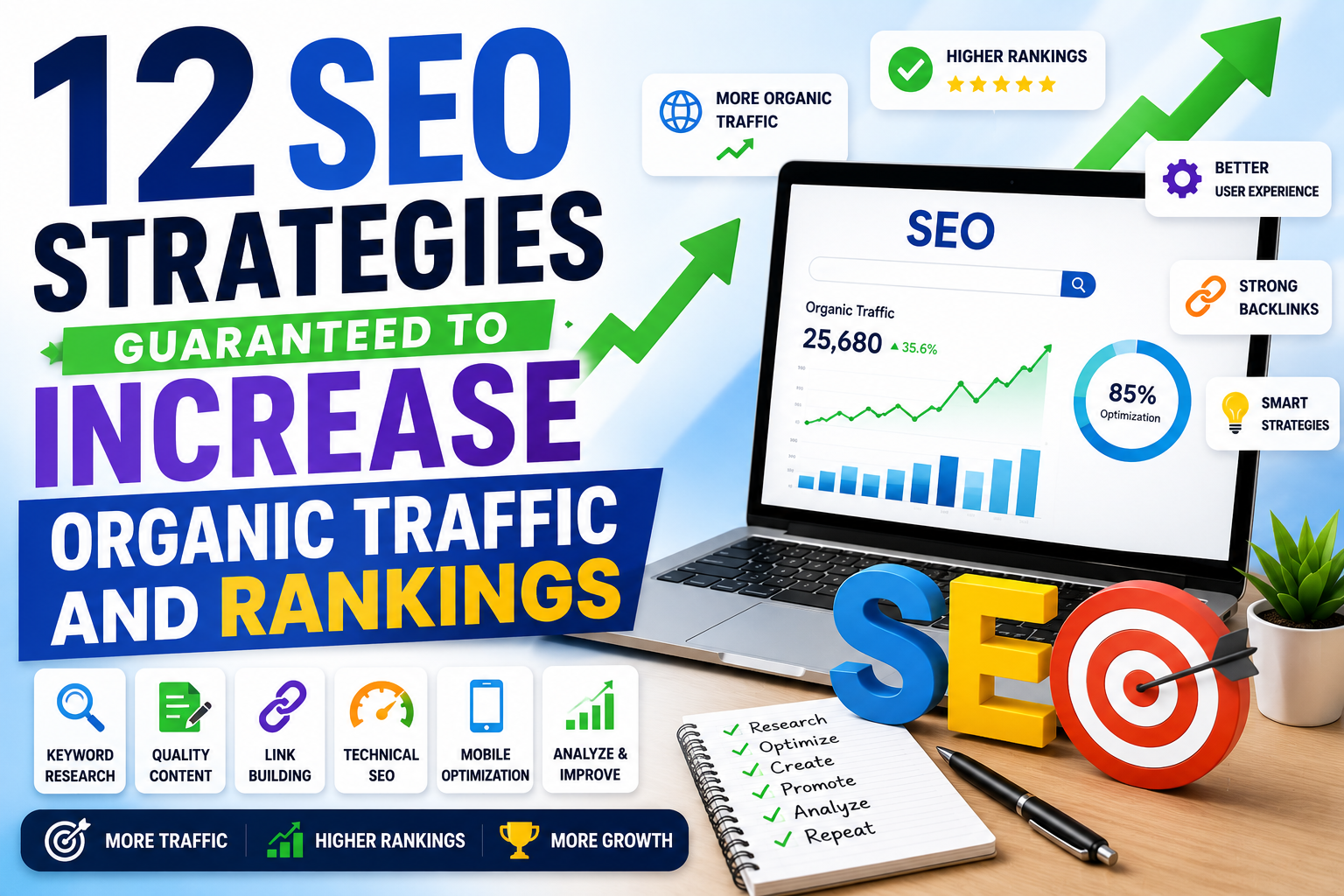

Driving organic traffic to websites and improving search engine rankings is the key focus of any website owner.
Whether you are an SEO greenhorn or a marketing veteran, these 12 practical SEO tips will assist you in developing a roadmap that attracts quality traffic,
improves visiting patterns to your website, and keeps you in line with all the new search engine trends.
Let us examine these strategies that will propel your SEO efforts.
1. Find Keywords People Search For
One of the first steps before implementing SEO growth techniques is keyword research.
You need to learn the words and phrases your target audience searches for in large volumes.
SEO tools such as Ahrefs, SEMrush, and Google Keyword Planner can also be used to select keywords that would suit the needs of users and that aren’t too competitive.
Do not forget long tail keywords – more specific and less competitive phrases that help in capturing niche search traffic.
Avoid utilizing keywords based on the search intention, such as keywords targeting informational purpose, keywords targeting transactional purpose, and keywords targeting navigational function.
Through this strategy, high-quality leads are generated because the audience finds value in the content presented, which increases sales or meets the required call to action.
2. Improve On-Page Factors
On-page SEO refers to enhancing particular web pages to get better positions or gain organic traffic.
The elements include title tags, meta tags, headers (H1, H2, H3), and URLs, which are essential in helping search engines determine the right content for every page.
Create clear, specific meta tags about the titles of your content, along with a brief and concise meta description that is optimized for clicks.
Avoid long and vague headers; instead, use short and concisely defined headers for users looking at the page and search engines.
When structuring URLs, it is best to keep them concise, keyword-centric, and informative since this format enhances usability and improves search engine categorization.
3. Post High-Quality and Relevant Content
SEO needs content – it is what draws visitors, educates them, and keeps them occupied.
Work on coming up with unique and quality in-depth pieces of material that give answers or solutions to the specific needs of users.
Support your arguments with figures, data, and facts to make your content more persuasive.
Also, try to keep the content quite current, especially in the areas that are ever-evolving, so that people’s respect for your work is not diminished.
With the great quality of content that you post, you will be able to earn many links from other sites, and this improves your site ranking and authority as well.
4. Content for Mobile Users
Google uses websites optimized for mobile devices first when indexing.
Responsive design makes it possible for the website to correctly display the content on various types of devices, and the fast page loading time provides a great user experience.
Websites should be optimized for mobile devices; sites should be tested with tools such as Google’s Mobile-Friendly Test to check for mobile optimization.
Never use pop-up ads for mobile phones as they are disruptive for users; also use bigger text and buttons for a better user experience.
Mobile optimization is not only about the ranking factor, but it is also more about the growing number of mobile users.
5. Improve the Speed of Page Loading
A slow website can discourage visitors from staying, and page load speed is a ranking factor.
Use tools like GTmetrix and Google PageSpeed Insights to check how quickly your website loads.
Use a reputable hosting company to increase load times, enable browser caching, minify CSS and JavaScript files, and compress images.
Additionally, think about distributing content across servers globally via a Content Delivery Network (CDN) to lower latency.
Increased rankings and conversion rates can result from faster page speeds, which also enhance user experience and lower bounce rates.
6. Construct High-Quality Backlinks

Backlinks are a basic component of SEO, as they signal to the search engines that your content is valuable and reliable.
Center on winning backlinks from definitive and significant websites in your industry.
You can accomplish this by guest blogging, joining forces with influencers, or creating shareable, important content that normally draws in links.
Maintain a strategic distance from low-quality link-building schemes, such as buying links or utilizing link farms, as these strategies can lead to penalties.
Instep, construct important associations with legitimate locales, prioritizing quality over quantity for long-term SEO benefits.
7. Optimize Pictures and Media Files
Images and media improve your content, but they can moderate your ranking if not optimized.
To improve picture SEO, utilize graphic, keyword-rich file names and incorporate alt labels depicting each picture’s content.
Alt labels not as it were make pictures available to outwardly impeded clients but moreover offer assistance look motors get it the context of pictures.
Compress pictures utilizing instruments like TinyPNG or ImageOptim to diminish their size without losing quality.
Also, consider utilizing present-day picture formats like WebP, which are smaller in record measure, to boost page speed advance.
8. Optimize Internal Linking
Internal links are hyperlinks that connect pages inside your website, and they play a noteworthy part in disseminating link value and improving navigation.
Utilize valuable content that incorporates target keywords and leads clients to related topics.
This approach not as it were makes a difference looks like motors creep your location more viably but also keeps guests locked in by empowering them to investigate more pages.
A strong internal linking methodology can improve your site’s SEO and decrease bounce rates, as clients spend more time exploring through your substance.
9. Use Structured Data Markup
Structured information, or schema markup, is a code arrangement that makes a difference look motors way better get it your substance.
By providing organized information, you can make your location eligible for rich results, such as star ratings, item costs, and occasion points of interest,
which can upgrade your listing’s appearance and pull in clicks.
Utilize Google’s Organized Information Markup Partner or tools like Schema.org to include construction to your location.
Wealthy pieces do not progress perceivability but increment click-through rates, as they give clients quick, significant data sometime recently they visit your location.
10. Enhance User experience (UX)

Google considers client encounters an imperative positioning calculation, impacting how clients connect with your location.
A positive UX implies a natural route, clear calls to action (CTAs), and lock-in formats.
Center on making a clean plan with a consistent content structure, easy-to-read textual styles, and quick page load speeds.
Maintain a strategic distance from clutter and make it simple for guests to discover the data they’re looking for.
Also, consider running A/B tests to distinguish and move forward UX components, as fulfilled clients are more likely to remain longer, change over, and return.
11. Focus on Local SEO (if applicable)
For businesses that serve a particular geographic range, neighborhood SEO is basic.
Begin by optimizing your Google Business Profile with exact contact points of interest, categories, and a nitty-gritty portrayal of your services.
Collect positive reviews from satisfied clients to construct belief and improve rankings.
Building nearby citations—mentions of your business on registries or other websites—can encourage and reinforce your neighborhood SEO.
Being displayed on stages like Howl, TripAdvisor, or industry-specific registries makes a difference in progress perceivability in neighborhood look
comes about and drives neighborhood traffic.
12. Regularly Update and Refresh Content
SEO isn’t fair around making unused substance; it’s moreover around keeping up and improving existing content.
Frequently upgrade ancient posts with new data, current metrics, and pertinent watchwords to keep your substance important.
See for a substance that’s underperforming or obsolete, and make changes to adjust it to current patterns and best practices.
Google rewards overhauled substance as it provides more exact comes about for clients, so routinely reviving substance can improve rankings, extend the
life of your posts, and maintain activity over time.
Final Thoughts
Implementing these SEO strategies can change your website’s execution by driving more natural activity and progressing look motor rankings.
SEO requires reliable exertion and flexibility to adjust with looking motor calculation upgrades.
By centering on quality substance, specialized optimization, and client involvement, you’ll be on a relentless way to SEO victory.
Take these steps, develop your expertise, and adapt as required to remain competitive in the advancing world of SEO.

Muhammad Irfan Gulzar SEO PROFESSIONAL
As an SEO PROFESSIONAL, I help businesses rank higher on Google