

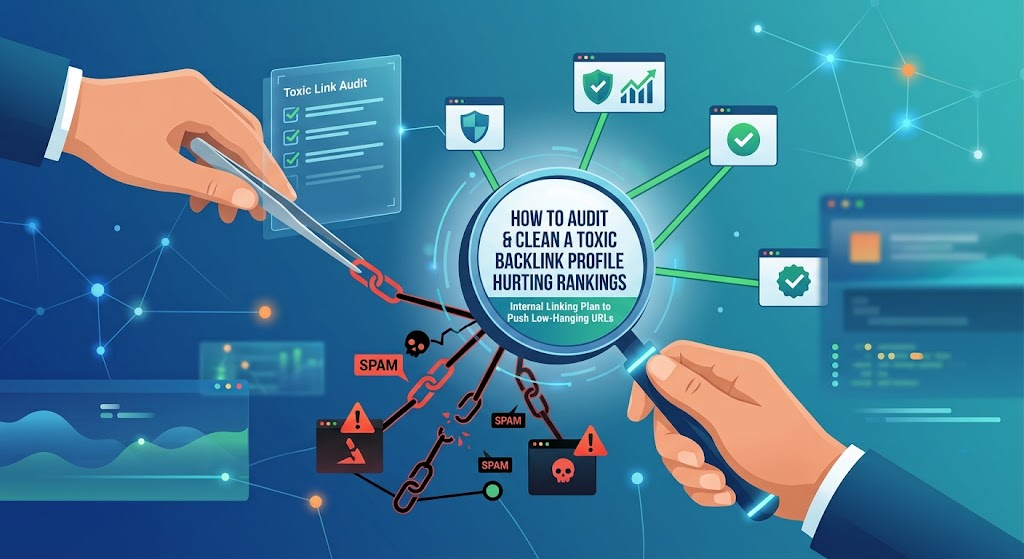

Every website that actively publishes content or builds links eventually attracts unwanted attention.
From automated scraper networks and spam directory clones to low-tier private blog networks (PBNs), your site will accumulate low-quality links over time.
For years, standard SEO advice was simple:
Download an export from your favorite backlink analysis tool, filter by “Spam Score” or “Toxic Score,” and upload a massive disavow file to Google Search Console.
In 2026, blindly disavowing links causes far more ranking drops than the spam itself.
Search engines rely on sophisticated algorithmic mechanisms such as Google’s SpamBrain,
which proactively neutralize and ignore manipulative links rather than automatically penalizing the target domain.
If you aggressively disavow questionable links that actually pass residual topical relevance or citation value, you pull the rug out from your own organic rankings.
This comprehensive guide outlines how to audit, evaluate, and clean a toxic backlink profile safely, methodically, and without sacrificing your organic search traffic.
What Actually Constitutes a “Toxic” Backlink?
Third-party metric scores (like Semrush’s Toxicity Score or Moz’s Spam Score) are heuristic algorithms.
They evaluate surface patterns such as missing TLD diversity, shared IP subnets, or high outbound link counts. However, search engines evaluate links
based on intent, topical alignment, and manipulation signals.
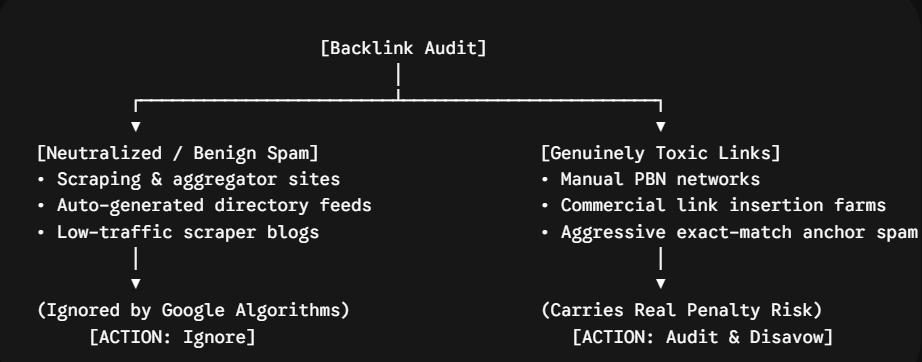
1. Manipulative Private Blog Networks (PBNs)
Networks built on expired domains, with fabricated footprints designed solely to sell high-metric links.
These pages usually cover disjointed topics across gambling, crypto, home improvement, and SaaS within the same blog archive.
2. Over-Optimized Exact-Match Anchor Spam
If a URL with 50 referring domains suddenly receives 400 links with the exact anchor phrase “best cheap cloud hosting platform,” this triggers algorithmic over-optimization filters.
When anchor text profiles look unnatural, entire URL clusters can experience algorithmic suppression.
3. Injected & Hacked Links
Malicious injections on compromised WordPress sites or forum software that point links with adult, pharmaceutical, or foreign-language commercial anchors toward your technical content.
.
4. Paid Commercial Link Farms
Websites with zero editorial standards, masquerading as general news platforms or guest post directories.
They often feature hundreds of outbound “dofollow” links per week across wildly unrelated topics with no organic impressions in return.
The Risk of Over-Cleaning: Why Backlink Audits Go Wrong
The biggest danger in backlink cleanup is collateral damage.
Many backlinks that third-party tools flag as “toxic” are simply:
- Forum scrapers archiving legitimate community discussions.
- Old industry roundups from low-traffic blogs.
- Non-English translation syndications of your original articles.
- Automated RSS feed republishers.
Google’s algorithms already assign these links a weight of zero.
If you include thousands of these links in a disavow file alongside a handful of genuine historical links that were passing minor referral authority, your net link equity drops.
The result is an immediate loss of keyword rankings on pages 1 and 2.
Step-by-Step Framework for Auditing Your Backlink Profile
To clean your backlink profile without collateral damage, use a tiered, manual verification process instead of relying on automated filters.
Step 1: Aggregate Data from Multiple Sources
No single SEO tool maintains a complete map of the web. Relying on one database gives an incomplete picture of your profile.
- Export your live links from Google Search Console (under Links > Top linking sites).
- Export historical and active referring domains from Ahrefs, Semrush, or Moz.
- Merge all datasets into a single spreadsheet and de-duplicate by root referring domain (domain.com).
Step 2: Segment Links by Risk Indicator
Organize your consolidated domain list into three distinct categories based on structural metrics:
| Risk Tier | Profile Characteristics | Audit Priority |
| High Risk | Obvious anchor text spam (adult/pharma/casino), hacked CMS injection patterns, massive link spikes over 48 hours. | Immediate Manual Review |
| Medium Risk | Low domain traffic (< 100/mo), high outbound-to-inbound link ratio, generic multi-niche guest post platforms. | Selective Spot-Checking |
| Low Risk | High topical relevance, organic search visibility, natural branded/URL anchor text, genuine editorial mentions. | Safe / Whitelist |
Step 3: Conduct a Manual Spot Check
Before flagging any domain for removal or disavow, open 15–20 high-risk URLs directly in your browser. Inspect the following attributes:
- Context of the link: Is the link placed naturally inside an editorial sentence, or is it hidden in a footer, sidebar widget, or low-quality forum profile?
- Anchor Text Intent: Is the anchor branded (Your Brand Name), natural URL format ([https://example.com](https://example.com)), or aggressive commercial keywords?
- Indexing Status: Check if the linking page is indexed in Google (site:[linkingpage.com/url](https://linkingpage.com/url)). If Google has completely de-indexed the domain, their systems have already nullified its link value.
How to Clean Toxic Links Safely
Once you have identified links that pose genuine manual action or algorithmic risks, execute your remediation strategy using the following hierarchy:
[Step 1: Manual Outreach] ──(No Response)──> [Step 2: Domain-Level Disavow] ──> [Step 3: Monitor SERP Impact]
1. Manual Outreach (For High-Value or High-Risk Assets)
If you previously engaged in aggressive guest posting or directory submissions that you now need removed, contact the webmaster directly:
- Request complete link removal or an update of the attribute to rel=”nofollow” or rel=”sponsored”.
- Keep requests brief, professional, and clear, citing the exact URL where the link is located and your target anchor text.
2. Strategic Disavow via Google Search Console
If outreach is unviable or the links originate from spam networks, use Google’s Disavow Tool. Follow these critical rules:
- Always Disavow at the Domain Level: Do not disavow individual page URLs on spam sites. Spam networks frequently generate hundreds of subpages.
- Use domain:spammydomain.com to neutralize the entire origin.
- Keep Comments Clean: Add dates and brief notes inside your .txt file using # for internal version tracking.
Example Clean Disavow Format:
# Disavow file updated August 2026
# Confirmed PBN network and anchor spam
domain:cheapviagrapills-online.biz
domain:automated-scraper-feed-hub.net
domain:free-backlinks-generator-2026.org
# Specific paid link where the webmaster refused removal
# Disavow file updated August 2026
# Confirmed PBN network and anchor spam
3. Upload and Re-Index
Submit your file to the official Google Disavow Tool under your verified Search Console property.
Google processes these directives as algorithmic hints when crawling the web, effectively detaching those nodes from your site’s link graph.
Rebalancing Your Anchor Text & Link Profile After a Cleanup
Removing or disavowing bad links only solves half of the equation.
If toxic links distorted your anchor text distribution, your profile may now appear thin or skewed.
1. Target Safe Anchor Text Distributions
Healthy backlink profiles reflect natural editorial behavior. Ensure your overall profile adheres to balanced ratios:
- Branded Anchors (40–50%): Brand name, variations, and domain names (e.g., Smart SEO Trends, smartseotrends.com).
- Naked URLs (20–25%): Clean URL links (https://…, www…).
- Partial Match / Topical LSI (15–20%): Conversational anchors (e.g., guide to link auditing, check out this SEO breakdown).
- Exact Match (< 5–10%): Strict commercial keywords reserved exclusively for your strongest, high-authority editorial placements.
2. Dilute with High-Quality Inbound Links
The most effective way to recover from historical link toxicity is not continuous purging—it is authority dilution.
Focus on acquiring natural, topically aligned contextual backlinks from reputable industry resources, digital PR campaigns, and original research studies.
High-authority editorial links reinforce positive entity signals, making minor background web spam statistically irrelevant to search engine algorithms.
Ongoing Backlink Maintenance Routine
To prevent link toxicity from affecting your site in the future:
- Schedule a Quarterly Audit: Export referring domains every 90 days to spot sudden, unnatural link velocity spikes early.
- Monitor Google Search Console Security & Manual Actions: Check the Security & Manual Actions tab monthly to ensure no manual penalties have been applied.
- Audit Before Major Site Migrations: Never migrate domains or restructure URL architectures while carrying an unreviewed, high-risk backlink profile.
By focusing on manual verification, conservative disavow practices, and continuous high-authority link acquisition, you protect your site from algorithmic penalties while safeguarding your hard-earned organic rankings.
One response to “How to Audit and Clean a Toxic Backlink Profile Without Hurting Rankings”
[…] and disavow toxic, spammy, or irrelevant links that might be dragging down your site’s health […]