

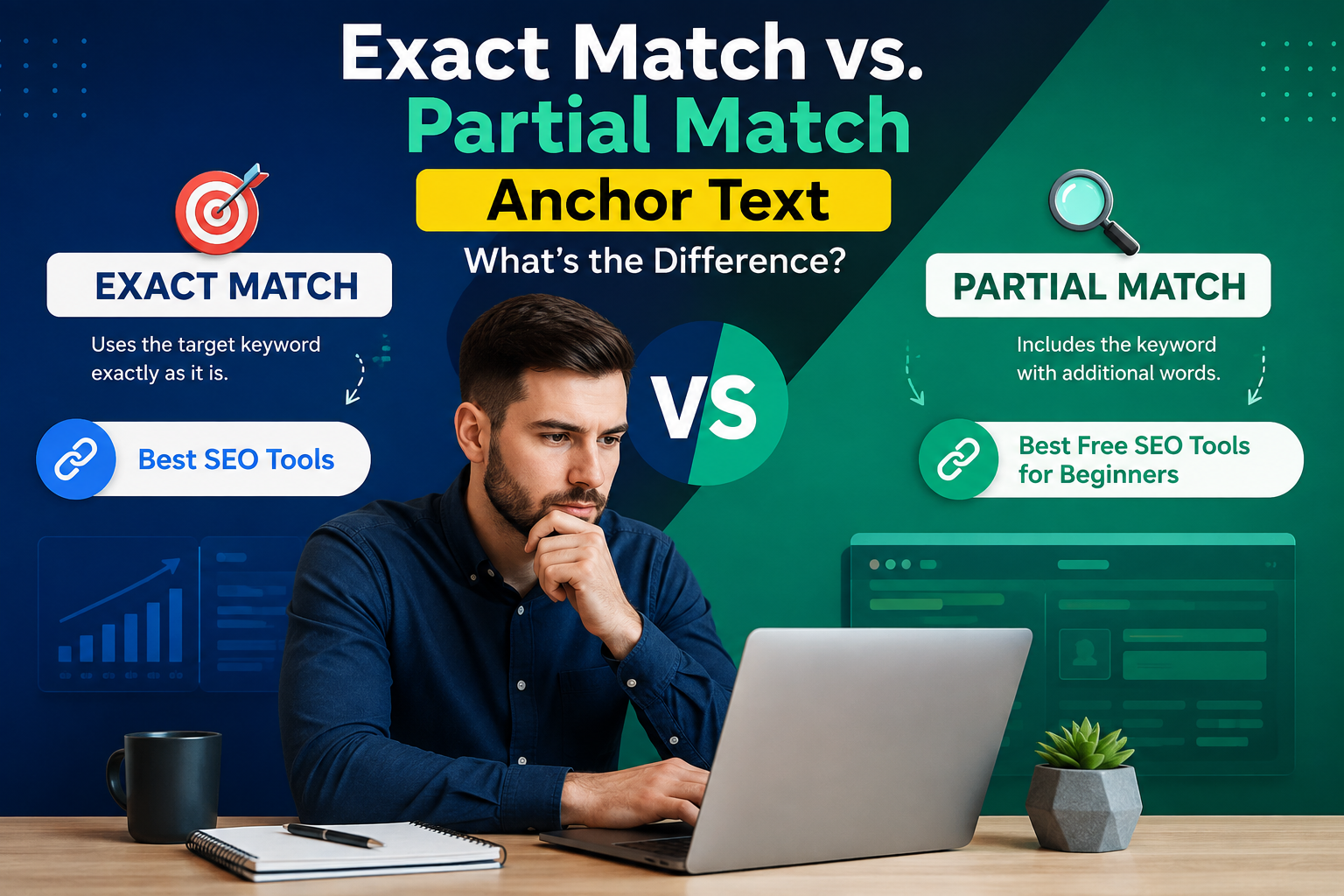

Anchor text is one of the most important elements of a backlink because it gives search engines context about the page being linked to.
Two of the most commonly discussed types are exact-match anchor text and partial-match anchor text.
Understanding the difference between them can help you build a more natural backlink profile and avoid relying too heavily on one keyword variation.
What Is Exact Match Anchor Text?
Exact match anchor text uses the target keyword exactly as it appears in your SEO strategy.
For example, suppose you want to rank a page for:
guest posting services
If another website links to your page using the anchor:
guest posting services
that is an exact match anchor.
Other examples include:
- link building services
- SEO tools
- anchor text
- domain age checker
The anchor text exactly matches the keyword you are targeting.
Why Is Exact Match Anchor Text Important?
Exact match anchors can provide strong topical context because the words used in the link directly describe the destination page.
For example, if an article discusses backlink strategies and includes a link with the anchor text link building services both users and search engines can easily understand what the linked page is about.
However, using the same exact-match keyword repeatedly across many backlinks can make your backlink profile look unnatural.
That’s why exact match anchors should generally be part of a diverse anchor text profile, rather than the only type of anchor you use.
What Is Partial Match Anchor Text?
Partial match anchor text contains part of your target keyword along with additional descriptive words.
For example, if your target keyword is:
guest posting services
a partial match could be:
high-quality guest posting services
Another example:
Target keyword:
link building services
Partial-match anchors could include:
- professional link building services
- effective link building strategies
- quality services for link building
- SEO link building solutions
The target keyword or a variation of it appears within a longer, more natural phrase.
Exact Match vs. Partial Match: Key Difference
The easiest way to understand the difference is:
| Exact Match | Partial Match |
| Uses the target keyword exactly | Includes part of the target keyword |
| More specific | More flexible |
| Highly descriptive | Often sounds more natural |
| Useful for keyword relevance | Useful for anchor diversity |
| Shouldn’t be overused | Easier to vary naturally |
For example, if your target keyword is anchor text, then:
Exact match:
anchor text
Partial match:
anchor text best practices
Both can point to the same page, but they provide slightly different wording and context.
Which Is Better for SEO?
There isn’t one universal winner.
A strong backlink profile should look natural and diverse, rather than consisting almost entirely of exact-match keywords.
For example, imagine a website receives 100 backlinks. If nearly every website uses the same commercial keyword as the anchor, the profile may look less natural than one containing a mixture of branded, partial-match, generic, naked URL, and other descriptive anchors.
A more varied profile might include:
- Smart SEO Trends — branded
- anchor text guide — partial match
- learn more — generic
- smartseotrends.com — naked URL
- anchor text — exact match
The goal isn’t to follow a fixed percentage. The goal is to make your anchors relevant to the context in which they appear.
When Should You Use Exact Match Anchor Text?
Exact-match anchors can make sense when the keyword naturally fits the sentence.
For example:
Businesses looking to improve their rankings can explore professional link building services to strengthen their backlink profiles.
If the linked page is specifically about link building services, the anchor makes sense to the reader.
The important point is natural placement. Don’t force an exact-match keyword into a sentence simply because you want to manipulate rankings.
When Should You Use Partial Match Anchor Text?
Partial-match anchors are useful when an exact keyword doesn’t fit naturally into the sentence.
For example, instead of:
Learn more about guest posting services.
You could write:
Learn more about building backlinks through guest posting.
The second version provides additional context while still being closely related to the target topic.
Partial-match anchors can therefore make it easier to create natural editorial links within informative content.
Exact Match vs. Partial Match in Guest Posting
Guest posting provides a good example of how both anchor types can work together.
Suppose your target page is about guest posting services.
An article could naturally link to it using:
Exact match:
guest posting services
Partial match:
professional guest posting solutions
Branded:
Smart SEO Trends
Generic:
learn more
The best choice depends on the sentence, surrounding content, and purpose of the link.
Don’t Forget Context
Anchor text shouldn’t be evaluated separately from the content surrounding it.
A relevant anchor placed within a useful paragraph can provide much better context than a keyword inserted awkwardly into unrelated content.
For example, an article about SEO outreach discussing different ways to acquire editorial backlinks might naturally link to a page about guest posting services.
The surrounding topic, anchor text, destination page, and website relevance all work together.
This is particularly important when building contextual backlinks through guest posts and link insertions.
Common Mistakes With Exact and Partial Match Anchors
1. Using the same anchor everywhere
Repeating one exact keyword across every backlink isn’t a good approach.
2. Forcing keywords into sentences
If the anchor sounds unnatural to a human reader, rewrite it.
3. Ignoring relevance
The website and surrounding article should be relevant to the destination page whenever possible.
4. Focusing only on keyword anchors
Branded and descriptive anchors also have an important role in creating a natural backlink profile.
5. Using outdated anchor text strategies
SEO evolves, so anchor text should be approached as part of an overall quality-focused link-building strategy rather than as a simple keyword-placement tactic.
Final Thoughts
The difference between exact match and partial match anchor text is simple: exact match uses the target keyword exactly, while partial match includes the target keyword or its variation within a broader phrase.
Neither should be treated as the only “correct” option.
For a sustainable SEO strategy, focus on relevance, natural wording, contextual placement, and anchor diversity.
Use exact-match anchors when they genuinely fit the content, and use partial-match anchors when a broader or more descriptive phrase provides better context.
When combined with branded, generic, and URL-based anchors, exact and partial match anchors can contribute to a more natural and useful backlink profile.