

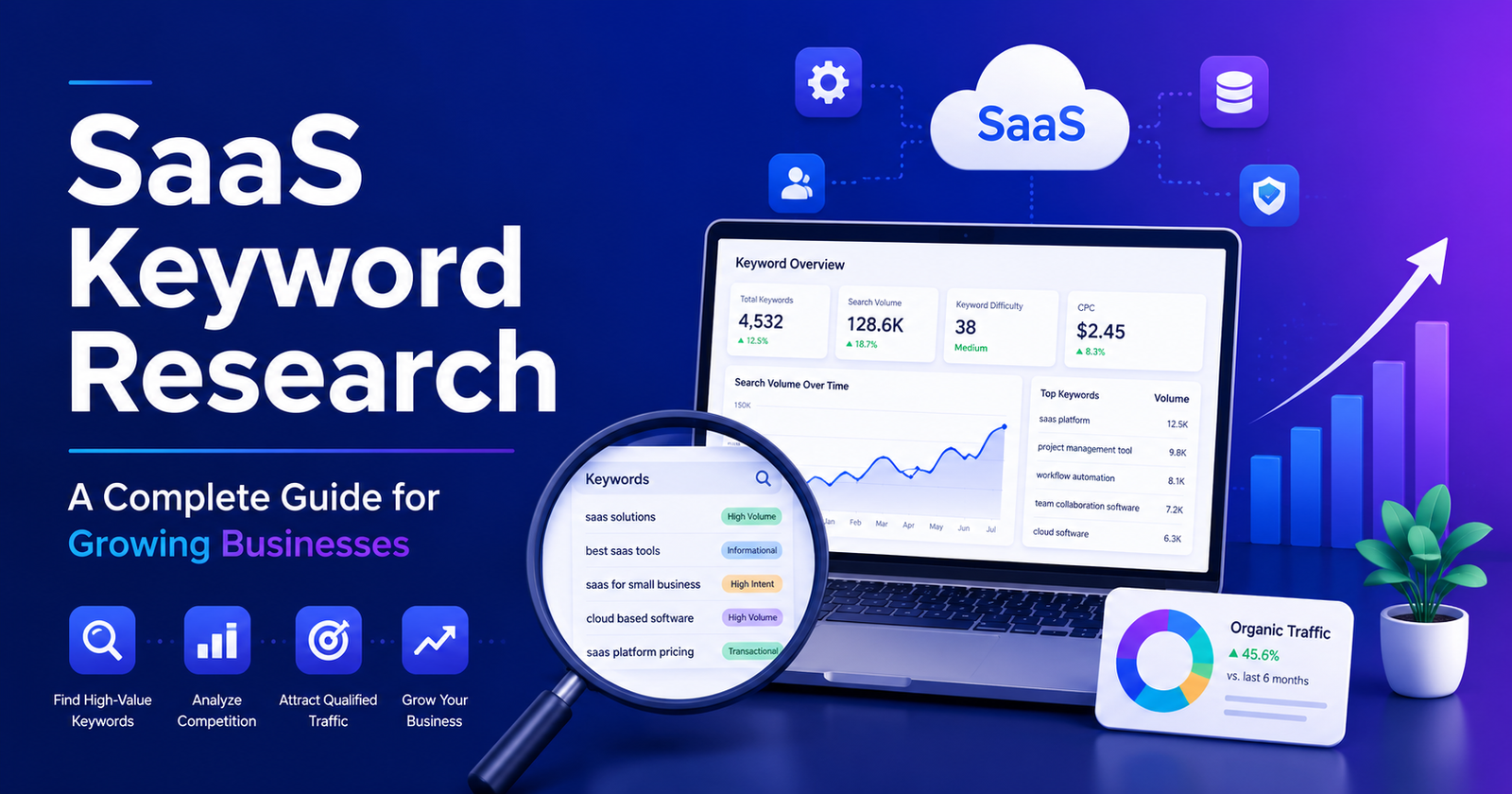

SaaS Keyword Research: How Growing SaaS Businesses Can Succeed in 2026
Keyword research is the backbone of every successful SaaS SEO strategy.
Unlike traditional businesses, SaaS companies compete in highly competitive search results where ranking for the right keywords can generate recurring organic traffic, qualified leads, and long-term revenue.
However, many SaaS businesses make the mistake of targeting only high-volume keywords.
While search volume is important, understanding search intent, customer pain points, and the buyer’s journey is what separates successful SaaS SEO campaigns from unsuccessful ones.
In this guide, you’ll learn how to conduct SaaS keyword research, identify profitable opportunities, organize keywords into topic clusters, and create content that attracts users at every stage of the sales funnel.
What Is SaaS Keyword Research?
SaaS keyword research is the process of identifying the search terms your potential customers use when looking for software solutions, comparisons, tutorials, integrations, pricing information, or industry knowledge.
Instead of chasing random keywords, SaaS companies should focus on attracting users with clear purchase intent.
For example, someone searching for:
- CRM software for startups
- Best project management software
- Email marketing automation tools
is much closer to becoming a customer than someone searching for a broad term like “software.”
Why Is SaaS Keyword Research Important?
A strong keyword strategy helps you:
- Generate qualified organic traffic
- Reduce customer acquisition costs
- Increase free trial signups
- Improve product visibility
- Build topical authority
- Create content that matches search intent
- Outperform competitors in organic search
Since SaaS businesses often rely on recurring subscriptions, investing in SEO can deliver compounding returns over time.
Understand Search Intent Before Choosing Keywords
One of the biggest mistakes SaaS marketers make is focusing only on search volume.
Instead, identify why users are searching.
Informational Keywords
Users want to learn something.
Examples:
- What is CRM software?
- How does cloud storage work?
- SaaS SEO guide
These keywords are excellent for blog posts and educational resources.
Commercial Keywords
Users are comparing different solutions.
Examples:
- Best CRM software
- Ahrefs alternatives
- Project management tools comparison
These keywords often convert well because users are evaluating options before making a decision.
Transactional Keywords
Users are ready to take action.
Examples:
- Buy CRM software
- SEO software pricing
- Start free trial
These should be targeted through landing pages and product pages.
Find Keywords Your Customers Actually Search
A successful SaaS SEO strategy starts by understanding your audience.
Ask questions like:
- What problems are they trying to solve?
- What software alternatives are they considering?
- Which features matter most?
- What questions do they ask before purchasing?
You can collect ideas from:
- Google Search Console
- Google Autocomplete
- People Also Ask
- Industry forums
- Reddit discussions
- Customer support conversations
- Competitor websites
These sources often reveal long-tail keywords with lower competition and higher conversion potential.
Analyze Your Competitors
Competitor analysis helps you discover keyword opportunities you may have overlooked.
Review:
- Blog topics
- Product pages
- Comparison articles
- Integration pages
- Help documentation
- Resource centers
Look for keywords where competitors rank well, but your website has little or no visibility.
These gaps can become valuable content opportunities.
Focus on Long-Tail Keywords
Long tail keywords may have lower search volume, but they usually bring more qualified visitors.
Examples include:
- Best CRM software for small businesses
- SEO tools for SaaS startups
- Email automation software for agencies
- Customer onboarding software for healthcare
These searches are more specific and often indicate stronger purchase intent.
Build Topic Clusters
Instead of publishing unrelated articles, organize your content into topic clusters.
For example:
Pillar Page
SaaS SEO Guide
Supporting Articles
- SaaS Keyword Research
- SaaS Link Building
- Technical SEO for SaaS
- SaaS Content Marketing
- SaaS On-Page SEO
- SaaS SEO Checklist
This structure improves internal linking and helps search engines understand your expertise in the topic.
Optimize Content for Featured Snippets
Featured snippets can significantly increase your organic visibility.
To improve your chances:
- Answer questions directly.
- Use numbered and bulleted lists.
- Keep definitions concise.
- Include descriptive headings.
- Add comparison tables where appropriate.
Well-structured content is easier for both users and search engines to understand.
Use SEO Tools to Simplify Keyword Research
Keyword research becomes much easier with the right tools. While premium SEO platforms offer advanced insights, free seo tools can also support your workflow.
For example, when publishing educational content, adding structured data can help search engines better understand your pages.
You can generate different types of schema quickly using our Free Schema Markup Generator, making it easier to implement structured data without writing code manually.
Similarly, while optimizing titles, meta descriptions, or headings, character limits matter.
Our Word and Character Counter helps you check content length and maintain SEO-friendly formatting before publishing.
These simple tools can streamline your optimization process and improve overall content quality.
How to Map Keywords to the Right Pages
One keyword should never be targeted by multiple pages. Doing so can lead to keyword cannibalization, where your own pages compete against each other in search results.
Instead, assign one primary keyword to each page and support it with closely related secondary keywords.
For example:
| Page | Primary Keyword | Supporting Keywords |
| Homepage | SaaS SEO Services | SaaS SEO Agency, SaaS SEO Company |
| Blog | SaaS Keyword Research | Keyword Research for SaaS, SaaS Keywords |
| Blog | SaaS Link Building | Link Building for SaaS Companies |
This approach helps search engines understand the purpose of each page and improves your chances of ranking.
Optimize Every SaaS Page for SEO
Keyword research doesn’t end after choosing keywords. You also need to optimize your pages effectively.
Here’s a simple on-page SEO checklist:
- Include the primary keyword in the title.
- Write a compelling meta description.
- Use descriptive H2 and H3 headings.
- Add internal links to relevant pages.
- Optimize images with descriptive alt text.
- Keep URLs short and keyword-friendly.
- Improve page loading speed.
- Add structured data where appropriate.
These small improvements can significantly enhance your website’s visibility over time.
Measure Your Keyword Performance
.
Publishing content is only the beginning. Regular monitoring helps you understand what’s working and where improvements are needed.
Keep an eye on:
- Organic traffic
- Keyword rankings
- Click-through rate (CTR)
- Impressions
- Bounce rate
- Average engagement time
- Conversion rate
- Free trial sign-ups or demo requests
Google Search Console is one of the best free tools for tracking keyword performance, impressions, and average positions.
Reviewing this data regularly can help you identify pages that are close to ranking on the first page of Google and deserve additional optimization.
Common SaaS Keyword Research Mistakes
Many SaaS companies struggle to grow organically because they repeat the same SEO mistakes.
Ignoring Search Intent
Ranking for a high-volume keyword is meaningless if it doesn’t attract your ideal customers.
Targeting Only High-Volume Keywords
High search volume often comes with intense competition. Long-tail keywords are usually easier to rank for and attract more qualified visitors.
Publishing Thin Content
A short article rarely satisfies user intent for competitive SaaS topics. Focus on creating comprehensive, valuable content that answers readers’ questions in depth.
Forgetting Internal Linking
Internal links help distribute authority across your website and improve navigation. Connect related articles naturally to strengthen your site’s topical relevance.
Not Updating Existing Content
SEO is an ongoing process. Refresh older articles with updated statistics, examples, screenshots, and internal links to keep them relevant.
Frequently Asked Questions
What is SaaS keyword research?
SaaS keyword research is the process of identifying search terms that potential software buyers use throughout their buying journey, from learning about a problem to comparing solutions and making a purchase.
Which keywords are best for SaaS SEO?
The best keywords depend on your product and audience. A balanced strategy should include informational, commercial, transactional, and long-tail keywords that align with different stages of the customer journey.
How often should I perform keyword research?
Review your keyword strategy every three to six months or whenever you launch new features, enter new markets, or notice changes in search trends.
Are long-tail keywords important?
Yes. Long-tail keywords generally have lower competition, clearer search intent, and higher conversion potential, making them valuable for SaaS businesses.
Can free SEO tools help with keyword optimization?
Absolutely. While premium platforms offer deeper insights, free tools can simplify many optimization tasks.
For example, if you’re implementing structured data to improve search visibility, you can use our Free Schema Markup Generator to create valid schema markup quickly.
Likewise, when optimizing page titles, headings, or meta descriptions, our Word and Character Counter helps ensure your content stays within recommended length limits.
Final Thoughts
Successful SaaS keyword research isn’t about finding the highest-volume keywords; it’s about understanding your audience, matching search intent, and creating content that solves real problems.
By targeting a mix of informational, commercial, and transactional keywords, organizing them into topic clusters, and continuously monitoring performance, you can build a sustainable SEO strategy that drives qualified traffic and long-term growth.
Remember that SEO is a marathon, not a sprint.
Consistently publishing high-quality, user-focused content, refining your keyword strategy, and optimizing existing pages will strengthen your site’s authority over time.
With patience and the right approach, SaaS keyword research can become one of your most effective channels for generating recurring organic traffic and attracting customers.