

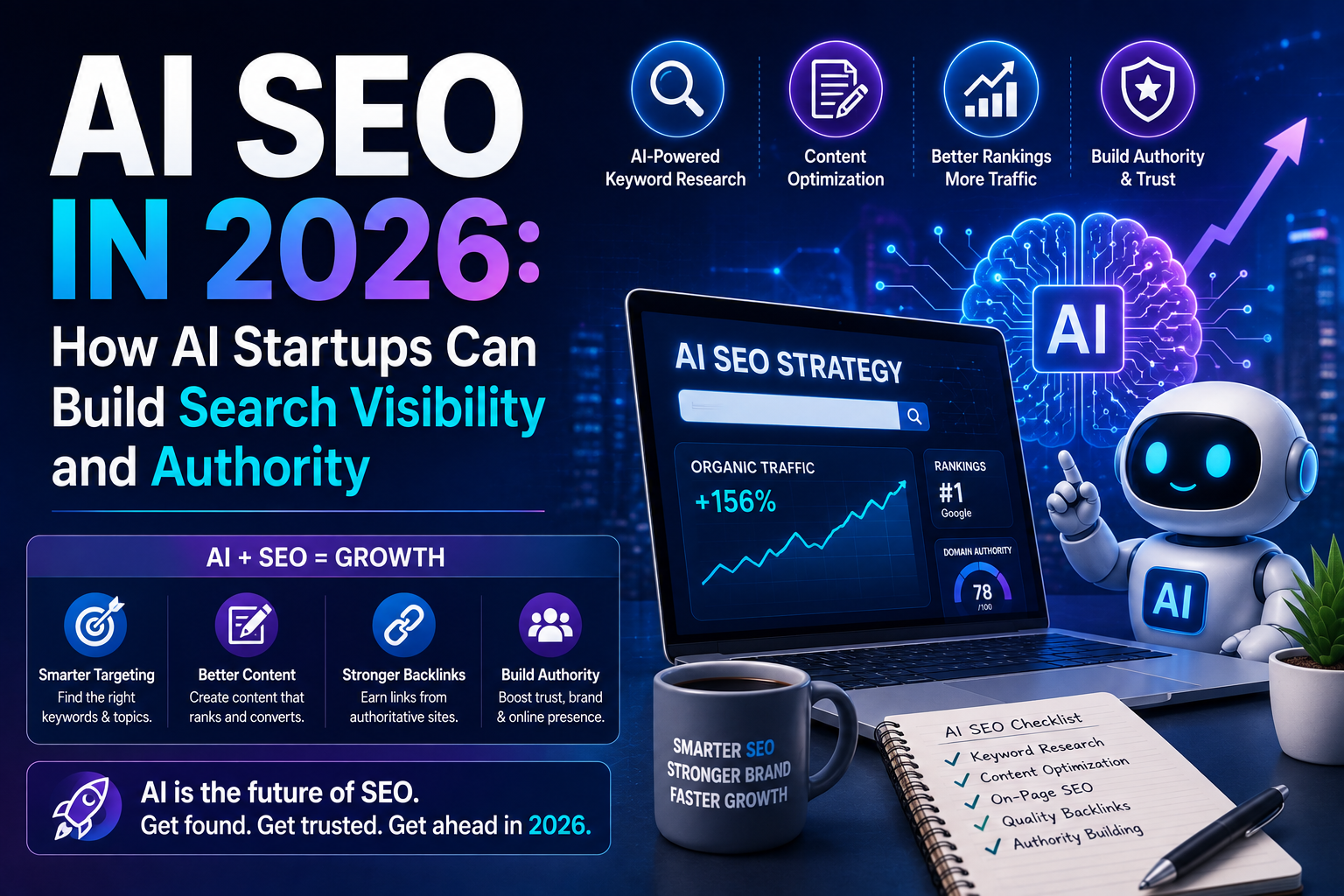

AI SEO in 2026: How AI Startups Can Build Search Visibility and Authority
The AI industry is growing at an extraordinary pace.
Every week, new AI tools, SaaS platforms, automation products, and intelligent applications enter the market.
While this creates exciting opportunities for startups, it also makes online competition significantly harder.
Having a powerful AI product is no longer enough.
Startups need to make sure potential customers can actually discover them through search engines,
AI-powered search platforms, industry publications, and other digital channels.
This is where AI SEO comes into play.
A well-planned SEO strategy can help AI startups build topical authority, attract relevant organic traffic,
earn trusted mentions, and turn search visibility into sustainable business growth.
For AI-powered businesses, building a strong digital presence requires more than simply launching a useful product;
companies also need a clear strategy for search visibility, content, authority, and audience growth.
What Is AI SEO?
AI SEO refers to the use of search engine optimization strategies specifically designed for businesses operating in the artificial intelligence ecosystem.
The fundamentals of SEO still matter, including keyword research, technical optimization, content quality, internal linking, and backlinks.
However, AI companies also need to address rapidly changing search behavior and the increasing influence of AI-powered search and answer engines.
For an AI startup, this means creating content that is not only optimized for traditional search engines but also structured clearly enough to be understood
and referenced by modern AI systems.
1. Establish a Clear Topical Focus
One of the biggest mistakes new AI companies make is publishing content about every AI-related subject they can find.
Instead, startups should establish a clear topical focus.
For example, an AI writing platform could build authority around topics such as:
- AI content creation
- AI writing workflows
- AI content optimization
- AI writing for businesses
- AI copywriting
- AI content marketing
Publishing comprehensive content around closely related topics helps demonstrate expertise and gives search engines a clearer
understanding of what the website is about.
Rather than publishing 50 unrelated AI articles, a startup can gain more by developing several interconnected content clusters centered on its core product and audience.
2. Build Topic Clusters Around Important Keywords
Keyword research should go beyond finding a handful of high-volume terms.
AI startups should identify a primary topic and then build supporting content around it.
For example, a website targeting the keyword AI marketing tools could create supporting articles such as:
- Best AI Marketing Tools for Small Businesses
- How AI Is Changing Digital Marketing
- AI Tools for Social Media Marketing
- AI Marketing Automation Guide
- AI Content Tools for Marketing Agencies
- How to Measure AI Marketing ROI
These pages can be connected through internal links, creating a strong topical structure.
This approach can help users discover related information while also making the website easier for search engines to crawl and understand.
3. Target Long-Tail Search Queries
Broad keywords such as “AI” or “AI tools” are extremely competitive.
New startups should therefore look for more specific search queries that closely match their target audience.
For example:
Broad:
AI tools
More specific:
AI tools for ecommerce businesses
Highly targeted:
AI product description generator for Shopify stores
Long-tail keywords generally have lower search volume, but they can attract visitors with much clearer intent.
For startups with limited domain authority, targeting specific queries can be a more realistic way to build organic visibility.
4. Create Content That Actually Solves Problems
AI content has become increasingly common, which means simply publishing large quantities of generic articles isn’t enough.
AI startups should focus on creating genuinely useful resources.
Consider publishing:
- Detailed tutorials
- Original research
- Industry reports
- Product comparisons
- Case studies
- Expert interviews
- Data-driven articles
- Practical guides
- Frequently asked questions
For example, instead of publishing another generic article about “What Is AI?”, an
AI marketing platform could publish a detailed guide showing exactly how marketing teams can integrate AI into their existing workflow.
Useful content is more likely to attract engagement, mentions, shares, and natural backlinks.
5. Optimize Content for AI-Powered Search
Search behavior is changing as users increasingly interact with AI-powered answer engines.
This means businesses should make their content easy to understand and extract information from.
Use:
- Clear headings
- Short explanatory sections
- Descriptive subheadings
- Lists where appropriate
- Concise definitions
- Original statistics
- Author information
- Expert insights
- Frequently asked questions
The objective isn’t to write content specifically for machines. Instead, make the information exceptionally clear for humans.
Well-structured and authoritative content is more useful across traditional and AI-powered discovery channels.
6. Develop Original Research
Original data can become a powerful SEO asset.
AI startups can conduct surveys, analyze industry trends, publish benchmark reports, or study their own anonymized product data.
For example, an AI SaaS company could publish:
“2026 AI Adoption Report: How Small Businesses Are Using Artificial Intelligence”
If the research contains useful statistics, bloggers, journalists, and other websites may reference it.
These citations can generate:
- Brand awareness
- Referral traffic
- Backlinks
- Social engagement
- Industry credibility
Original research can therefore support both SEO and digital PR at the same time.
7. Earn High-Quality Backlinks
Content alone doesn’t guarantee strong search visibility.
AI startups also need to build authority outside their own websites.
Relevant backlinks from trustworthy websites can help strengthen a site’s authority and introduce the brand to new audiences.
However, startups should prioritize relevance and editorial quality instead of trying to acquire as many links as possible.
For businesses that don’t have an established outreach team, professional link building services can help identify relevant publishing opportunities and build a consistent off-page SEO strategy.
The focus should be on earning contextual placements from websites that are genuinely relevant to the startup’s industry, audience, or subject matter.
8. Use Digital PR to Generate Brand Mentions
Digital PR and SEO can work particularly well for AI companies because the industry generates constant news and discussion.
Startups can pitch journalists and publications with:
- New research
- Product launches
- Industry predictions
- Expert commentary
- Original statistics
- AI trend analysis
- Customer success stories
Being quoted as an industry expert can generate valuable exposure even when the resulting coverage doesn’t include a backlink.
Over time, repeated mentions can help establish a recognizable brand within the AI ecosystem.
9. Strengthen Internal Linking
Internal links are often overlooked by startups.
Every important page should be connected to relevant supporting content.
For example, an article about AI automation could link to:
- AI automation software
- AI workflow guide
- AI productivity tools
- Customer case studies
- Related tutorials
A well-planned internal linking structure helps users navigate the website and distributes authority between relevant pages.
It can also help search engines discover new content more efficiently.
10. Demonstrate Real Expertise
Trust is becoming increasingly important in competitive search environments.
AI companies should clearly demonstrate who is behind their content and products.
Important elements include:
- Author bios
- Expert contributors
- Company information
- Original experience
- Customer testimonials
- Case studies
- Transparent product information
- Updated content
If an article makes technical or business claims about AI, supporting those claims with credible sources and practical experience can make the content more trustworthy.
11. Optimize the Technical Foundation
Even excellent content can struggle if the website has technical problems.
AI startups should regularly review:
- Website speed
- Mobile usability
- Indexability
- XML sitemaps
- Canonical tags
- Broken links
- Structured data
- HTTPS
- URL structure
- Core Web Vitals
Technical SEO doesn’t replace great content, but it creates the foundation that allows search engines to discover, crawl, and understand the website effectively.
12. Measure SEO Performance
SEO should be treated as an ongoing growth channel rather than a one-time project.
AI startups should monitor:
- Organic clicks
- Impressions
- Keyword rankings
- Organic conversions
- Backlinks
- Referring domains
- Brand mentions
- Engagement
- Sign-ups
- Revenue generated from organic traffic
It’s also important to identify which pages generate business results.
A page receiving 10,000 visitors isn’t necessarily more valuable than one generating 100 highly qualified visitors who convert into customers.
Final Thoughts
AI startups operate in one of the most competitive digital markets in 2026. As more companies launch
AI products, simply having a good tool is no longer enough to win online.
Startups need a comprehensive strategy that combines topical authority, long-tail keyword targeting, high-quality content,
technical SEO, internal linking, digital PR, and authoritative backlinks.
The strongest approach is to build a recognizable source of expertise around a specific AI niche rather than chasing every trending keyword.
By consistently publishing useful information, earning relevant mentions, building authoritative links, and demonstrating genuine expertise,
AI startups can create a stronger search presence and establish sustainable organic growth in 2026.