

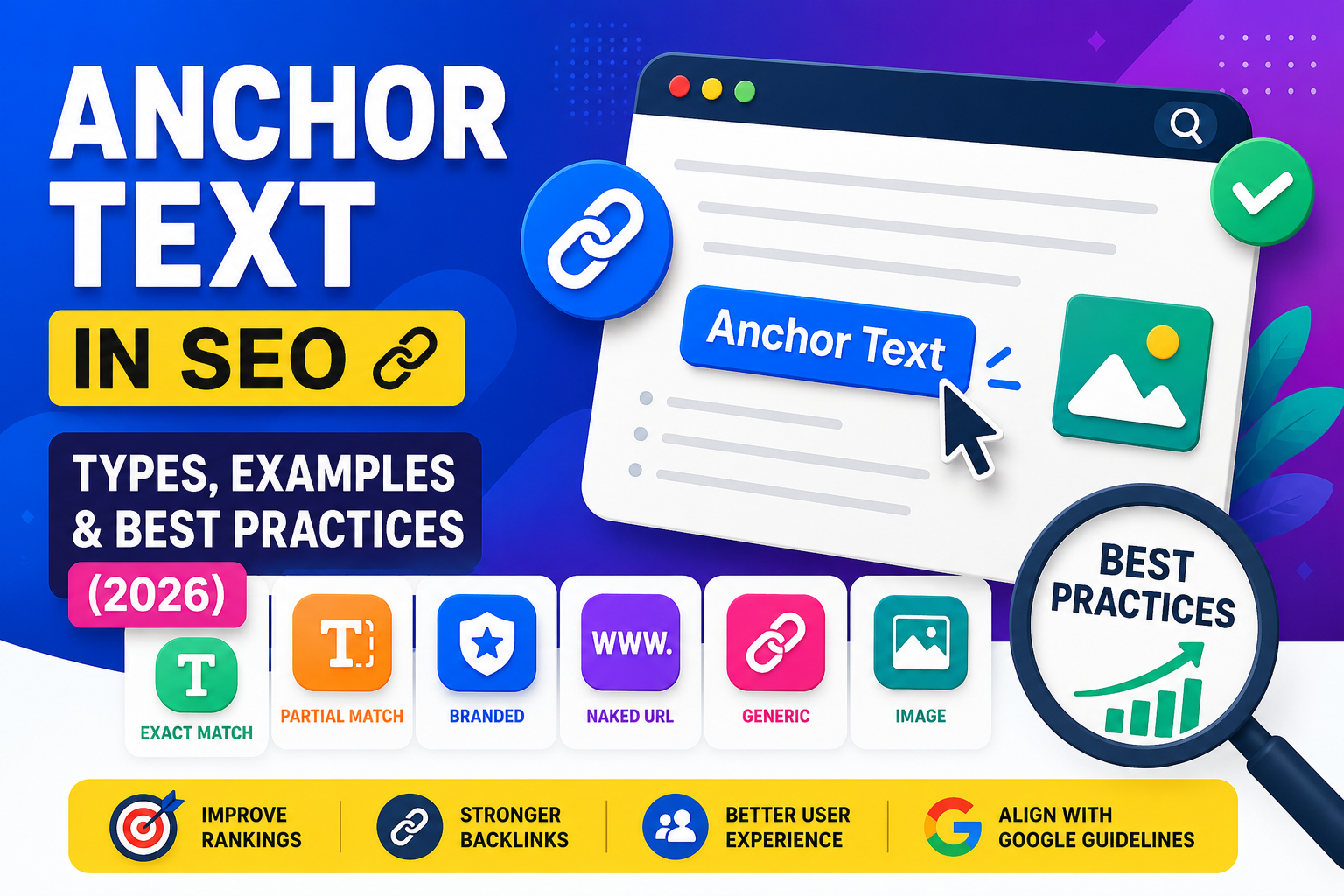

Anchor Text in SEO: Types, Examples & Best Practices
Anchor text is one of the most important yet often overlooked aspects of SEO.
Whether you’re building backlinks, improving internal linking, or optimizing your website for search engines, choosing the right anchor text can significantly impact your rankings.
Many website owners focus only on getting backlinks, but the words used within those links matter just as much.
A well-optimized anchor text strategy helps search engines understand the context of your page while improving user experience.
In this guide, you’ll learn what anchor text is, the different types of anchor text, practical examples, and the best practices you should follow in 2026.
What Is Anchor Text in SEO?
Anchor text is the clickable text within a hyperlink. It tells users and search engines what the linked page is about before they click on it.
For example:
- Good Anchor Text: SEO keyword research guide
- Poor Anchor Text: Click here
When Google crawls a page, it uses anchor text as one of the signals to understand the topic and relevance of the linked page.
Why Is Anchor Text Important?
Anchor text plays an important role in both user experience and search engine optimization.
A well-written anchor text helps:
- Improve topical relevance
- Provide context to search engines
- Increase click-through rates
- Strengthen internal linking
- Support a natural backlink profile
- Improve keyword rankings when used correctly
However, overusing exact-match keywords can lead to an unnatural link profile, so balance is essential.
Types of Anchor Text
Understanding the different types of anchor text helps you build a diverse and natural backlink profile.
1. Exact Match Anchor Text
This anchor text exactly matches your target keyword.
Example:
Anchor: Anchor Text in SEO
This type can be powerful but should be used sparingly to avoid appearing manipulative.
2. Partial Match Anchor Text
Contains your primary keyword along with additional words.
Examples:
- Learn about anchor text in SEO
- Best anchor text practices
- Guide to anchor text optimization
This is one of the safest and most recommended anchor text types.
3. Branded Anchor Text
Uses your brand name as the clickable text.
Examples:
- Smart SEO Trends
- Ahrefs
- Semrush
Branded anchors help create a natural backlink profile and build trust.
4. Naked URL Anchor
The URL itself becomes the anchor.
Example:
https://smartseotrends . com
These are common in forums, citations, and references.
5. Generic Anchor Text
Uses common phrases instead of keywords.
Examples include:
- Click here
- Learn more
- Read this article
- Visit the website
Generic anchors improve readability but shouldn’t dominate your link profile.
6. Image Anchor Text
When an image links to another page, its Alt Text acts as the anchor text for search engines.
Always write descriptive alt text instead of leaving it blank.
Anchor Text Examples
Here are a few practical examples:
| Poor Anchor | Better Anchor |
| Click Here | Complete SEO Checklist |
| Read More | Beginner’s Guide to Technical SEO |
| Visit Website | Best Link Building Strategies |
| Learn More | Local SEO Optimization Tips |
The better anchor provides clear context about the destination page.
Anchor Text for Internal Links
Anchor text isn’t only for backlinks.
Internal links also help search engines understand your site’s structure.
For example:
Instead of:
“Click here to read another article.”
Use:
“Read our complete guide to Technical SEO.”
This gives Google more context while helping visitors navigate your website naturally.
Anchor Text for Backlinks
When building backlinks, diversity is key.
A healthy backlink profile usually includes a mix of:
- Branded anchors
- Partial-match anchors
- Naked URLs
- Generic anchors
- Exact-match anchors (used sparingly)
This looks much more natural than using the same keyword repeatedly.
Common Anchor Text Mistakes
Many websites make these mistakes:
- Using the same exact-match keyword repeatedly
- Over-optimizing backlinks
- Using “Click Here” everywhere
- Linking unrelated pages
- Ignoring internal anchor text
- Creating keyword-stuffed anchors
Google’s algorithms are much better at identifying unnatural linking patterns than they were a few years ago, so maintaining a balanced anchor text profile is essential.
Anchor Text Best Practices for 2026
Google has become much better at understanding the context and intent behind links.
Instead of relying on exact-match keywords, modern SEO focuses on relevance, user experience, and natural language.
Follow these best practices to build a strong anchor text strategy in 2026.
1. Prioritize Relevance
Your anchor text should accurately describe the content of the destination page. Misleading anchor text creates a poor user experience and may reduce trust.
Example
❌ Best SEO Tools → Links to a page about email marketing
✅ Best SEO Tools for Beginners → Links to an article reviewing SEO tools
Relevant anchors improve both usability and topical authority.
2. Keep Your Anchor Text Natural
Anchor text should fit naturally within the sentence instead of feeling forced.
Instead of writing:
We offer best cheap affordable SEO services USA.
Write:
Explore our SEO services for small businesses to improve your online visibility.
Natural writing helps users while making your content easier for search engines to understand.
3. Diversify Your Anchor Text
Using the same keyword repeatedly is one of the most common SEO mistakes.
A healthy backlink profile includes different anchor types, such as:
- Branded anchors
- Partial-match anchors
- Generic anchors
- Naked URLs
- Exact-match anchors
- Image anchors
Diversification makes your backlink profile appear organic.
4. Don’t Overuse Exact-Match Keywords
Years ago, exact-match anchors worked extremely well.
Today, excessive use can appear manipulative.
Instead of using:
Anchor Text in SEO
for every backlink, vary your anchors:
- Learn about anchor text
- SEO anchor text guide
- Best anchor text practices
- Internal linking guide
- Smart SEO Trends
Variation reduces optimization risks.
5. Optimize Internal Links
Internal links are completely under your control.
Instead of generic phrases like:
- Click here
- Read more
Use descriptive anchors such as:
- Technical SEO Checklist
- Complete Link Building Guide
- Keyword Research Tips
This helps both users and search engines navigate your website more effectively.
6. Think About the User First
Every link should answer one simple question:
Will this help the reader?
If the answer is yes, it’s probably a good link.
Google rewards websites that focus on user experience rather than manipulation.
How to Analyze Your Anchor Text Profile
Regularly reviewing your backlink profile helps you identify over-optimization and maintain a healthy distribution of anchor types.
You can use SEO tools such as:
- Google Search Console
- Ahrefs
- Semrush
- Moz
- Majestic
When analyzing your anchor profile, look for:
- Overused exact-match keywords
- Excessive generic anchors
- Brand anchor distribution
- Toxic or spammy backlinks
- Broken internal links
- Irrelevant referring domains
Monitoring these metrics helps maintain a balanced backlink profile over time.
Common Anchor Text Mistakes to Avoid
Even experienced SEO professionals occasionally make anchor text mistakes.
Avoid these common issues:
Keyword Stuffing
Repeating the same keyword in every backlink creates an unnatural pattern.
Irrelevant Links
Only link to pages that genuinely relate to the surrounding content.
Too Many Generic Anchors
Using “Click Here” or “Read More” everywhere provides little context.
Ignoring Internal Links
Many websites focus only on backlinks while neglecting internal anchor optimization.
Buying Spammy Links
Low-quality backlinks with over-optimized anchors can do more harm than good.
Frequently Asked Questions
What is anchor text in SEO?
Anchor text is the clickable text within a hyperlink that tells users and search engines what the linked page is about.
Which anchor text is best for SEO?
There isn’t one perfect anchor type. A natural combination of branded, partial-match, generic, and contextual anchors typically works best.
Does anchor text affect rankings?
Yes. Anchor text provides context that helps search engines understand the topic of the linked page. However, relevance and quality are more important than keyword repetition.
Should I use exact-match anchor text?
Yes—but in moderation. Overusing exact-match anchors may create an unnatural backlink profile.
What is branded anchor text?
A branded anchor uses your business or website name as the clickable text.
Example:
Smart SEO Trends
Final Thoughts
Anchor text remains a fundamental part of SEO in 2026, but success no longer comes from stuffing keywords into every link.
Instead, focus on relevance, natural language, and creating a balanced mix of anchor text types.
Whether you’re building backlinks or strengthening your internal linking structure, descriptive and user-focused anchor text helps search engines
understand your content while improving navigation for visitors.
Rather than chasing shortcuts, build links that genuinely add value.
A thoughtful anchor text strategy not only supports better rankings but also creates a stronger, more trustworthy website over the long term.
One response to “Anchor Text in SEO: Types, Examples & Best Practices (2026)”
[…] descriptive anchor text rather than generic phrases such […]