

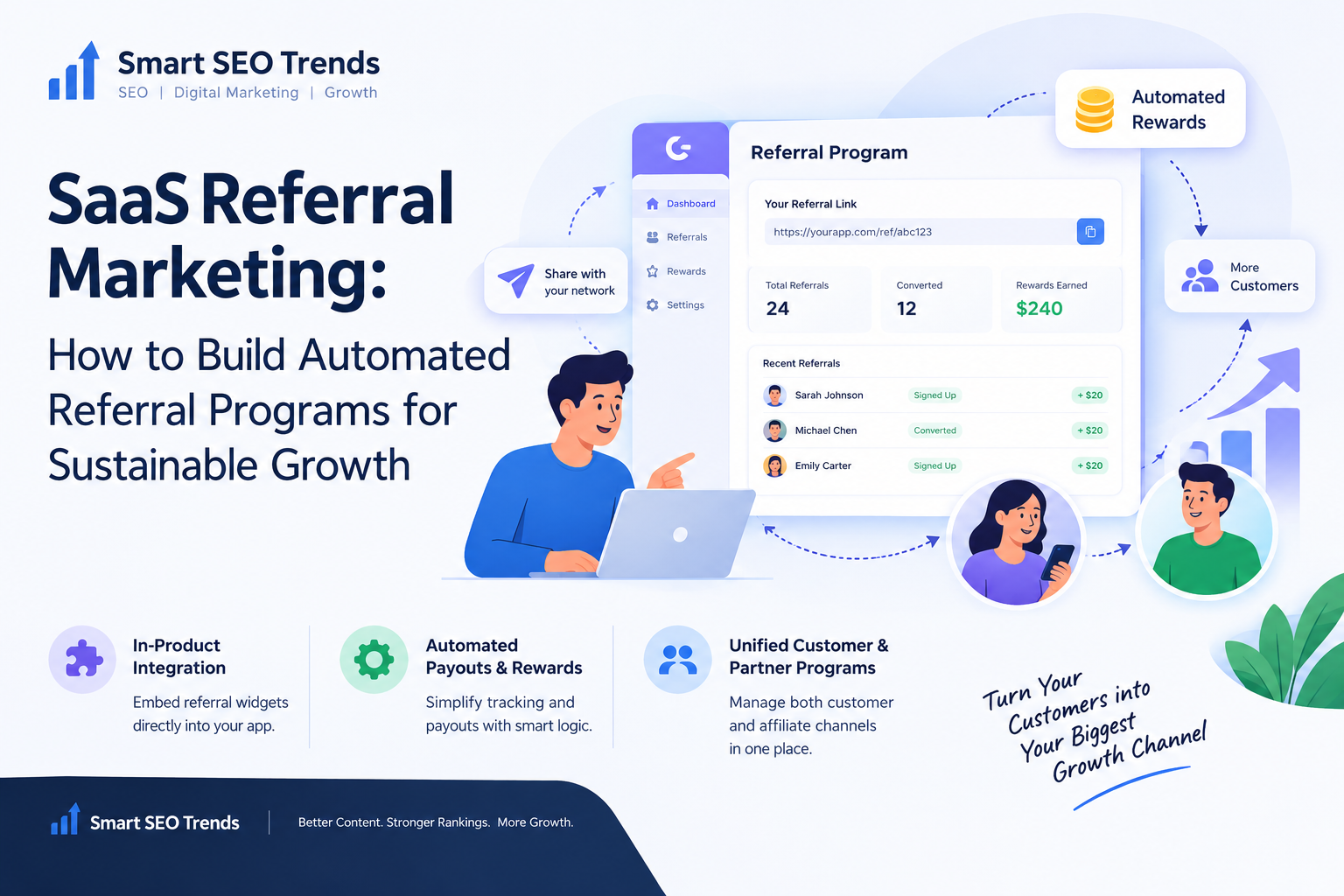

Customer acquisition is one of the biggest challenges for SaaS companies.
Paid advertising, sales outreach, content marketing, and other acquisition channels can help businesses reach new audiences, but they also require ongoing investment in time and resources.
For SaaS businesses looking to diversify their acquisition strategy, customer referrals offer another opportunity.
Existing users who understand a product’s value can introduce it to colleagues, business partners, and other potential customers who may benefit from the same solution.
However, referrals do not always happen consistently on their own.
Without a structured process, businesses may struggle to track recommendations, attribute conversions, manage rewards, and understand which referrals generate revenue.
This is where SaaS referral marketing becomes valuable.
By combining a clear referral strategy with automation, software companies can make it easier for customers and partners to recommend their products while tracking the results.
What Is SaaS Referral Marketing?
SaaS referral marketing is a customer acquisition strategy that encourages existing users, customers, or business partners to recommend a software product to other potential buyers.
Depending on the business model, a referral program may reward participants when someone they refer signs up,
becomes a paying customer, or meets another predefined conversion goal.
For example, a project management platform might encourage existing customers to invite colleagues from other companies.
If a referred company subscribes to a paid plan, the referring customer may receive account credits, a cash reward, or another agreed benefit.
Referral programs can serve several purposes:
- Generate leads through existing customer relationships.
- Encourage satisfied users to recommend a product.
- Support customer acquisition alongside paid advertising and outbound sales.
- Build relationships with affiliates, consultants, and strategic partners.
- Measure the revenue generated through referral activity.
The effectiveness of a referral program depends on the product, customer experience, incentive structure, and the quality of the people being referred. Simply launching a program does not guarantee additional customers.
Why SaaS Companies Are Exploring Referral Programs
Traditional acquisition channels remain important, but relying on a single channel can create risks.
Advertising costs can change, outbound campaigns require continuous effort, and content marketing may take time to generate meaningful results.
Referral marketing gives businesses another way to reach potential customers.
1. Reach Relevant Audiences Through Existing Customers
Customers often know other professionals who face similar challenges.
A satisfied SaaS user may recommend a tool to a colleague, business partner, or professional community.
These recommendations can introduce a product to people who already understand the problem it solves.
However, referrals still need to be evaluated like other acquisition sources, since not every recommendation will result in a qualified lead or paying customer.
2. Diversify Customer Acquisition Channels
A referral program can complement SEO, paid campaigns, email marketing, and outbound sales.
For example, a SaaS business might use SEO to attract visitors searching for a solution, paid advertising to reach new audiences, and customer referrals to encourage existing users to introduce the product to others.
Using several channels gives marketing teams more opportunities to identify which sources generate qualified customers at a sustainable cost.
3. Encourage Customer Advocacy
A well-designed referral program gives customers a straightforward way to recommend a product they already value.
The process should be simple. Users need to understand how to share their referral links, what qualifies as a successful referral, and when rewards become available.
When the experience is clear, and the product delivers genuine value, customers may be more willing to participate.
Why Manual Referral Programs Become Difficult to Manage
A referral program can begin with a simple spreadsheet, a referral code, and a basic reward policy.
As participation increases, however, manual processes can become harder to maintain.
Marketing and operations teams may need to track referral sources, verify conversions, calculate rewards, answer participant questions, and reconcile payouts.
Several problems can emerge.
Inconsistent attribution: Without reliable tracking, businesses may struggle to determine which participant referred a new customer.
Time-consuming reward management: Teams may need to calculate commissions or credits manually and confirm whether each referral qualifies.
Limited performance visibility: Basic spreadsheets may not provide a clear view of referral activity, conversion rates, or revenue generated by individual campaigns.
Potential abuse: Poorly designed programs can be vulnerable to duplicate accounts, self-referrals, or other attempts to claim rewards improperly.
Limited scalability: A process that works for a small group of participants may become difficult to manage as the program expands.
Automation can help address these challenges by connecting referral activity with conversion tracking, reward rules, reporting, and payout workflows.
How to Build an Automated SaaS Referral Program
Automation works best when it supports a clearly defined strategy.
Before selecting a platform, SaaS companies should establish how their program will operate and what outcomes they want to measure.
Step 1: Define the Goal of the Program
Start by deciding what the referral program should achieve.
Some businesses want to generate more qualified leads, while others focus on paid subscriptions, annual recurring revenue, or expansion into new customer segments.
The goal determines which actions should qualify for a reward.
A free account registration may be sufficient for one campaign, while another business may only reward referrals after a customer makes a successful payment.
Choose a conversion event that aligns with the business objective.
Step 2: Identify the Right Participants
Not every customer will be equally interested in referring a product.
Consider which users receive the most value from the software, which customers are actively engaged, and whether consultants, agencies,
or complementary software providers could introduce relevant prospects.
For example, a marketing automation platform might benefit from referrals through marketing consultants and agencies that already work with businesses looking for automation tools.
The program should make participation accessible without requiring customers to become professional salespeople.
Step 3: Choose an Appropriate Reward Structure
Rewards should motivate participation without undermining profitability.
Depending on the business model, options may include account credits, fixed rewards, commissions, or recurring rewards tied to subscription revenue.
Before launching, establish clear rules for eligibility, conversion validation, cancellations, refunds, and payout timing.
It is also important to calculate the potential cost of rewards against the revenue and customer retention associated with referred accounts.
Step 4: Integrate Referral Tracking Into the Product
A referral experience is easier to use when customers can find it within the product they already use.
Depending on the platform, integration may include personalized referral links, sharing tools, attribution tracking, and progress updates.
In-product access can reduce the friction involved in discovering and participating in the program. It also helps businesses connect referral activity with the customer journey.
The technical requirements will vary according to the product, existing systems, and integration method.
Step 5: Automate Reward Calculation and Payouts
Once referral rules are established, automation can reduce the administrative work involved in managing rewards.
A referral platform may calculate rewards after qualifying conversions, apply campaign-specific rules, notify participants, and process eligible payouts.
Businesses should still review their program’s reporting, fraud controls, tax requirements, and payment processes.
Automation reduces repetitive work, but it does not eliminate the need for appropriate oversight.
Step 6: Monitor Performance and Improve the Program
A referral program should be measured like any other acquisition channel.
Useful metrics include:
- Referral participation rate.
- Number of referred signups.
- Sign-up-to-paid conversion rate.
- Revenue attributed to referrals.
- Reward expenses per acquired customer.
- Retention and churn among referred customers.
- Overall return on referral program investment.
Review these metrics regularly to identify weaknesses.
If users share links but few prospects convert, the issue may involve audience relevance, onboarding, product positioning, or the quality of the referral offer.
How Cello Helps Automate SaaS Referral Programs
Cello is a referral platform designed for software businesses that want to manage customer referrals and partner referral programs.
Rather than relying entirely on manual tracking, businesses can use its integrations and referral management features to organize how users share
products, how referrals are attributed, and how qualifying rewards are handled.
Here are some of the capabilities worth considering.
In-Product Referral Experiences
Cello supports integrating referral experiences into web and mobile products through its SDKs.
This allows businesses to make referral features accessible within their existing user experience.
For SaaS companies, in-product integration can provide a convenient way for users to discover and share their referral links.
Automated Referral Tracking and Rewards
Managing referral attribution and rewards manually can become complicated as programs grow.
Cello provides referral tracking, campaign management, reward calculation, and automated payout capabilities.
These features can help businesses establish consistent processes for rewarding qualifying referrals.
Companies should review the platform’s current integrations and plan-specific features to confirm that they match their technical and operational requirements.
Customer and Partner Referral Programs
Some SaaS businesses rely on customer recommendations, while others also work with affiliates, consultants, and technology partners.
Cello supports both user referral and partner referral programs, making it relevant to businesses that want to manage these acquisition channels through one platform.
The appropriate setup depends on the company’s sales model, partner relationships, reward structure, and reporting requirements.
To learn more, visit Cello’s referral platform.
Referral Marketing vs. Paid Advertising: Should SaaS Companies Choose One?
Referral marketing and paid advertising serve different purposes.
Paid campaigns can help businesses reach audiences beyond their existing customer base and test messaging across different segments.
Referral programs encourage customers and partners to introduce the product to people within their networks.
Neither channel is automatically better in every situation.
A paid campaign may generate leads quickly but require continuous spending.
A referral program may generate valuable introductions, but participation and conversions can be unpredictable, particularly during the early stages.
The right comparison involves measuring the actual cost and quality of acquired customers.
For a fair assessment, include advertising spend, referral rewards, software fees, operational costs, conversion rates, and customer retention.
Compare results over an appropriate period rather than relying on signups alone.
Many SaaS companies can benefit from using referral marketing alongside their existing acquisition strategy rather than treating it as a complete replacement for paid channels.
Common Mistakes to Avoid When Launching a Referral Program
Even a well-designed referral platform cannot compensate for an unclear offer or a poor customer experience.
Offering rewards that do not match customer motivation: Choose incentives that are attractive to participants while remaining financially sustainable.
Making participation complicated: Too many steps, unclear eligibility rules, or difficult sharing processes can discourage customers from referring others.
Rewarding low-quality conversions: Focus on meaningful outcomes rather than rewarding every signup regardless of relevance or quality.
Ignoring fraud prevention: Define eligibility rules and use suitable verification measures to reduce duplicate or invalid referrals.
Failing to communicate program rules: Participants should understand how referrals are tracked, which actions qualify, and when rewards are issued.
Measuring activity instead of business results: A large number of shared links does not necessarily indicate a successful program. Evaluate conversions, revenue, retention, and total acquisition costs.
Final Thoughts
SaaS referral marketing can provide another route to customer acquisition by encouraging existing users and business partners to recommend software products to relevant audiences.
The strongest programs combine a product worth recommending with clear incentives, a straightforward sharing experience, reliable attribution, and meaningful performance measurement.
Automation can make these programs easier to manage as participation grows, particularly when referral tracking, reward calculations, and reporting would otherwise require substantial manual effort.
Platforms such as Cello offer tools for businesses that want to integrate referral experiences into their products and manage customer and partner programs.
Before choosing a platform, evaluate its integrations, pricing, reward options, compliance features, and suitability for your business model.
Ultimately, referral marketing works best as part of a broader customer acquisition strategy.
By measuring results carefully and improving the experience over time, SaaS companies can determine whether referrals are a sustainable source of qualified customers and revenue.